
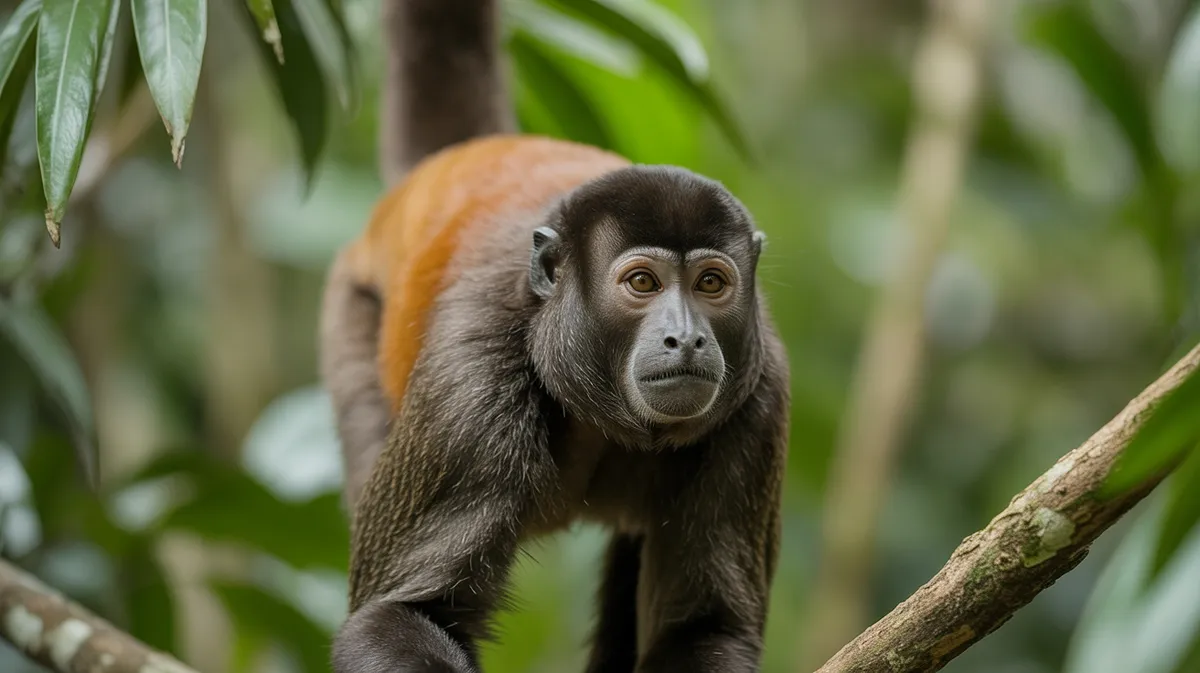
About the Humboldt's Woolly Monkey
Humboldt's Woolly Monkey is a large, robust primate native to the tropical rainforests of the western Amazon Basin in South America. Recognized by its thick, woolly fur, which is typically brownish or grayish, this species possesses a strong prehensile tail used for grasping branches as it moves through the forest canopy. Social and intelligent, Humboldt's Woolly Monkeys live in multi-male, multi-female groups and display complex vocalizations and behaviors. These monkeys play a crucial ecological role as seed dispersers, helping to maintain the health of their forest habitats. Unfortunately, they face threats from habitat loss and hunting, leading to their vulnerable conservation status.
Fascinating facts
Arboreal Lifestyle
Humboldt's Woolly Monkeys spend nearly all their lives in the upper canopy of dense rainforests, rarely descending to the ground.
Group Living
They live in social groups of 10-45 individuals, which helps them defend territory and care for their young.
Diet Diversity
Their omnivorous diet includes fruits, seeds, leaves, flowers, and occasionally insects and small vertebrates.
Detailed description
Humboldt's Woolly Monkey (Lagothrix lagothricha) is a robust New World primate, with adults typically weighing between 7 and 10 kilograms and measuring 40–60 cm in body length, not including their highly prehensile tails, which can reach up to 75 cm. Their dense, woolly fur provides insulation against the cool, humid conditions of the upper Amazonian rainforest canopy. The species exhibits strong sexual dimorphism, with males generally larger than females. Their broad, rounded heads, wide-set nostrils, and powerful jaws are adapted for processing a varied diet. The hands and feet are large and dexterous, with opposable thumbs that facilitate precise manipulation of food and branches. Socially, Humboldt's Woolly Monkeys form cohesive groups of 10–45 individuals, characterized by complex hierarchies and strong affiliative bonds, especially among females. They are highly arboreal, rarely descending to the ground, and use their muscular tails as a fifth limb for grasping and balancing. Vocal communication is sophisticated, including a range of calls for group coordination, alarm, and social interaction. The species is diurnal, spending most of the day foraging, traveling, and engaging in social behaviors such as grooming and play. As frugivores with an omnivorous tendency, they play a vital role in seed dispersal, contributing significantly to forest regeneration and ecosystem health.
Did you know?
The prehensile tail of Humboldt's Woolly Monkey is so dexterous that it has a bare underside, providing a better grip much like a fingertip.
Research & sources
Behaviour & social structure
Humboldt's Woolly Monkeys are primarily frugivorous, with fruit constituting up to 75% of their diet, supplemented by leaves, seeds, flowers, and occasionally insects, small vertebrates, and eggs. Foraging is a group activity, often coordinated by vocalizations and visual signals. They exhibit fission-fusion dynamics, where subgroups split and merge throughout the day depending on food availability and social factors. Social interactions are marked by frequent grooming, coalition formation, and playful behaviors, particularly among juveniles. Dominance hierarchies exist, with males competing for status but also cooperating in group defense. Daily activity peaks in the early morning and late afternoon, with midday periods spent resting and socializing. Woolly monkeys are known for their cautious, deliberate locomotion, moving quadrupedally and suspending from branches with their tails and limbs. They maintain large home ranges (up to 800 hectares), which they traverse in search of seasonal fruiting trees.
Reproduction & life cycle
Reproduction in Humboldt's Woolly Monkeys is non-seasonal, though some populations show peaks in births during periods of food abundance. Females reach sexual maturity at around 5–7 years, while males mature slightly later. Courtship involves mutual grooming and vocalizations, with mating occurring throughout the year. The gestation period lasts approximately 7.5 months (225 days), after which a single infant is born. Infants are highly dependent, clinging to their mother's belly for the first few months before riding on her back. Maternal care is extensive, with weaning occurring at 12–18 months. Alloparenting (care by other group members) is observed, particularly among juveniles and subadults. Interbirth intervals are typically 2–3 years, reflecting the high investment in offspring survival.
Adaptations & survival
Humboldt's Woolly Monkeys possess several adaptations for arboreal life, including a prehensile tail with a tactile pad for gripping branches, and flexible limb joints for brachiation and climbing. Their woolly fur insulates against temperature fluctuations in the canopy. Dental adaptations, such as robust molars and strong jaw muscles, allow them to process tough fruits and seeds. Behaviorally, their fission-fusion social structure reduces intra-group competition for food and enhances foraging efficiency. Their large brains support complex social cognition, problem-solving, and communication. Seasonal dietary flexibility enables them to exploit a wide range of food resources, buffering against periods of fruit scarcity.
Cultural significance
While not as prominent in indigenous mythology as some other primates, woolly monkeys are occasionally featured in local folklore as symbols of agility and intelligence. In some Amazonian communities, they are hunted for food or used in traditional medicine, though such practices are declining due to legal protections and conservation education. Their charismatic appearance and social complexity have made them important flagship species for rainforest conservation campaigns.
Recent research
Recent research has focused on the genetic diversity of woolly monkey populations, revealing significant subspecies differentiation and highlighting the need for region-specific conservation strategies. Studies using GPS tracking and remote sensing have provided insights into their ranging patterns and habitat requirements. Behavioral research has documented sophisticated social learning, tool use (in captivity), and the impact of habitat fragmentation on group cohesion. Ongoing projects are investigating the role of woolly monkeys in seed dispersal networks and their responses to climate change. Conservation genetics and disease ecology are emerging fields of interest, particularly in the context of zoonotic disease transmission.
Sources
Lagothrix lagothricha (Humboldt’s Woolly Monkey): Taxonomy, Ecology, and Behavior
Di Fiore, A., & Campbell, C. J. (2011)
scientificIUCN Red List of Threatened Species: Lagothrix lagothricha
IUCN SSC Primate Specialist Group
conservationThe Woolly Monkeys: Behavior, Ecology, Systematics, and Evolution in South American Primates
A.B. Rylands, K.A.I. Nekaris, and R.A. Mittermeier (Eds.) (2021)
scientificLagothrix lagothricha: The IUCN Red List of Threatened Species 2020
IUCN SSC Primate Specialist Group
conservationVideos
Habitat
Tropical rainforest


Conservation
The Humboldt's Woolly Monkey is currently classified as Vulnerable on the IUCN Red List.
Threats & challenges
Major threats to Humboldt's Woolly Monkeys include habitat loss due to deforestation for agriculture, logging, and infrastructure development, particularly in the western Amazon Basin. They are also hunted for bushmeat and captured for the illegal pet trade, with hunting pressure especially high near human settlements. Fragmentation of forest habitats isolates populations, reducing genetic diversity and increasing vulnerability to disease. Population trends are declining, with estimates suggesting a reduction of over 30% in the past three generations. Conservation challenges include enforcing protected areas, mitigating human-wildlife conflict, and promoting sustainable land use practices.
Taxonomy
Scientific name
Lagothrix lagothricha
- Kingdom
- Animalia
- Phylum
- Chordata
- Class
- Mammalia
- Order
- Primates
- Family
- Atelidae
- Genus
- Lagothrix
- Species
- lagothricha
Community notes
Share your observations about the Humboldt's Woolly Monkey.
No community notes yet. Be the first!
Discover more wildlife
More fascinating animals from the encyclopedia.