
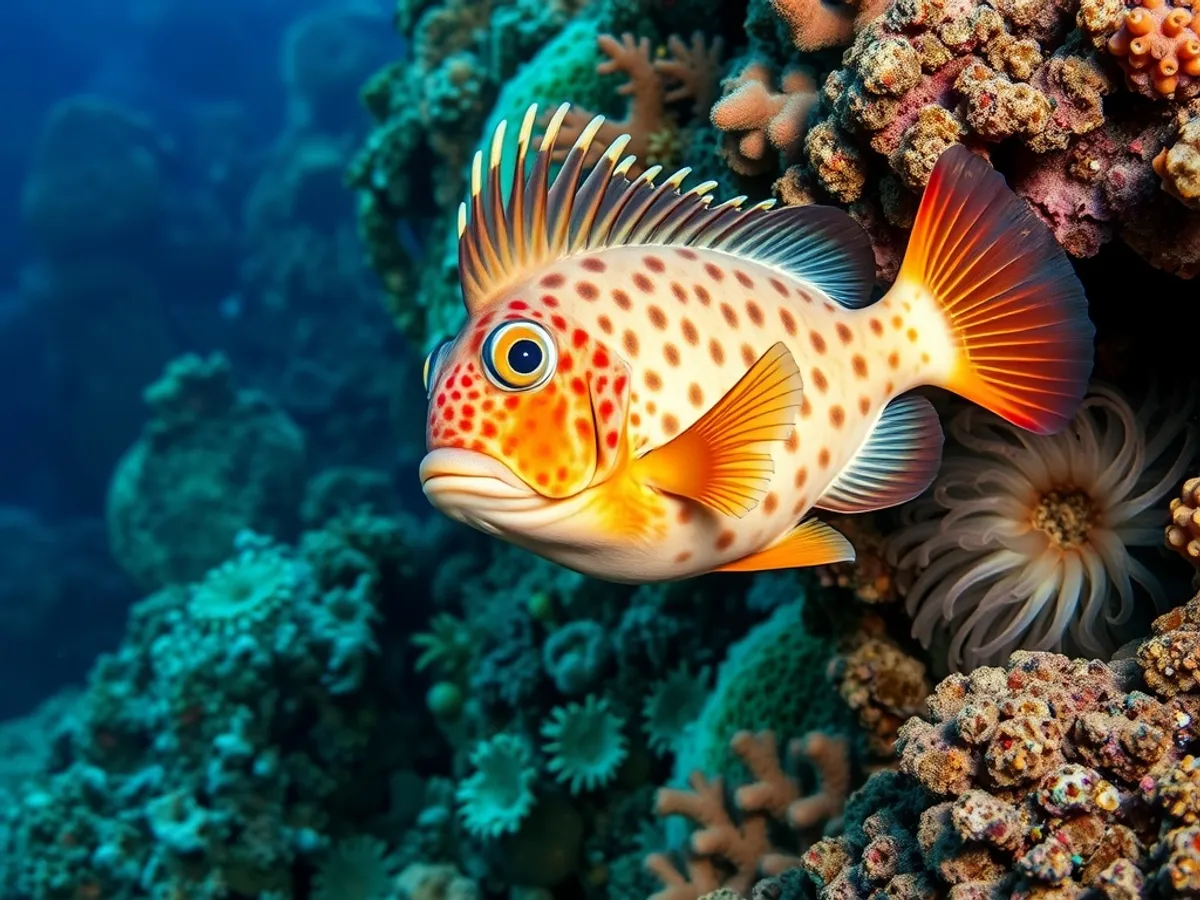
About the Humphead Parrotfish
The parrotfish eats the reef. Its teeth are fused into a heavy beak, and behind that sits a second set — a pharyngeal mill in the throat, which grinds up what the beak has bitten off. It scrapes and bites chunks of coral to get at the algae growing in and on it, digests the algae, and passes the rock. That means a large parrotfish excretes a substantial quantity of fine white sand every year, and a great deal of the beach on a tropical island has been through a parrotfish. It also, remarkably, goes to bed inside a bubble. At night some parrotfish secrete a cocoon of mucus from glands near the gills and sleep inside it — a sleeping bag that appears to mask their scent from night-hunting predators like moray eels, and to act as a barrier against blood-feeding parasites. Many parrotfish are sequential hermaphrodites, changing sex from female to male, and changing colour so completely in the process that the two phases were once described as different species.
Fascinating facts
Beak-like Teeth
The humphead parrotfish's teeth are fused into a strong beak, allowing them to bite and scrape algae from coral and even break off pieces of reef.
Sand Producers
By grinding and digesting coral, a single humphead parrotfish can produce hundreds of kilograms of sand each year, contributing to the formation of tropical beaches.
Largest Parrotfish
This species is the largest among all parrotfishes, reaching up to 1.5 meters in length and weighing as much as a human adult.
Detailed description
The humphead parrotfish (Bolbometopon muricatum) is the largest of all parrotfish species, with adults commonly reaching lengths of 1.2 to 1.5 meters and exceptional individuals weighing up to 75 kilograms. Its most distinctive feature is the prominent, bulbous forehead (cephalic hump), which becomes more pronounced with age and is used in ritualized headbutting contests among males. The body is robust and covered in large, cycloid scales, with coloration varying from dull green to bluish or gray, sometimes with pinkish hues on the face. The beak-like dental plates are fused and extremely powerful, enabling the fish to bite off and grind hard coral and calcareous algae. Humphead parrotfish have small eyes set high on the head and a blunt snout. Their pharyngeal teeth further crush ingested material, facilitating the digestion of tough coral skeletons. They are diurnal, spending daylight hours feeding and moving in loose aggregations, while at night they rest in reef crevices or caves. Socially, they often form large schools of up to 75 individuals, which may help reduce predation risk and increase foraging efficiency. The species plays a critical ecological role as a bioeroder, producing significant quantities of sand through their feeding activity and maintaining coral reef health by controlling algal growth.
Did you know?
Despite their massive size and tough beaks, humphead parrotfish are known to sleep in groups in shallow reef areas, sometimes even producing a mucous cocoon to mask their scent from predators.
Research & sources
Wikipedia summary
The green humphead parrotfish is the largest species of parrotfish, growing to lengths of 1.5 m (4.9 ft) and weighing up to 75 kg (165 lb).
Behaviour & social structure
Humphead parrotfish are primarily diurnal and highly social, often seen in groups ranging from a few individuals to large schools. Their feeding behavior is characterized by repetitive biting of live coral and algae-covered substrates, with individuals capable of ingesting up to several tons of reef carbonate per year. This feeding not only provides nutrition but also helps prevent algal overgrowth, promoting coral recruitment. Males may engage in headbutting displays, using their cephalic humps to establish dominance or compete for mates. At night, individuals seek shelter in reef crevices or under ledges, sometimes secreting a mucous cocoon that may deter parasites and mask their scent from nocturnal predators. Daily routines include foraging at dawn and dusk, with resting periods during midday and nighttime. Juveniles are more solitary and cryptic, often hiding among branching corals.
Reproduction & life cycle
Bolbometopon muricatum is primarily gonochoristic (separate sexes), though some evidence suggests rare instances of protogynous hermaphroditism. Spawning typically occurs seasonally, often synchronized with lunar cycles and at dawn, when large aggregations gather at specific reef sites. Females release pelagic eggs into the water column, which are externally fertilized by males. There is no parental care; eggs and larvae are planktonic, drifting with ocean currents before settling onto suitable reef habitats. Sexual maturity is reached at approximately 5 to 8 years of age, with females maturing slightly earlier than males. Fecundity is high, with a single female capable of producing hundreds of thousands of eggs per spawning event. Recruitment success is highly variable and dependent on environmental conditions and predation rates.
Adaptations & survival
The humphead parrotfish exhibits several remarkable adaptations for its ecological niche. Its fused dental plates and robust pharyngeal jaws are specialized for scraping and grinding hard coral, a rare dietary adaptation among reef fishes. The cephalic hump is a secondary sexual characteristic used in intraspecific combat and possibly as a visual signal. Their large size and schooling behavior provide protection from predators such as sharks and large groupers. The ability to secrete a mucous cocoon at night is thought to reduce predation risk and parasite load. Physiologically, they possess a highly alkaline digestive system capable of processing calcium carbonate, and their intestines are adapted for extracting nutrients from tough, fibrous algal material. Their coloration provides camouflage among reef structures, and juveniles often mimic the appearance of other reef fish for added protection.
Cultural significance
In many Indo-Pacific cultures, the humphead parrotfish is both a traditional food source and a symbol of healthy reefs. Its large size and striking appearance have made it a subject of local folklore and art. In some Pacific island communities, its presence is associated with traditional fishing practices and taboos that regulate harvest to ensure sustainability. However, increasing demand and commercialization have led to overexploitation in some areas. The species is also a popular attraction for divers and ecotourism, contributing to local economies and raising awareness about reef conservation.
Recent research
Recent research has focused on the ecological role of Bolbometopon muricatum as a keystone bioeroder, with studies quantifying their contribution to sand production and reef sediment dynamics. Genetic studies are investigating population connectivity across the Indo-Pacific, revealing significant genetic structuring and highlighting the need for region-specific management. Ongoing research is also examining the impacts of climate change on their feeding behavior and reproductive success. Notably, advances in acoustic telemetry and underwater video monitoring have provided new insights into their movement patterns, habitat use, and spawning aggregations. Conservation research is exploring the effectiveness of marine protected areas (MPAs) and community-based management in sustaining populations.
Videos
Habitat
Coral reefs

Conservation
The Humphead Parrotfish is currently classified as Vulnerable on the IUCN Red List.
Threats & challenges
Major threats to Bolbometopon muricatum include overfishing, particularly through spearfishing at night when the fish are vulnerable and easy to approach. Their slow growth, late maturity, and tendency to form predictable spawning aggregations make them especially susceptible to population declines. Habitat degradation from coral reef destruction, pollution, and climate change (including coral bleaching and ocean acidification) further threaten their survival. Illegal and unregulated fishing, as well as the use of destructive fishing methods, exacerbate these pressures. Population trends are declining across much of their range, and local extirpations have been reported in several regions. The species is currently listed as Vulnerable by the IUCN, with urgent conservation measures needed to prevent further declines.
Taxonomy
Scientific name
Bolbometopon muricatum
- Kingdom
- Animalia
- Phylum
- Chordata
- Class
- Actinopterygii
- Order
- Perciformes
- Family
- Scaridae
- Genus
- Bolbometopon
- Species
- muricatum
Community notes
Share your observations about the Humphead Parrotfish.
No community notes yet. Be the first!
Discover more wildlife
More fascinating animals from the encyclopedia.