
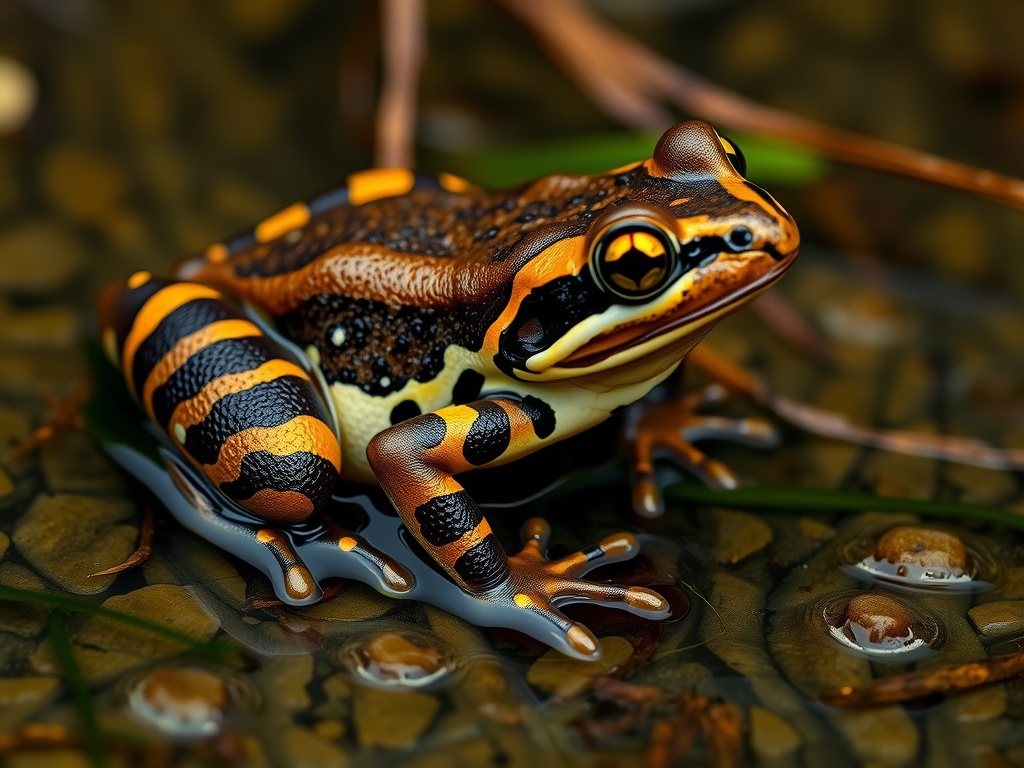
About the Iberian Painted Frog
The Iberian Painted Frog is a small, robust amphibian native to the Iberian Peninsula, primarily found in Portugal and western and central Spain. It is recognized for its warty skin and striking color variations, ranging from brown and olive to gray, often marked with dark spots or patches. This frog inhabits a variety of freshwater environments, such as slow-moving streams, ponds, and marshes, and is most active during the rainy season. Despite its adaptability, it is sensitive to pollution and habitat alteration.
Fascinating facts
Colorful Camouflage
Its variable skin coloration helps it blend into diverse habitats, from muddy banks to rocky streams.
Unique Tongue
The Iberian Painted Frog has a round, disk-shaped tongue that quickly snaps out to catch insects and small invertebrates.
Water-Loving Breeder
Breeding occurs in temporary or permanent water bodies, and the tadpoles develop rapidly in response to changing water levels.
Detailed description
The Iberian Painted Frog (Discoglossus galganoi) is a medium-sized, robust amphibian, typically measuring 45–65 mm in snout-vent length, with females generally larger than males. Its body is somewhat flattened, with a broad, rounded snout and prominent, upward-facing eyes that provide a wide field of vision. The skin is granular and warty, often exhibiting a mosaic of earthy tones—brown, olive, or gray—accentuated with irregular dark blotches or marbling, which serve as camouflage against the leaf litter and substrate of its habitats. The ventral surface is usually lighter, sometimes with faint mottling. Notably, the species lacks a distinct tympanum (external ear), a trait characteristic of the genus Discoglossus. The limbs are relatively short and strong, with unwebbed fingers and partially webbed toes, aiding in both terrestrial movement and swimming. This frog is primarily nocturnal, emerging at dusk to forage and breed, and is known for its secretive nature, often hiding under stones or within dense vegetation during the day. Its call is a series of short, metallic clicks, produced by males during the breeding season. The species demonstrates a high degree of ecological plasticity, occupying a range of habitats from pristine Mediterranean woodlands to disturbed agricultural landscapes.
Did you know?
The Iberian Painted Frog is one of the few European frogs with visible, disk-shaped eardrums and a unique, flattened body shape that helps it hide among rocks.
Research & sources
Wikipedia summary
The Iberian painted frog is a species of frog in the family Alytidae. It is found in Portugal and Spain, where its natural habitats are temperate forests, temperate shrubland, Mediterranean-type shrubby vegetation, rivers, intermittent rivers, swamps, freshwater marshes, intermittent freshwater marshes, sandy shores, arable land, and grassland. It is threatened by habitat loss.
Behaviour & social structure
Discoglossus galganoi is predominantly nocturnal, with peak activity occurring during humid nights, especially following rainfall. It is a solitary species outside the breeding season, exhibiting minimal social interaction except during communal breeding events. Foraging behavior is opportunistic; the frog employs a sit-and-wait strategy, ambushing small invertebrates such as insects, spiders, and annelids. It uses its sticky tongue to capture prey with rapid, precise strikes. During the day, individuals seek shelter under rocks, logs, or within burrows to avoid desiccation and predation. The species is known for its relatively low site fidelity, often moving between water bodies in response to seasonal changes in habitat availability. Vocalizations are primarily restricted to males during the breeding season, serving both to attract females and establish territories among rival males.
Reproduction & life cycle
Breeding in the Iberian Painted Frog is closely tied to rainfall and typically occurs from late winter to early spring (January to April), though timing may vary with local climate. Males congregate at the edges of temporary or permanent water bodies, where they emit advertisement calls to attract females. Amplexus is axillary (the male grasps the female behind her forelimbs), and fertilization is external. Females lay between 200 and 1,000 eggs per clutch, attaching them singly or in small groups to submerged vegetation or detritus. Embryonic development is rapid, with hatching occurring within 5–10 days depending on temperature. The larval (tadpole) stage lasts 2–3 months, after which metamorphosis produces juvenile frogs. There is no parental care post-oviposition. Breeding success is highly dependent on the persistence of suitable aquatic habitats during the larval period.
Adaptations & survival
Discoglossus galganoi exhibits several adaptations for survival in Mediterranean climates, including tolerance of fluctuating water availability and the ability to exploit both permanent and temporary aquatic habitats. Its cryptic coloration and warty skin provide effective camouflage against predators. The granular skin also aids in moisture retention, essential for survival during dry periods. Partially webbed toes enhance swimming efficiency, while strong limbs facilitate terrestrial locomotion. The species can tolerate moderate habitat disturbance and is able to breed in artificial water bodies such as irrigation ditches and cattle troughs. Its reproductive strategy, characterized by rapid larval development, is an adaptation to ephemeral water bodies prone to drying.
Cultural significance
The Iberian Painted Frog does not have a prominent role in Iberian folklore or traditional practices, but it is occasionally referenced in local environmental education as an indicator species for healthy freshwater ecosystems. Its presence is valued by conservationists and naturalists as a symbol of Mediterranean wetland biodiversity. In some rural communities, frogs in general are considered beneficial for controlling insect populations.
Recent research
Recent molecular studies have clarified the taxonomic status of Discoglossus galganoi, distinguishing it from closely related species such as D. jeanneae. Ongoing research focuses on its population genetics, habitat use, and responses to environmental change, particularly in fragmented landscapes. Studies have highlighted the species' adaptability to anthropogenic habitats, though concerns remain about genetic isolation in fragmented populations. Research into its call structure and breeding ecology has provided insights into reproductive isolation and speciation within the genus. Monitoring programs are in place to assess population trends and inform conservation management.
Videos
Habitat
Freshwater streams, ponds, marshes, and temporary pools
 Various Continental Regions
Grassland
Open areas dominated by grasses rather than trees, supporting numerous herbivores and their predators.
 Elevated Terrain
Mountain
High-altitude environments with varying climates and specialized wildlife adapted to rugged terrain and thin air.
 Global
Forest
Wooded areas with significant tree cover and diverse plant and animal communities.
 Global
Freshwater
Lakes, rivers, and wetlands with diverse aquatic ecosystems.
Conservation
The Iberian Painted Frog is currently classified as Least Concern on the IUCN Red List.
Threats & challenges
The primary threats to the Iberian Painted Frog are habitat loss and degradation, particularly due to agricultural expansion, urbanization, and water extraction, which reduce the availability of suitable breeding sites. Pollution from pesticides and fertilizers further impacts water quality and larval survival. Although currently assessed as Least Concern by the IUCN due to its broad distribution and presumed large population, localized declines have been reported, especially in intensively farmed regions. Climate change poses an emerging threat, potentially altering rainfall patterns and increasing the frequency of droughts, which could reduce breeding opportunities and larval survival rates. Road mortality and the introduction of predatory fish to breeding sites are additional concerns.
Taxonomy
Scientific name
Discoglossus galganoi
- Kingdom
- Animalia
- Phylum
- Chordata
- Class
- Amphibia
- Order
- Anura
- Family
- Alytidae
- Genus
- Discoglossus
- Species
- galganoi
Community notes
Share your observations about the Iberian Painted Frog.
No community notes yet. Be the first!
Discover more wildlife
More fascinating animals from the encyclopedia.