
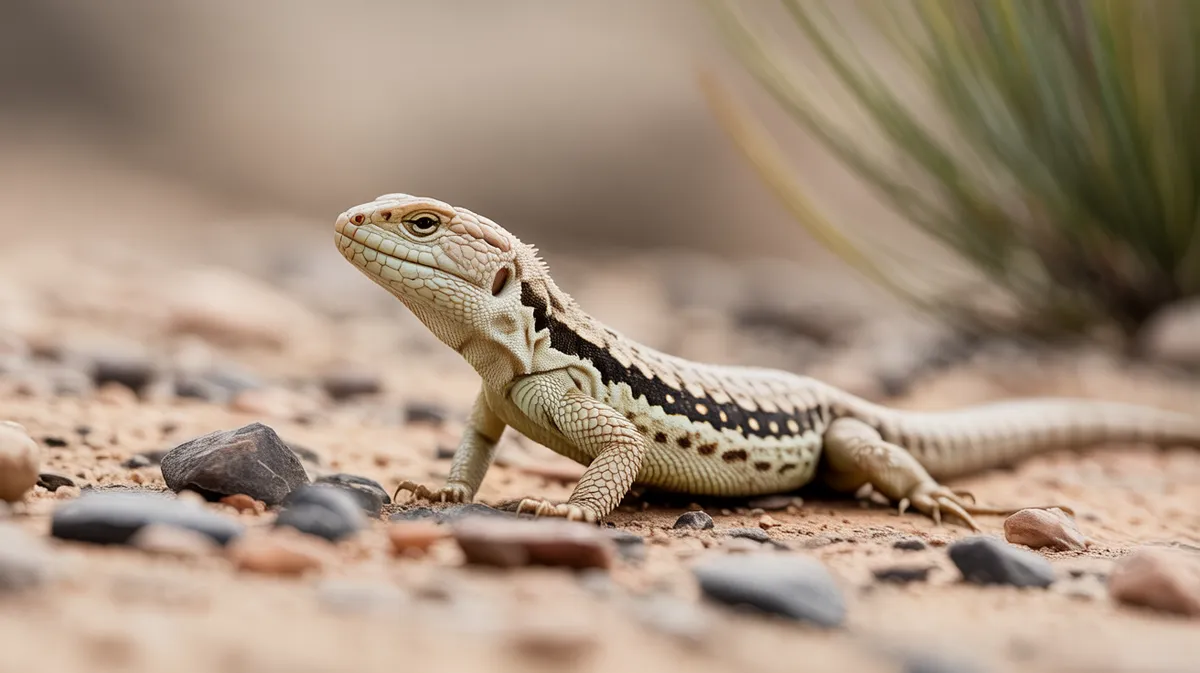
About the Keeled Earless Lizard
The Keeled Earless Lizard is a small, slender reptile distinguished by its lack of external ear openings and the presence of distinct, keeled scales on its dorsal surface. Native to the arid and semi-arid regions of southern Texas and northeastern Mexico, this lizard is well-adapted to sandy and gravelly habitats where it can quickly burrow to escape predators. Its cryptic coloration provides excellent camouflage against the substrate, while its swift, agile movements make it an effective insect hunter. Despite its elusive nature, the Keeled Earless Lizard plays an important role in the ecosystem as both predator and prey.
Fascinating facts
No External Ears
The Keeled Earless Lizard lacks visible ear openings, a unique adaptation that helps keep out sand and debris in its arid habitat.
Sand Specialist
This species thrives in sandy or gravelly areas, where it can quickly dig and hide beneath the surface.
Quick Escape Artist
It is known for its remarkable speed and agility, allowing it to dart away from predators with impressive bursts.
Detailed description
The Keeled Earless Lizard (Holbrookia propinqua) is a small, slender-bodied phrynosomatid lizard, typically measuring 45–65 mm in snout-vent length, with a total length (including tail) reaching up to 150 mm. Its most distinctive anatomical features are the absence of external ear openings—an adaptation thought to prevent sand intrusion—and the presence of sharply keeled, pointed dorsal scales, which provide both protection and camouflage. The coloration is highly variable, generally matching the sandy or gravelly substrate of its habitat, with gray, tan, or brown tones and faint dorsal striping or spots. Sexual dimorphism is subtle, but males may exhibit more pronounced ventral coloration during the breeding season. The head is wedge-shaped with a short snout, and the limbs are long and slender, facilitating rapid, agile locomotion. The tail is relatively long and tapers to a fine point. Holbrookia propinqua is diurnal, relying on visual cues for communication and predator detection. It is primarily terrestrial, rarely climbing, and is known for its ability to rapidly burrow into loose sand when threatened. The lizard's cryptic coloration and stillness often allow it to avoid detection by predators. Its diet consists mainly of ants, beetles, grasshoppers, and other small arthropods, which it captures with quick lunges. The species is solitary outside of the breeding season, with individuals maintaining overlapping home ranges but rarely interacting except during courtship or territorial disputes.
Did you know?
Keeled Earless Lizards can bury themselves completely in loose sand within seconds to escape danger or extreme heat.
Research & sources
Wikipedia summary
Holbrookia propinqua, commonly known as the keeled earless lizard, is a species of phrynosomatid lizard.
Behaviour & social structure
Holbrookia propinqua is a highly active, ground-dwelling lizard that spends much of its day basking in open, sunlit areas to regulate its body temperature. It exhibits sit-and-wait predation, remaining motionless until prey comes within striking distance, though it may also actively forage among sparse vegetation. When threatened, it employs a combination of rapid sprinting and sudden burrowing to evade predators such as birds, snakes, and mammals. Social interactions are limited; individuals are generally solitary, but males may display territorial behaviors during the breeding season, including lateral flattening, push-ups, and tail waving. Communication is primarily visual, with body postures and movements signaling aggression, submission, or reproductive readiness. The lizard is most active during the warmer parts of the day, retreating to burrows or under debris during extreme heat or at night.
Reproduction & life cycle
Breeding in Holbrookia propinqua typically occurs in late spring to early summer (April–June), coinciding with rising temperatures and increased food availability. Males establish and defend territories to attract females, engaging in courtship displays that include head bobbing and body arching. After mating, females lay a single clutch of 2–8 leathery eggs, which are deposited in shallow nests excavated in loose sand or soil. Incubation lasts approximately 45–60 days, depending on environmental conditions. There is no parental care; hatchlings are independent from birth and resemble miniature adults. In favorable climates, females may produce a second clutch later in the season. Sexual maturity is typically reached within one year, allowing for rapid population turnover.
Adaptations & survival
Holbrookia propinqua exhibits several key adaptations for life in arid and semi-arid environments. The absence of external ear openings minimizes sand ingress during burrowing and reduces water loss. Keeled dorsal scales enhance camouflage by disrupting the animal's outline and may aid in shedding sand. Its cryptic coloration matches the substrate, providing effective concealment from both predators and prey. The lizard's long limbs and lightweight body enable swift, agile movement across loose sand, while its ability to burrow quickly offers refuge from extreme temperatures and predation. Physiologically, it is tolerant of high temperatures and can withstand significant dehydration, traits common among desert reptiles. Behavioral thermoregulation, such as basking and seeking shade, allows it to maintain optimal body function in fluctuating thermal environments.
Cultural significance
The Keeled Earless Lizard holds limited direct cultural significance, but it is an important component of the arid ecosystem, serving as both predator and prey. In some regions, it is recognized by local communities as a harmless and beneficial insectivore. It occasionally features in regional natural history education and outreach programs, highlighting the biodiversity of desert and grassland habitats. There are no known traditional uses or significant roles in mythology or folklore.
Recent research
Recent research on Holbrookia propinqua has focused on its physiological adaptations to extreme environments, including studies of water balance, thermoregulation, and metabolic rates. Genetic analyses have clarified its relationships within the Holbrookia genus and revealed subtle population structuring across its range. Ongoing field studies are examining the impacts of habitat fragmentation and climate change on its distribution and reproductive success. Notably, the species serves as a model organism for understanding the evolution of earless morphology in lizards and the ecological consequences of burrowing behavior. Citizen science initiatives and long-term monitoring projects continue to contribute valuable data on its natural history and conservation status.
Videos
Habitat
Arid and semi-arid deserts, sandy flats, and grasslands


Conservation
The Keeled Earless Lizard is currently classified as Least Concern on the IUCN Red List.
Threats & challenges
Currently assessed as Least Concern by the IUCN, Holbrookia propinqua faces localized threats from habitat degradation, particularly due to agricultural expansion, urbanization, and off-road vehicle activity, which can destroy or fragment sandy habitats. Pesticide use may reduce prey availability and directly harm lizard populations. Climate change poses a potential long-term threat by altering the temperature and moisture regimes of its habitat. Despite these challenges, the species remains widespread and locally abundant, with stable population trends in most areas. Conservation efforts focus on habitat preservation and minimizing human disturbance in key areas.
Taxonomy
Scientific name
Holbrookia propinqua
- Kingdom
- Animalia
- Phylum
- Chordata
- Class
- Reptilia
- Order
- Squamata
- Family
- Phrynosomatidae
- Genus
- Holbrookia
- Species
- propinqua
Community notes
Share your observations about the Keeled Earless Lizard.
No community notes yet. Be the first!
Discover more wildlife
More fascinating animals from the encyclopedia.