
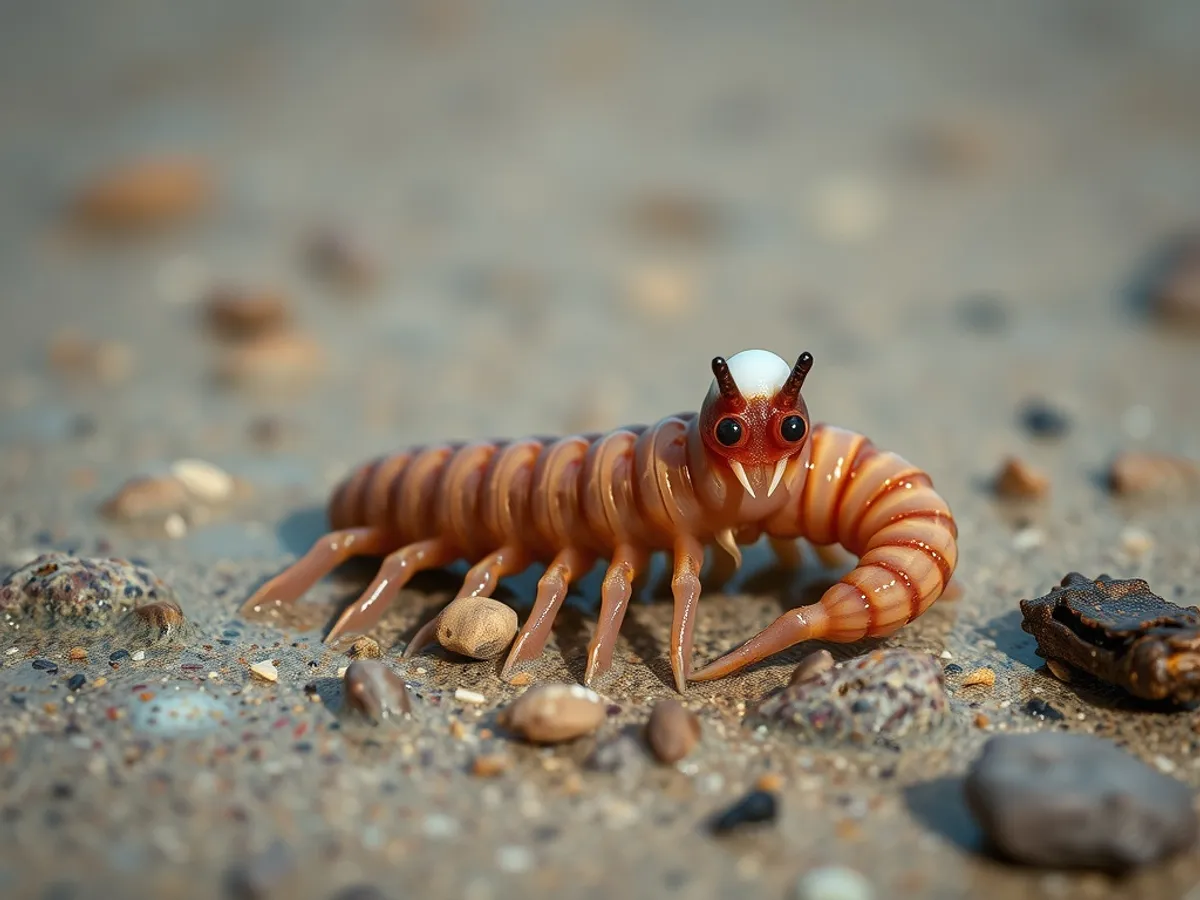
About the King Ragworm
The King Ragworm is a large, predatory marine polychaete worm found along the coasts of Europe and North America. Recognizable by its iridescent, segmented body that can reach up to 1.2 meters in length, this worm is an important part of the intertidal ecosystem. King Ragworms are powerful burrowers, using a muscular proboscis equipped with strong jaws to hunt for prey beneath the sand and mud. They play a vital role as both predator and prey, serving as a food source for fish and birds and as popular bait for anglers.
Fascinating facts
Impressive Size
King Ragworms are among the largest polychaete worms, sometimes growing over 1 meter long.
Powerful Jaws
They have eversible jaws used to catch prey, capable of delivering noticeable bites to humans.
Fishing Bait
Their lively nature and size make them a favored bait among sea anglers for catching fish like bass and cod.
Detailed description
The King Ragworm (Alitta virens) is one of the largest polychaete annelids, with adults commonly reaching lengths of 30–60 cm, though exceptional individuals may exceed 120 cm. Its elongated, segmented body is composed of over 200 segments, each bearing paired parapodia equipped with chaetae (bristles) that aid in locomotion and burrowing. The worm's coloration is typically iridescent greenish-brown to reddish, with a distinct sheen caused by microscopic surface structures. The anterior end features a muscular, eversible proboscis armed with two robust, chitinous jaws capable of seizing prey and excavating sediment. King Ragworms are primarily nocturnal, spending daylight hours in U-shaped or J-shaped burrows up to 1 meter deep, which they construct in soft sediments. Their burrowing activity contributes significantly to sediment aeration and nutrient cycling within intertidal ecosystems. Although generally solitary, high population densities may lead to overlapping burrow systems. Alitta virens exhibits remarkable regenerative abilities, capable of regrowing lost segments. It is a key prey item for many coastal fish, wading birds, and crustaceans, and is also harvested extensively for use as fishing bait.
Did you know?
Despite being invertebrates, King Ragworms have a primitive but effective circulatory system with a series of blood vessels and a closed system, similar to more complex animals.
Research & sources
Behaviour & social structure
King Ragworms are predominantly solitary and territorial, aggressively defending their burrows from intruders. They are ambush predators, extending their anterior segments from the burrow entrance to detect vibrations and chemical cues from potential prey, which include smaller invertebrates such as crustaceans, mollusks, and other polychaetes. Feeding is facilitated by rapid eversion of the proboscis to grasp and immobilize prey with their jaws. In addition to active predation, they may scavenge organic detritus. During high tide or at night, they may venture partially out of their burrows to forage. Social interactions are generally limited to competition for space and resources, though synchronized spawning events can lead to temporary aggregations. Burrow maintenance is a daily activity, involving the removal of sediment and detritus to maintain water flow and oxygenation.
Reproduction & life cycle
Alitta virens is dioecious, with separate male and female individuals. Reproduction typically occurs once annually, with timing varying by latitude but generally peaking in spring or early summer. Spawning is synchronized and often triggered by environmental cues such as temperature and photoperiod. During spawning, worms leave their burrows and release gametes into the water column in a process known as broadcast spawning. Fertilization is external, and the resulting planktonic larvae (trochophores) drift with currents for several weeks before settling and metamorphosing into juvenile worms. There is no parental care post-spawning, and adults may die shortly after reproduction (a phenomenon known as semelparity) in some populations.
Adaptations & survival
King Ragworms possess several adaptations for life in dynamic intertidal environments. Their muscular, extendable proboscis and powerful jaws allow them to capture a variety of prey and excavate complex burrow systems. The parapodia and chaetae provide excellent traction in soft sediments, while the ability to regenerate lost segments aids survival after predation or injury. Physiologically, they are tolerant of wide fluctuations in salinity, temperature, and oxygen levels, enabling them to thrive in estuarine as well as fully marine habitats. Their burrowing behavior not only offers protection from predators and desiccation but also positions them advantageously for feeding on both benthic and suspended food sources.
Cultural significance
King Ragworms have significant economic value as one of the most sought-after bait species for recreational and commercial sea fishing, especially in Europe and North America. They are collected both by hand and through aquaculture, with a substantial industry dedicated to their sustainable production. Historically, their use as bait has influenced local economies and fishing practices. While they do not feature prominently in mythology or folklore, their ecological importance and role in supporting coastal fisheries have made them a subject of interest in environmental education and conservation programs.
Recent research
Recent research on Alitta virens has focused on its regenerative biology, making it a model organism for studying annelid regeneration and stem cell dynamics. Studies have also examined its role in bioturbation and sediment nutrient cycling, highlighting its ecosystem engineering capabilities. Genetic analyses have clarified its taxonomic status and revealed significant population structure across its range. Ongoing research addresses the impacts of bait harvesting on population dynamics and intertidal community structure, as well as the species' physiological responses to environmental stressors such as hypoxia and pollution.
Sources
Polychaetes: An Interactive Identification Guide
Geoff Read & Kristian Fauchald (eds.), National Museum of Natural History, Smithsonian Institution (2021)
scientificIUCN Red List of Threatened Species: Alitta virens
International Union for Conservation of Nature (IUCN)
conservationAlitta virens (Sars, 1835): Taxonomy, biology, and ecology
Fauchald, K. & Jumars, P.A. (1979)
scientificVideos
Habitat
Intertidal zones of sandy and muddy shores

Conservation
The King Ragworm is currently classified as Least Concern on the IUCN Red List.
Threats & challenges
Currently classified as Least Concern, King Ragworm populations are considered stable across much of their range. However, localized threats include habitat degradation from coastal development, pollution (particularly heavy metals and hydrocarbons), and overharvesting for the bait industry. Climate change poses emerging challenges, with potential impacts from rising sea temperatures, ocean acidification, and altered sediment dynamics. In some regions, intensive bait collection has led to measurable declines in local populations and associated ecosystem effects. Nevertheless, their broad distribution and high reproductive output confer resilience to moderate levels of exploitation.
Taxonomy
Scientific name
Alitta virens
- Kingdom
- Animalia
- Phylum
- Annelida
- Class
- Polychaeta
- Order
- Phyllodocida
- Family
- Nereididae
- Genus
- Alitta
- Species
- virens
Community notes
Share your observations about the King Ragworm.
No community notes yet. Be the first!
Discover more wildlife
More fascinating animals from the encyclopedia.