
About the Knight Anole
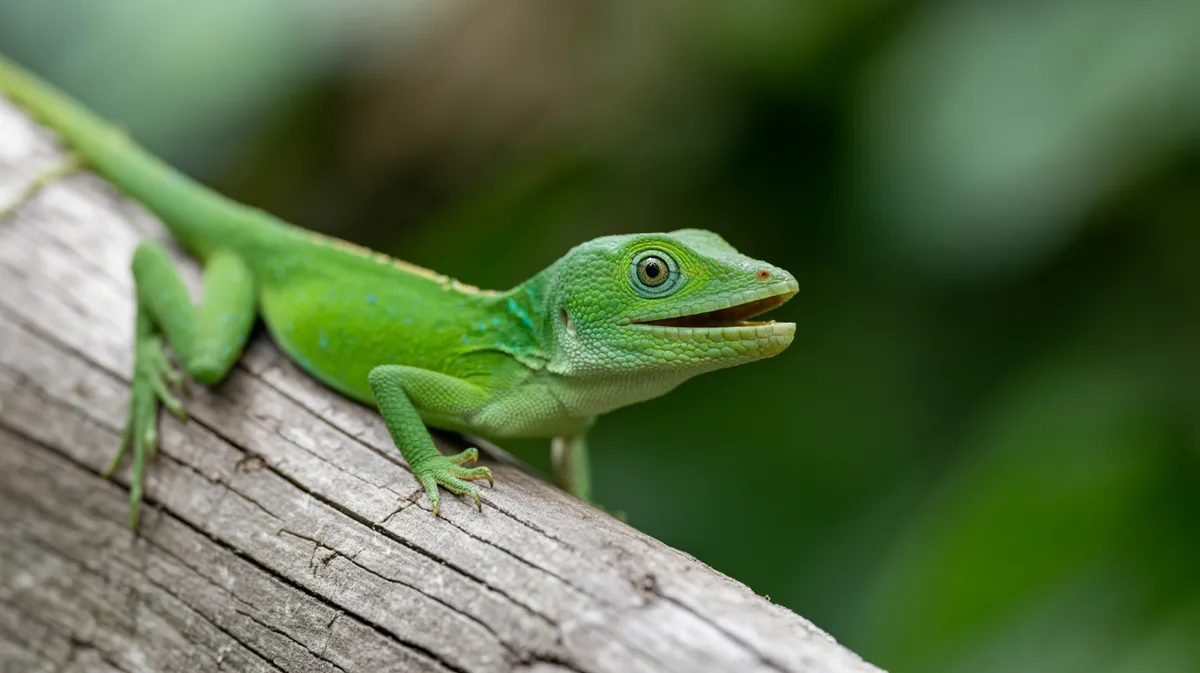
The Knight Anole is the largest species of anole lizard, native to Cuba but now also established in southern Florida. It is recognized by its vivid green coloration, prominent head, and a large, extendable pink throat fan (dewlap) used in displays. This arboreal reptile is highly territorial and spends most of its time in trees, where it actively hunts insects, small vertebrates, and occasionally fruit. Its powerful jaws and robust body make it a formidable predator among tree-dwelling lizards.
Fascinating facts
Arboreal Lifestyle
Knight Anoles spend almost all their time high in the trees, rarely descending to the ground except to lay eggs or move between trees.
Largest Anole Species
Reaching up to 50 cm (20 inches) in length, the Knight Anole is the largest of all anole species.
Dewlap Displays
Males have a prominent pink dewlap, which they extend during territorial and mating displays to communicate with other lizards.
Detailed description
The Knight Anole (Anolis equestris) is the largest member of the anole family, reaching total lengths of up to 50 cm (20 inches), with adult snout-to-vent lengths typically between 13–20 cm (5–8 inches). Its robust, muscular body is covered in bright emerald-green scales, sometimes marked with pale stripes or spots, and it can change its coloration to brown or grayish tones in response to temperature, stress, or camouflage needs. The head is large and angular, with pronounced supraorbital ridges and a powerful jaw structure adapted for subduing sizable prey. A prominent, extendable pink dewlap beneath the throat is used for communication and territorial displays. The limbs are long and strong, equipped with adhesive toe pads that allow for remarkable climbing agility on smooth surfaces and vertical tree trunks. Knight anoles are primarily arboreal, spending most of their lives in the forest canopy, but they occasionally descend to the ground. Their vision is highly developed, enabling them to detect both prey and rivals from considerable distances. These lizards are diurnal and highly territorial, with males aggressively defending their perches through head-bobbing, dewlap extension, and even physical combat. Their omnivorous diet includes insects, other lizards, small birds, and fruit, reflecting both opportunistic and predatory tendencies. In their native range of Cuba and introduced populations in Florida, they play a significant ecological role as both predator and prey within subtropical forest ecosystems.
Did you know?
Despite their bright coloration and size, Knight Anoles can remain perfectly still for long periods, blending seamlessly into the foliage and making them difficult to spot.
Research & sources
Wikipedia summary
The knight anole is the largest species of anole in the Dactyloidae family. Other common names include Cuban knight anole or Cuban giant anole, highlighting its native country, but it has also been introduced to Florida. In its native Cuba, this large anole is called chipojo or chupacocote.
Behaviour & social structure
Knight anoles are solitary and highly territorial, especially adult males, which establish and defend exclusive arboreal territories. Territorial disputes involve elaborate visual displays, including head-bobbing, push-ups, lateral body compression, and dewlap extension, sometimes escalating to biting and wrestling. They are diurnal, becoming active at dawn and basking in sunlit canopy branches to regulate body temperature. Hunting is primarily sit-and-wait, with the lizard remaining motionless before lunging at passing prey. Their diet is diverse: they consume large insects (beetles, grasshoppers, caterpillars), spiders, small vertebrates (other lizards, nestling birds, frogs), and occasionally fruit or nectar. Knight anoles are known for their boldness, sometimes preying on animals nearly half their own size. They maintain regular patrol routes within their territory, returning to favored basking and sleeping sites. At night, they sleep on narrow branches, often above ground to avoid predators.
Reproduction & life cycle
Breeding occurs primarily during the rainy season (typically March to October in Cuba and Florida), triggered by increased humidity and food availability. Courtship involves males displaying their dewlap and performing vigorous head-bobbing to attract females. After mating, females lay single, leathery eggs every 7–14 days, burying them in moist soil or leaf litter. Clutch size is typically one egg at a time, but a female may lay multiple eggs over the course of a season, totaling up to 10–12 eggs per year. Incubation lasts 6–8 weeks, depending on temperature and humidity. There is no parental care; hatchlings are independent from birth and must fend for themselves. Sexual maturity is reached at around 1–1.5 years of age.
Adaptations & survival
Knight anoles possess several key adaptations for arboreal life: enlarged subdigital toe pads with microscopic setae provide exceptional grip on smooth and vertical surfaces, while their prehensile tails aid in balance and maneuverability among branches. Their coloration provides camouflage among foliage, and their ability to shift hues helps regulate temperature and avoid detection. The large dewlap serves as a visual signal for communication, reducing the need for physical conflict. Their strong jaws and sharp teeth allow them to tackle a wide range of prey, including hard-shelled insects and small vertebrates. Acute vision, including the ability to detect ultraviolet light, enhances their ability to spot prey and rivals. Behavioral adaptations include site fidelity to preferred basking and sleeping locations, and the use of complex visual displays to mediate social interactions.
Cultural significance
In Cuba, the Knight anole is known as 'chipojo' or 'chupacocote' and is a familiar figure in folklore and local culture, sometimes regarded as a symbol of agility and resilience. Its striking appearance and bold behavior have made it a popular subject in ecotourism and wildlife photography. In the exotic pet trade, it is valued for its size and vivid coloration, though its aggressive temperament makes it less suitable for novice keepers. There are no known traditional medicinal or culinary uses.
Recent research
Recent research has focused on the ecological impact of introduced Knight anole populations in Florida, including their interactions with native anoles and potential effects on local biodiversity. Studies on their adhesive toe pad microstructure have contributed to biomimetic engineering, inspiring the development of advanced synthetic adhesives. Genetic analyses have clarified the evolutionary relationships within the Anolis genus, revealing significant cryptic diversity and adaptive radiation. Ongoing studies are examining the role of visual signaling in territoriality and mate selection, as well as the physiological mechanisms underlying their color change and thermal regulation.
Videos
Habitat
Tropical and subtropical forests

Conservation
The Knight Anole is currently classified as Least Concern on the IUCN Red List.
Threats & challenges
In their native range, Knight anoles face few natural predators due to their size, but hatchlings and juveniles are vulnerable to birds, snakes, and larger lizards. Habitat loss from deforestation and urbanization poses localized threats in Cuba, though the species remains widespread and adaptable. In Florida, introduced populations are thriving and may compete with native anoles and other arboreal lizards, potentially impacting local ecosystems. Human collection for the pet trade is not currently a major threat. Climate change may alter habitat suitability in the future, but the species' adaptability and broad diet buffer it against many environmental changes. Current population trends are stable, and the IUCN lists the species as Least Concern.
Taxonomy
Scientific name
Anolis equestris
- Kingdom
- Animalia
- Phylum
- Chordata
- Class
- Reptilia
- Order
- Squamata
- Family
- Dactyloidae
- Genus
- Anolis
- Species
- equestris
Community notes
Share your observations about the Knight Anole.
No community notes yet. Be the first!
Discover more wildlife
More fascinating animals from the encyclopedia.