
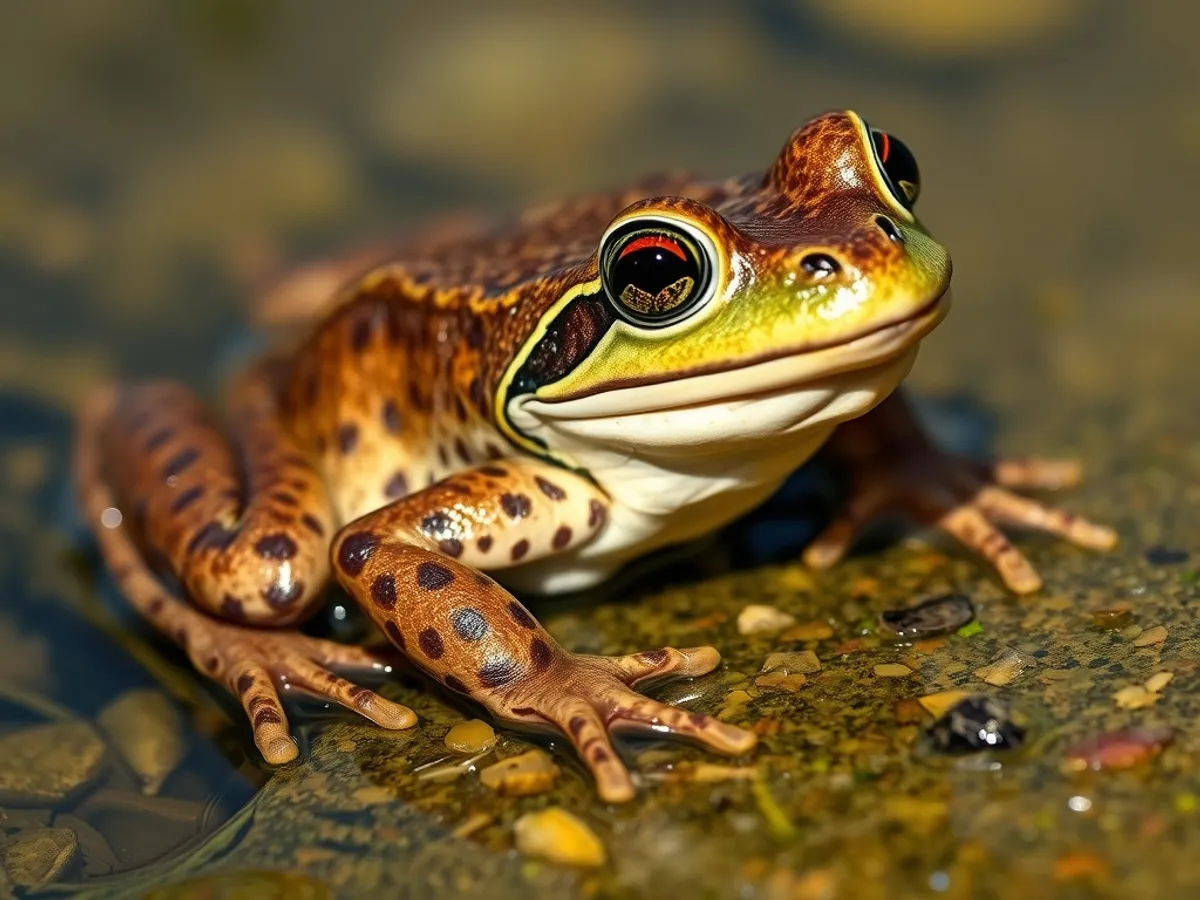
About the Lake Titicaca Frog
Telmatobius culeus lives entirely underwater in Lake Titicaca, 3,800 m up on the Peru-Bolivia border, where the air holds barely two-thirds the oxygen of sea level and the water is cold year-round. It has adapted by growing far more skin than it needs: the body hangs in loose, baggy, deeply pleated folds, dramatically increasing surface area for gas exchange, and the frog gets nearly all its oxygen through that skin rather than through its tiny, near-useless lungs. Its red blood cells are among the smallest of any amphibian and unusually numerous, boosting oxygen-carrying capacity. When oxygen runs low the frog performs "push-ups", bobbing up and down on its legs to drive water past the skin folds and increase the flow across its respiratory surface. It never leaves the water. The unkind common name "scrotum frog" comes from the sagging skin. It is Critically Endangered, hammered by collection for a Peruvian and Bolivian folk drink - the frogs are blended live into a smoothie sold as an aphrodisiac and tonic - as well as by pollution, introduced trout and chytrid fungus. In 2016, at least 10,000 dead frogs washed up on the Coata River in a mass mortality event linked to sewage.
Fascinating facts
Aquatic Lifestyle
Unlike most frogs, the Lake Titicaca Frog spends its entire life underwater, rarely coming to the surface.
Skin Breather
This frog's wrinkled skin greatly increases its surface area, allowing it to absorb enough oxygen from the cold, low-oxygen water of Lake Titicaca.
High-Altitude Survivor
It thrives at elevations around 3,800 meters (12,500 feet), one of the highest habitats for any amphibian.
Detailed description
The Lake Titicaca Frog (Telmatobius culeus) is a large, fully aquatic amphibian endemic to the high-altitude Lake Titicaca basin, straddling the border of Peru and Bolivia at elevations around 3,800 meters (12,500 ft). Adults typically range from 10 to 20 cm in snout-vent length, with some individuals exceeding 50 cm in total length and weighing up to 1 kg, making it the largest exclusively aquatic frog by mass. Its most distinctive anatomical feature is the highly folded, loose skin, which dramatically increases surface area to facilitate cutaneous respiration—an essential adaptation in the cold, oxygen-poor waters of its habitat. The frog’s limbs are robust and fully webbed, aiding in swimming, while its eyes are positioned dorsally for upward vision. Coloration varies from olive-green to brown, often with mottled patterns that provide camouflage among lake vegetation and rocky substrates. The species lacks external ears and has a reduced or absent tympanum, reflecting its adaptation to an underwater lifestyle. Lake Titicaca Frogs are primarily nocturnal, spending daylight hours concealed among rocks or aquatic plants. Their diet consists mainly of aquatic invertebrates, small fish, and occasionally plant matter. Social structure is not well-defined, but individuals may aggregate in suitable habitats, especially during the breeding season. Reproduction is aquatic, with external fertilization and the deposition of eggs among submerged vegetation or crevices. Tadpoles are large and undergo a prolonged larval stage, reflecting the cold environment and slow metabolic rates.
Did you know?
The Lake Titicaca Frog is so uniquely adapted to its environment that it can suffocate if taken out of water for too long.
Research & sources
Wikipedia summary
Telmatobius culeus, commonly known as the Titicaca water frog or Lake Titicaca frog, is a medium-large to very large and endangered species of frog in the family Telmatobiidae. It is entirely aquatic and found only in the Lake Titicaca basin, including rivers that flow into it and smaller connected lakes like Arapa, Lagunillas and Saracocha, in the Andean highlands of Bolivia and Peru. In reference to its excessive amounts of skin, it is sometimes jokingly referred to as the Titicaca scrotum frog.
Behaviour & social structure
Lake Titicaca Frogs are predominantly sedentary, often remaining motionless on the lakebed or among aquatic plants for extended periods. They are ambush predators, relying on stealth and sudden lunges to capture prey such as amphipods, aquatic insects, snails, and occasionally small fish. Feeding occurs primarily at night, when the frogs are more active and prey is abundant. Social interactions are minimal outside the breeding season, though loose aggregations may form in areas with optimal shelter or food resources. The species exhibits little territoriality, and physical confrontations are rare. Daily routines are influenced by water temperature and oxygen levels, with frogs seeking deeper or shallower waters as needed. They rarely surface, relying almost entirely on cutaneous respiration, and can perform a unique 'push-up' motion to increase water flow over their skin, enhancing oxygen uptake.
Reproduction & life cycle
Breeding occurs primarily during the rainy season (November to February), when water levels and temperatures are optimal. Males are believed to call underwater, producing low-frequency vocalizations to attract females, though this behavior is not well-documented due to the species' aquatic habits. Amplexus is axillary, and females lay clutches of several hundred eggs attached to submerged vegetation or rocky crevices. Embryonic development is entirely aquatic, with hatching occurring after 2–3 weeks, depending on temperature. Tadpoles are large, with external gills and a slow growth rate, often taking up to a year or more to metamorphose into juveniles. Parental care is absent; eggs and larvae are vulnerable to predation by fish and invertebrates.
Adaptations & survival
Telmatobius culeus exhibits several remarkable adaptations to its high-altitude, hypoxic environment. The most notable is its excessive, wrinkled skin, which maximizes surface area for cutaneous gas exchange, compensating for the low oxygen content of cold Andean waters. The species has a reduced reliance on pulmonary respiration; its lungs are small and sometimes vestigial. Hemoglobin with a high oxygen affinity further enhances oxygen uptake. Fully webbed feet and powerful hind limbs facilitate efficient swimming. Behavioral adaptations include nocturnality and reduced activity to conserve energy in the cold, nutrient-poor ecosystem. The frog’s coloration provides camouflage against predators, while its sedentary lifestyle minimizes exposure.
Cultural significance
The Lake Titicaca Frog holds significant cultural value for local Aymara and Quechua communities. Traditionally, it has been used in folk medicine, believed to possess aphrodisiac and healing properties, and is sometimes prepared as a 'frog juice' tonic. The species is also a symbol of the unique biodiversity of the Lake Titicaca region and has become an emblem for conservation efforts. In local mythology, the frog is associated with rain and fertility. Internationally, its unusual appearance has made it a subject of curiosity and conservation campaigns.
Recent research
Recent research has focused on the frog’s physiological adaptations to hypoxia, genetic diversity, and susceptibility to disease. Studies have revealed unique hemoglobin properties and skin microbiomes that may confer resistance to certain pathogens. Conservation breeding programs have been established in Peru and Bolivia, with some success in captive reproduction. Ongoing research aims to refine captive husbandry, understand population genetics, and develop effective reintroduction strategies. Environmental DNA (eDNA) monitoring is being used to assess population distribution and trends. The species has also become a model for studying amphibian responses to climate change and emerging infectious diseases.
Sources
Videos
Habitat
Freshwater lakes and streams at high altitudes


Conservation
The Lake Titicaca Frog is currently classified as Critically Endangered on the IUCN Red List.
Threats & challenges
The Lake Titicaca Frog faces severe threats, leading to its classification as Critically Endangered by the IUCN. Major challenges include habitat degradation from pollution (especially heavy metals, sewage, and agricultural runoff), overharvesting for human consumption and traditional medicine, introduction of non-native predatory fish (such as trout), and disease (notably chytridiomycosis caused by the fungus Batrachochytrium dendrobatidis). Climate change, resulting in altered water levels and temperatures, further exacerbates these threats. Population surveys indicate dramatic declines—some estimates suggest reductions of over 80% in recent decades. Conservation efforts are complicated by the frog’s restricted range, specialized habitat requirements, and slow reproductive rate.
Taxonomy
Scientific name
Telmatobius culeus
- Kingdom
- Animalia
- Phylum
- Chordata
- Class
- Amphibia
- Order
- Anura
- Family
- Telmatobiidae
- Genus
- Telmatobius
- Species
- culeus
Community notes
Share your observations about the Lake Titicaca Frog.
No community notes yet. Be the first!
Discover more wildlife
More fascinating animals from the encyclopedia.