
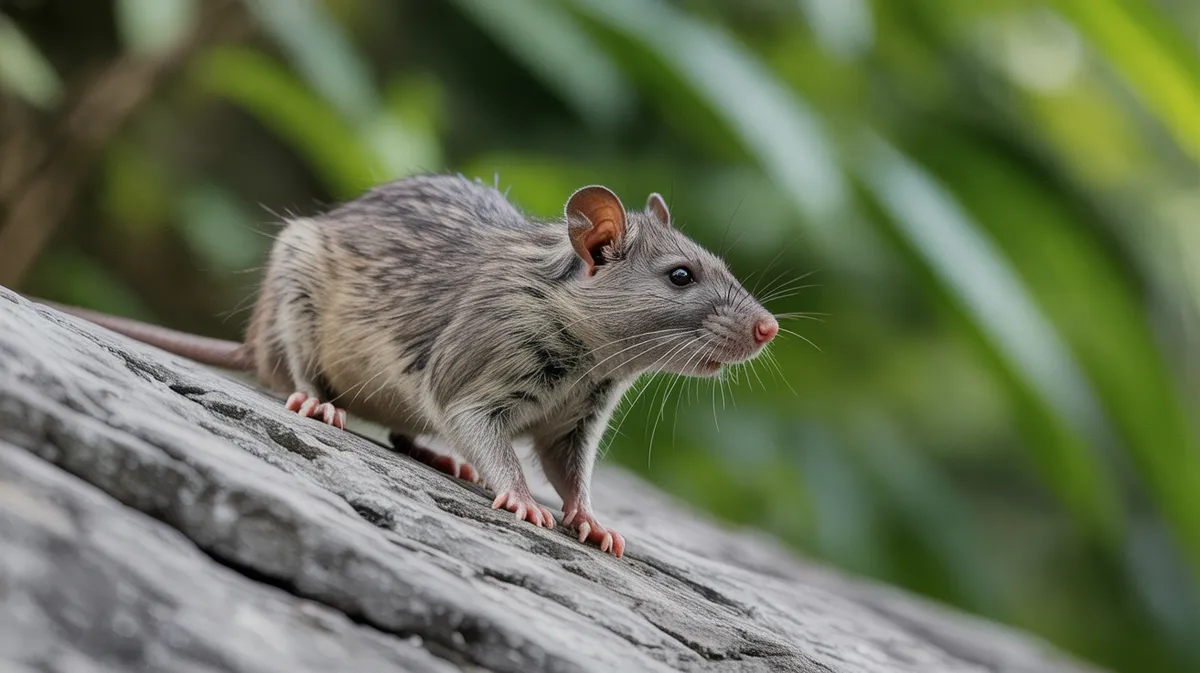
About the Laotian Rock Rat
Laonastes aenigmamus was found in 1996 in a meat market in Khammouane Province, Laos, laid out for sale among the bushmeat, and formally described in 2005 as a new species in a new family. Then it got stranger. In 2006 palaeontologists Mary Dawson and colleagues recognised it as a member of Diatomyidae - a rodent family known only from fossils, and believed to have gone extinct around 11 million years ago. The rock rat is therefore a Lazarus taxon of extraordinary depth, an animal that vanished from the fossil record in the Miocene and turned up on a butcher's block. Its closest living relatives are gundis of North Africa, not the rats it superficially resembles. The animal is squirrel-like, dark gray, with a long furry tail, splayed feet for scrambling over karst, and a waddling gait; it lives in limestone outcrops in central Laos, eats leaves, seeds and insects, and appears to be nocturnal and slow-moving. Local Lao people, who call it kha-nyou, had of course always known it and hunted it, and it was scientists who were 11 million years late. Its known range is small and it depends entirely on the region's karst limestone, which is being quarried for cement.
Fascinating facts
Living Fossil
The Laotian Rock Rat represents a family of rodents believed extinct since the Miocene era, making it a true 'living fossil.'
Unique Habitat
This species is specially adapted to live in the rugged limestone karst ecosystems of central Laos, where it shelters among rocks.
Nocturnal Forager
The rat is nocturnal, spending its nights searching for leaves, fruit, and seeds to eat while avoiding predators.
Detailed description
The Laotian rock rat (Laonastes aenigmamus) is a medium-sized rodent, typically measuring 26–30 cm in total length, with the tail accounting for about half this length (12–16 cm). Adults weigh between 300 and 400 grams. Its dense, soft fur is slate-gray to brownish-gray dorsally, with a paler underside, providing camouflage among limestone rocks. The head is elongated with a pointed snout, large vibrissae (whiskers), and small, rounded ears. The long, bushy tail is covered in coarse hairs and is used for balance while navigating rugged karst terrain. The limbs are short and robust, with strong claws adapted for climbing and gripping rocky surfaces. The Laotian rock rat is primarily nocturnal and crepuscular, emerging at dusk to forage. Its eyes are relatively large, an adaptation for low-light environments. The dental formula is unique among rodents, with ever-growing incisors and molars suited for gnawing tough plant material. Anatomically, it retains several primitive features reminiscent of ancient rodent lineages, such as a low-crowned molar structure and a distinctive skull morphology.
Did you know?
The Laotian Rock Rat was first discovered in a local food market before its scientific identification, surprising researchers with its evolutionary significance.
Research & sources
Wikipedia summary
The Laotian rock rat or kha-nyou, sometimes called the "rat-squirrel", is a species of rodent found in the Khammouan region of Laos. The species was first described in a 2005 article by Paulina Jenkins and coauthors, who considered the animal to be so distinct from all living rodents, they placed it in a new family, Laonastidae. It is in the monotypic genus Laonastes.
Behaviour & social structure
Laotian rock rats are solitary or found in small family groups, exhibiting a largely crepuscular and nocturnal activity pattern. They are agile climbers, moving deftly among limestone outcrops and crevices. Foraging primarily occurs at night, with individuals feeding on leaves, stems, seeds, and occasionally fruits, suggesting a generalist herbivorous diet. They use their sensitive whiskers to navigate and detect food in the dark. Shelter is taken in deep rock fissures or caves during the day to avoid predators and extreme temperatures. Vocalizations are rare, but individuals may communicate through scent marking and soft chirps. Territoriality is not strongly developed, but home ranges may overlap slightly. Grooming and dust-bathing are common behaviors, helping to maintain fur condition and reduce parasites.
Reproduction & life cycle
Reproductive biology is not fully documented, but field observations and captive studies suggest a seasonal breeding pattern, likely correlated with the onset of the wet season (May–September). Females appear to give birth to small litters, typically 1–3 young, after a gestation period estimated at 60–70 days. Neonates are altricial, born blind and hairless, and are cared for in secluded rock crevices. Maternal care is pronounced, with the mother nursing and grooming the young until they are weaned at approximately 4–5 weeks of age. There is no evidence of paternal involvement. Sexual maturity is reached at around 6–8 months. The reproductive rate is low compared to other rodents, likely an adaptation to a stable but resource-limited environment.
Adaptations & survival
The Laotian rock rat exhibits several specialized adaptations for its karstic habitat. Its robust limbs and strong claws facilitate climbing and gripping on jagged limestone surfaces. The bushy tail aids in balance. The cryptic coloration provides camouflage against rocky backgrounds. Large eyes and sensitive whiskers enhance nocturnal navigation. Dentition is adapted for processing tough, fibrous vegetation. Physiologically, it may have a low metabolic rate, consistent with its slow, deliberate movements and energy-poor diet. The use of deep crevices for shelter offers protection from predators and environmental extremes. Evolutionarily, it is a 'living fossil,' retaining primitive skeletal and dental features lost in most modern rodents, reflecting its ancient lineage within the Diatomyidae.
Cultural significance
Known locally as 'kha-nyou,' the Laotian rock rat holds minor significance in local folklore, sometimes regarded as a symbol of the mysterious and ancient nature of the karst landscape. It is occasionally hunted for food, but is not a staple or widely traded species. Its discovery has brought international attention to the region's biodiversity, and it is sometimes featured in ecotourism literature as a 'living fossil.' There are no known traditional medicinal or ritual uses.
Recent research
The Laotian rock rat was first described in 2005, astonishing zoologists by representing a lineage (Diatomyidae) thought extinct since the Miocene (over 11 million years ago). Subsequent molecular and morphological studies confirmed its status as a 'Lazarus taxon.' Recent research has focused on its phylogenetic relationships, revealing close affinities with fossil diatomyids from Asia. Ongoing field surveys aim to clarify its distribution, population density, and ecological requirements. Conservation genetics studies are underway to assess genetic diversity and inform management. The species' unique evolutionary history continues to attract interest from evolutionary biologists and paleontologists.
Sources
Videos
Habitat
Limestone karst forests


Conservation
The Laotian Rock Rat is currently classified as Data Deficient on the IUCN Red List.
Threats & challenges
While currently listed as Least Concern by the IUCN, the Laotian rock rat faces several localized threats. Habitat loss due to limestone quarrying, deforestation, and infrastructure development poses significant risks. Subsistence hunting for food by local communities has been reported, though the impact is not fully quantified. Its restricted range—limited to the karst forests of central Laos—makes it vulnerable to stochastic events and habitat fragmentation. Climate change may also alter the delicate microclimate of its rocky refuges. Population trends are poorly understood due to the species' elusive nature and inaccessible habitat, complicating conservation assessments.
Taxonomy
Scientific name
Laonastes aenigmamus
- Kingdom
- Animalia
- Phylum
- Chordata
- Class
- Mammalia
- Order
- Rodentia
- Family
- Diatomyidae
- Genus
- Laonastes
- Species
- aenigmamus
Community notes
Share your observations about the Laotian Rock Rat.
No community notes yet. Be the first!
Discover more wildlife
More fascinating animals from the encyclopedia.