
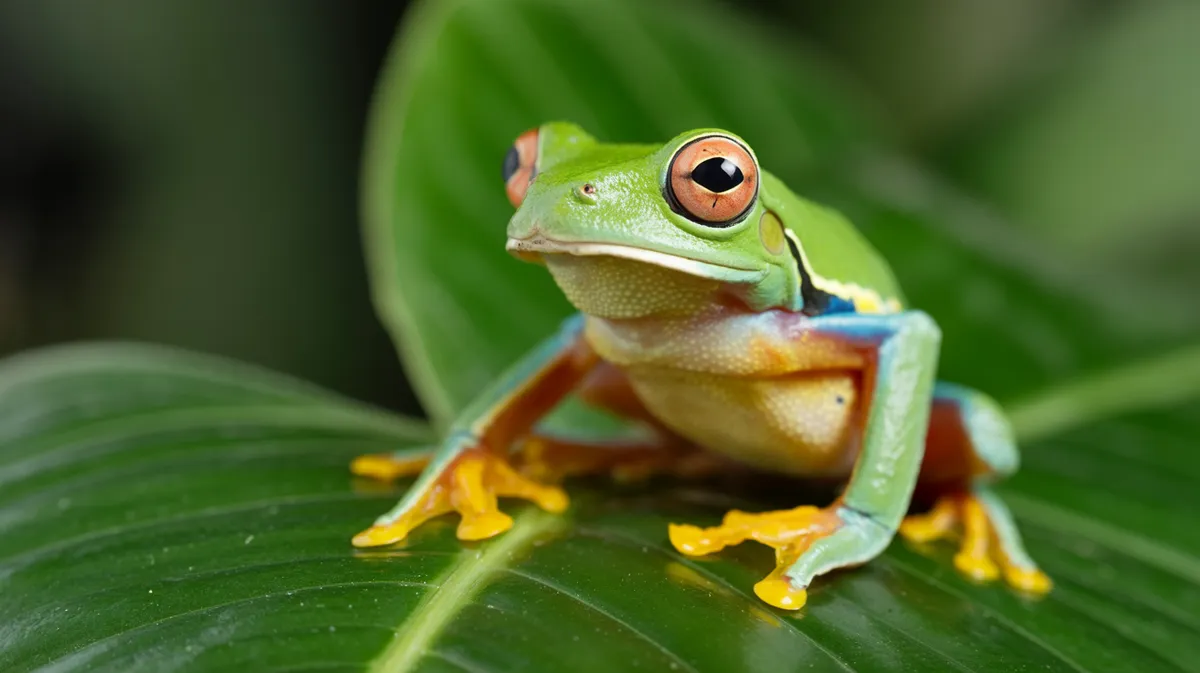
About the Leaf Frog
The Leaf Frog is a striking amphibian known for its vibrant green coloration and leaf-like appearance, which provides excellent camouflage among rainforest foliage. This nocturnal species is primarily arboreal, spending the majority of its life in the trees. Leaf Frogs possess large eyes with vertical pupils, allowing them to navigate and hunt insects during the night. Their adhesive toe pads enable them to cling to leaves and branches effortlessly, further enhancing their survival in dense forest canopies.
Fascinating facts
Masters of Camouflage
Leaf Frogs are so well-camouflaged that predators often overlook them while hunting among the leaves.
Nighttime Hunters
They are nocturnal and feed primarily on insects, using their sticky tongues to capture prey.
Unique Reproduction
Females lay eggs on leaves above water, ensuring tadpoles drop safely into water to develop.
Detailed description
Agalychnis hulli, commonly known as the Leaf Frog, is a medium-sized arboreal amphibian endemic to the lowland tropical rainforests of northeastern Peru and adjacent Ecuador. Adults typically measure 38–50 mm in snout-vent length, with females generally larger than males. The dorsal skin is a vivid emerald green, often with subtle blue or yellow lateral markings, and the ventral surface is pale and granular. The species’ slender limbs are equipped with enlarged, adhesive toe pads that facilitate climbing and adherence to smooth foliage. Their eyes are large and forward-facing, with vertical, elliptical pupils adapted for nocturnal vision. The skin is smooth and moist, aiding in cutaneous respiration and water absorption. During the day, Agalychnis hulli remains motionless on the undersides of leaves, relying on cryptic coloration for camouflage. At night, they become active, moving through the canopy in search of prey. This species is primarily solitary outside the breeding season, exhibiting minimal social interaction except during communal calling at breeding sites. Unique among many frogs, Agalychnis hulli exhibits a distinctive reproductive strategy involving oviposition on vegetation overhanging water bodies, with subsequent larval development occurring in aquatic habitats.
Did you know?
The Leaf Frog's skin secretes a waxy substance that helps prevent dehydration in the humid but variable rainforest climate.
Research & sources
Wikipedia summary
Phyllomedusinae is a subfamily of hylid tree frogs found in the Neotropics commonly called leaf frogs. Formerly, they were often considered as their own family, Phyllomedusidae.
Behaviour & social structure
Leaf Frogs are predominantly nocturnal, emerging at dusk to forage for a variety of invertebrates, including insects, spiders, and other small arthropods. They employ a sit-and-wait hunting strategy, remaining motionless until prey approaches within striking distance. Their powerful hind limbs enable rapid lunges to capture prey with their sticky tongues. Social interactions are limited, with individuals maintaining small, overlapping territories. During the breeding season, males congregate near temporary ponds or slow-moving streams and produce a series of soft, pulsed advertisement calls to attract females. Agalychnis hulli is generally arboreal, descending only to breed or, rarely, to escape predators. During the day, they adopt a flattened posture against leaves, minimizing shadow and exposure to predators.
Reproduction & life cycle
Breeding typically coincides with the onset of the rainy season, from November to March. Males establish calling sites on vegetation overhanging water and emit advertisement calls to attract females. Amplexus is axillary, with the male clasping the female just behind her forelimbs. Females lay clutches of 20–40 gelatinous eggs on the upper surfaces of leaves above water. Embryonic development lasts 7–14 days, after which the tadpoles hatch and drop into the water below. Parental care is minimal, though females may remain near the clutch briefly after oviposition. Tadpoles are aquatic, feeding on detritus and algae, and undergo metamorphosis after 6–8 weeks, depending on environmental conditions.
Adaptations & survival
Agalychnis hulli exhibits several adaptations for arboreal life, including expanded toe pads with specialized epithelial cells that secrete mucous for adhesion. Their cryptic coloration and ability to remain motionless during the day provide effective camouflage from visually oriented predators. The species’ vertical pupils enhance night vision, facilitating nocturnal foraging. Eggs are laid on leaves above water, reducing predation risk from aquatic predators and desiccation. The skin contains bioactive peptides that may deter microbial infections and predators. Behavioral adaptations include the selection of oviposition sites that minimize exposure to both terrestrial and aquatic threats.
Cultural significance
While Agalychnis hulli does not have a prominent role in local folklore compared to some other Neotropical frogs, leaf frogs in general are often regarded as symbols of rainforest health and biodiversity. Their striking appearance and unique reproductive strategies have made them subjects of interest in ecotourism and environmental education programs. In some indigenous Amazonian cultures, frogs are associated with rain and fertility, though there are no specific traditional uses or myths documented for this species.
Recent research
Recent research on Agalychnis hulli has focused on its reproductive ecology, particularly the adaptive significance of arboreal oviposition and embryonic development. Studies have examined the species’ sensitivity to environmental contaminants and the potential impacts of climate change on breeding phenology. Molecular phylogenetic analyses have clarified its relationships within the Phyllomedusinae subfamily, supporting its distinction from closely related species. Ongoing field studies are monitoring population dynamics and disease prevalence, especially in relation to the spread of chytrid fungus (Batrachochytrium dendrobatidis). Conservation initiatives are underway to assess habitat connectivity and the effectiveness of protected areas in maintaining viable populations.
Videos
Habitat
Tropical rainforest
 Tropical Regions
Rainforest
Dense, wet forests with the highest biodiversity on Earth, containing more than half of the world's plant and animal species.
 Global
Forest
Wooded areas with significant tree cover and diverse plant and animal communities.
 Global
Freshwater
Lakes, rivers, and wetlands with diverse aquatic ecosystems.
Conservation
The Leaf Frog is currently classified as Vulnerable on the IUCN Red List.
Threats & challenges
The primary threats to Agalychnis hulli are habitat loss and fragmentation due to deforestation for agriculture, logging, and infrastructure development in the Amazon basin. The species is also susceptible to pollution, particularly from agricultural runoff and pesticides. Climate change poses additional risks by altering rainfall patterns and breeding site availability. While not currently targeted by the pet trade, localized collection could become a concern. Population trends indicate a decline in some areas, prompting its classification as Vulnerable by the IUCN. Conservation challenges include the need for habitat protection, enforcement of environmental regulations, and monitoring of population health, particularly in light of emerging amphibian diseases such as chytridiomycosis.
Taxonomy
Scientific name
Agalychnis hulli
- Kingdom
- Animalia
- Phylum
- Chordata
- Class
- Amphibia
- Order
- Anura
- Family
- Phyllomedusidae
- Genus
- Agalychnis
- Species
- hulli
Community notes
Share your observations about the Leaf Frog.
No community notes yet. Be the first!
Discover more wildlife
More fascinating animals from the encyclopedia.