
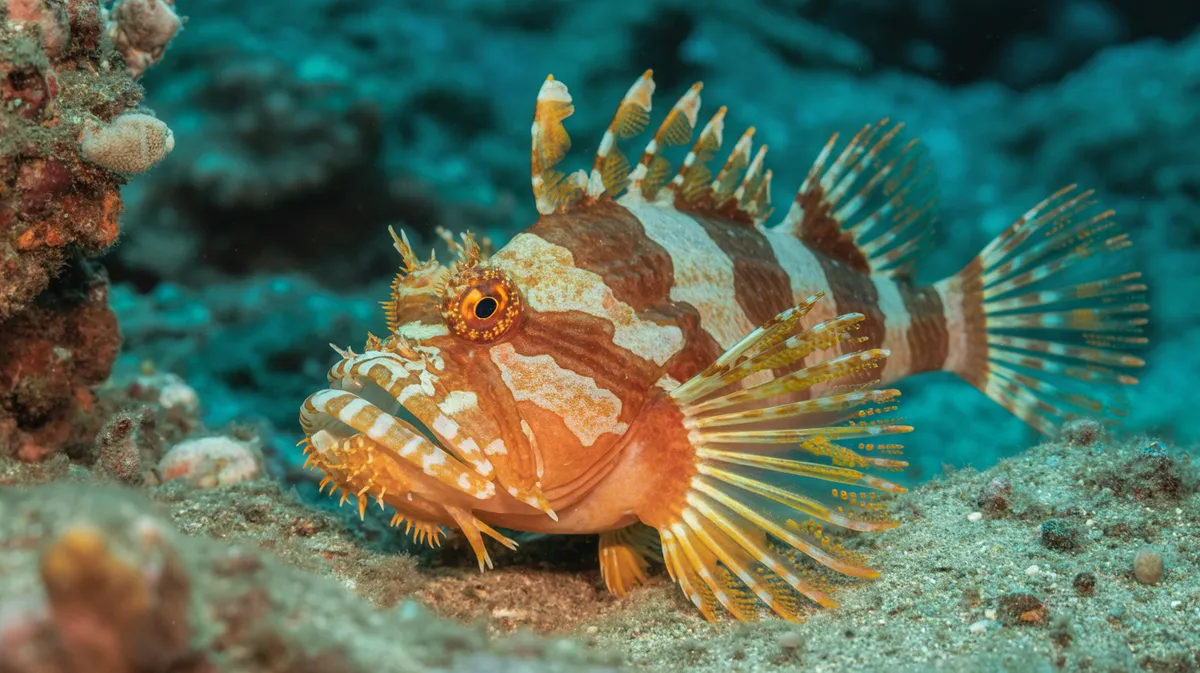
About the Leaf scorpionfish
The leaf scorpionfish is a small, cryptic marine fish known for its remarkable camouflage, resembling a drifting piece of leaf or algae. It inhabits coral reefs throughout the Indo-Pacific region, where it blends seamlessly with its surroundings to ambush prey. This species is laterally compressed and can change its color over several days to match its environment, ranging from white and pink to yellow, brown, or green hues. Despite its delicate appearance, it possesses venomous spines capable of deterring predators. The leaf scorpionfish is a fascinating example of mimicry and adaptation in reef ecosystems.
Fascinating facts
Leafy Disguise
The leaf scorpionfish’s body shape and motion perfectly mimic a drifting leaf, making it nearly invisible to both prey and predators.
Ambush Predator
It remains motionless for long periods, striking quickly at small fish and crustaceans that come within range.
Regular Skin Shedding
This fish sheds its outer skin every few weeks, a behavior uncommon among reef fishes, helping it to stay free of parasites and maintain its camouflage.
Detailed description
The leaf scorpionfish (Taenianotus triacanthus) is a small, laterally compressed marine fish, typically reaching lengths of 7–10 cm. Its body is highly flattened, with an elongated dorsal fin that mimics the undulating edge of a decaying leaf or algae, enhancing its camouflage among coral and rubble. The skin is often covered in fine filaments and irregularities, further breaking up its outline. Coloration is highly variable, ranging from pale white and pink to vivid yellow, green, brown, or even purplish hues, and individuals can gradually change color over several days to better match their environment. The species lacks scales but possesses a rough, papery texture, which, combined with its slow, swaying movements, enhances its resemblance to drifting detritus. The head is large relative to the body, with a wide, upturned mouth and prominent orbital ridges. Venomous spines are present in the dorsal, anal, and pelvic fins, serving as a deterrent to potential predators. Leaf scorpionfish are solitary and highly sedentary, relying on their camouflage for both predation and defense. Their cryptic appearance and unique adaptations make them a classic example of aggressive mimicry within coral reef ecosystems.
Did you know?
Unlike many reef fish, the leaf scorpionfish uses its wide pectoral fins to 'walk' along the substrate, rather than swimming actively.
Research & sources
Wikipedia summary
Taenianotus is a monotypic genus of marine ray-finned fish belonging to the family Scorpaenidae, the scorpionfishes. Its only species is Taenianotus triacanthus, the leaf scorpionfish, paperfish, paper scorpionfish, sailfin leaffish or threespine scorpionfish. This taxon has a wide Indo-Pacific distribution.
Behaviour & social structure
Leaf scorpionfish are ambush predators, remaining motionless for extended periods while swaying gently to mimic the movement of leaves or algae in the current. They primarily hunt small crustaceans, juvenile fish, and other invertebrates, using a rapid, suction-based strike to capture prey that ventures too close. Feeding typically occurs during daylight hours, though they may also hunt at dusk. Social interactions are minimal; individuals are territorial and maintain a solitary existence, only tolerating conspecifics during the breeding season. They exhibit site fidelity, often remaining in the same small area for weeks or months, shifting position only when disturbed or when food resources are depleted. Defensive behaviors include raising their dorsal fin spines and flattening against the substrate to avoid detection.
Reproduction & life cycle
Reproduction in Taenianotus triacanthus is oviparous, with external fertilization. Spawning is thought to occur seasonally, often synchronized with lunar cycles and water temperature changes, though precise timing varies across its range. During courtship, males and females engage in brief, close interactions before the female releases a gelatinous mass of eggs into the water column, which is then fertilized by the male. There is no parental care; eggs and larvae are planktonic, drifting with ocean currents until settling onto suitable reef habitats. Larval development is rapid, with juveniles adopting cryptic coloration and behavior soon after settlement.
Adaptations & survival
The leaf scorpionfish exhibits a suite of adaptations for camouflage and predation. Its laterally compressed body and irregular fin margins mimic the appearance of drifting leaves or algae, providing both concealment from predators and an effective hunting strategy. The ability to change color over several days allows individuals to blend with varying backgrounds. Venomous dorsal, anal, and pelvic fin spines deter predation. The absence of scales and the presence of skin filaments further disrupt the fish's outline. Its sedentary lifestyle conserves energy, while a highly protrusible mouth enables rapid suction feeding. These adaptations have evolved in response to intense predation pressure and competition within diverse coral reef environments.
Cultural significance
The leaf scorpionfish holds modest significance in human culture. In some Indo-Pacific regions, it is featured in local folklore as a symbol of stealth and transformation due to its remarkable camouflage. It is occasionally displayed in public aquaria, admired for its unique appearance and behavior. There is no known traditional use in medicine or cuisine, likely due to its venomous spines and small size.
Recent research
Recent research has focused on the biomechanics of the leaf scorpionfish's camouflage and feeding strategies, including studies on color change mechanisms and the hydrodynamics of its suction feeding. Genetic analyses have confirmed its monotypic status and clarified its phylogenetic relationships within Scorpaenidae. Ongoing ecological studies are examining the impacts of coral bleaching and habitat loss on its distribution and abundance. The species is also used as a model organism in studies of aggressive mimicry and reef fish community dynamics.
Videos
Habitat
Coral reefs

Conservation
The Leaf scorpionfish is currently classified as Least Concern on the IUCN Red List.
Threats & challenges
Currently assessed as Least Concern by the IUCN, the leaf scorpionfish faces few direct threats due to its wide distribution and cryptic lifestyle. However, it is indirectly affected by coral reef degradation, climate change, and habitat loss, which can reduce available shelter and prey. Collection for the aquarium trade is localized and not considered a major threat at present. Population trends are stable, but ongoing monitoring is recommended due to the species' reliance on healthy reef ecosystems.
Taxonomy
Scientific name
Taenianotus triacanthus
- Kingdom
- Animalia
- Phylum
- Chordata
- Class
- Actinopterygii
- Order
- Scorpaeniformes
- Family
- Scorpaenidae
- Genus
- Taenianotus
- Species
- triacanthus
Community notes
Share your observations about the Leaf scorpionfish.
No community notes yet. Be the first!
Discover more wildlife
More fascinating animals from the encyclopedia.