
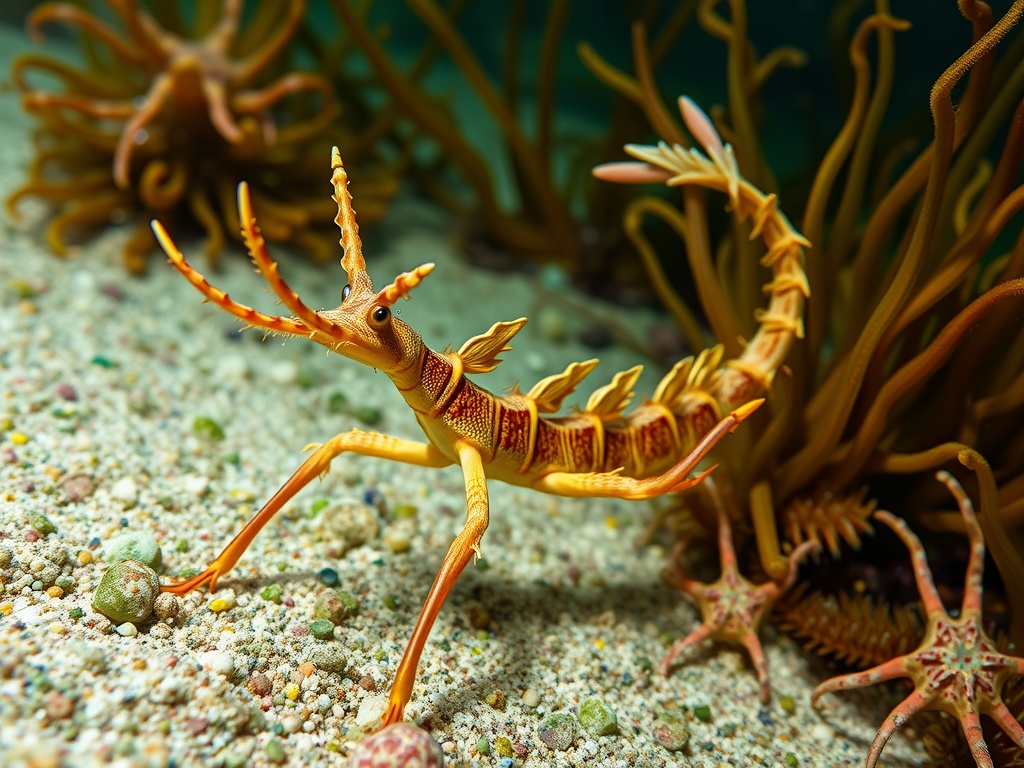
About the Leafy seadragon
Phycodurus eques is found only along the southern coast of Australia, from Western Australia to Victoria, and its leaf-like appendages are not fins and do not propel it at all - they are purely decorative outgrowths that break its outline among the kelp and seagrass it drifts through. Propulsion comes from two nearly transparent, high-frequency fins, a pectoral fin behind the head for steering and a dorsal fin along the back for drive, which flicker so fast they are almost invisible, giving the illusion of a piece of seaweed moving under its own power. Unlike a seahorse, the seadragon cannot grip anything: it has no prehensile tail, so it cannot anchor and must simply go where the surge takes it, which makes it vulnerable to being cast ashore in storms. It has no teeth and no stomach; it feeds by sucking mysid shrimp through a pipette-like snout, and must feed almost constantly. Reproduction follows the family rule: the male takes the eggs. The female deposits about 250 bright pink eggs onto a spongy brood patch on the underside of the male's tail, where they are embedded in cups of tissue, and he carries and oxygenates them for around nine weeks before releasing the young, which are independent immediately.
Fascinating facts
Dragons of the Sea
Leafy seadragons get their name from their ornate, leaf-like appendages, which make them look like mythical dragons gliding through water.
Tiny Prey
They feed mainly on small crustaceans such as mysid shrimp, sucking them up through their long, pipe-like snouts.
Male Pregnancy
Male leafy seadragons carry and incubate up to 250 eggs on a brood patch under their tails until they hatch.
Detailed description
The leafy seadragon (Phycodurus eques) is a remarkable marine fish, reaching lengths of up to 35 cm (about 14 inches), and is instantly recognizable by its ornate, leaf-like appendages that extend from its head, body, and tail. These appendages are not used for locomotion but serve as highly effective camouflage, mimicking the appearance of drifting seaweed and kelp in its native habitats. The body is elongated and laterally compressed, with a rigid, bony armor typical of the Syngnathidae family. Leafy seadragons possess a small, tubular snout adapted for suction feeding, lacking teeth and a stomach, which necessitates frequent feeding on small crustaceans such as mysid shrimp, amphipods, and planktonic organisms. Their movement is subtle and graceful, powered by nearly transparent pectoral and dorsal fins that undulate rapidly, making them appear to drift effortlessly with ocean currents. Leafy seadragons are solitary and exhibit highly cryptic behavior, spending much of their time motionless or moving slowly among seaweed beds. They have well-developed eyesight, which aids in detecting prey and avoiding predators. Unlike seahorses, leafy seadragons cannot grasp objects with their tails. Their coloration varies from yellow to greenish-brown, often matching the local environment. The species is endemic to temperate southern and western Australian coastal waters, particularly in areas with dense seagrass meadows and kelp forests, at depths ranging from 3 to 50 meters.
Did you know?
Despite their elaborate appearance, leafy seadragons are poor swimmers and rely almost entirely on camouflage to evade predators.
Research & sources
Wikipedia summary
The leafy seadragon or Glauert's seadragon, is a marine fish. It is the only member of the genus Phycodurus in the family Syngnathidae, which includes seadragons, pipefish, and seahorses.
Behaviour & social structure
Leafy seadragons are primarily solitary and exhibit a sedentary lifestyle, relying on their camouflage to avoid predation rather than active escape. They are diurnal, with peak activity during daylight hours when they forage for prey. Their feeding strategy involves slow, deliberate movements to approach prey, followed by rapid suction through their elongated snout. They do not actively pursue prey over distances but instead ambush small crustaceans and zooplankton drifting nearby. Social interactions are minimal outside of the breeding season, and individuals maintain loose territories. Leafy seadragons are not known to form schools or aggregations. They exhibit site fidelity, often remaining within a limited home range for extended periods. When threatened, they may sway their bodies to mimic the motion of seaweed, enhancing their camouflage.
Reproduction & life cycle
Leafy seadragons have a unique reproductive strategy among fishes. Breeding occurs annually, typically between October and January, coinciding with the austral spring and summer. Courtship involves an elaborate display where the male and female mirror each other's movements in a synchronized 'dance.' After courtship, the female deposits up to 250 bright pink eggs onto a specialized brood patch located on the underside of the male's tail. The male fertilizes the eggs externally as they are transferred. The eggs are embedded in small cup-like structures on the brood patch, where they receive oxygen and protection. Incubation lasts about 4-6 weeks, depending on water temperature. Upon hatching, fully formed juvenile seadragons are released into the water column and receive no further parental care. Juveniles are independent from birth and must rely on their camouflage and innate behaviors for survival.
Adaptations & survival
The leafy seadragon's most distinctive adaptation is its elaborate dermal appendages, which provide exceptional camouflage in seaweed and kelp environments, reducing predation risk. Its rigid, bony body offers protection from predators but limits flexibility. The transparent dorsal and pectoral fins allow for nearly invisible propulsion, enhancing stealth. The elongated snout enables efficient suction feeding on small, elusive prey. Leafy seadragons lack a prehensile tail, unlike seahorses, but their cryptic coloration and swaying behavior further enhance disguise. Their reproductive adaptation, with males brooding eggs, increases offspring survival by providing oxygenation and protection during development. Additionally, their slow metabolism suits their low-energy lifestyle and frequent feeding requirements.
Cultural significance
The leafy seadragon holds significant cultural value in Australia, serving as the official marine emblem of the state of South Australia. It is a symbol of marine biodiversity and conservation, featured in local art, tourism, and educational campaigns. The species is highly prized by divers and underwater photographers for its striking appearance and rarity. In Aboriginal mythology, seadragons are sometimes associated with stories of sea spirits or guardians, although specific references to Phycodurus eques are limited. The species is protected by law in Australia, reflecting its importance to natural heritage.
Recent research
Recent research has focused on the leafy seadragon's genetics, population structure, and habitat use, revealing low genetic diversity and limited dispersal between populations, which may increase vulnerability to environmental change. Studies using acoustic telemetry and underwater surveys have improved understanding of their home range and movement patterns. Advances in captive breeding techniques have been made, but successful long-term rearing remains challenging due to their specialized diet and sensitivity to environmental conditions. Ongoing research aims to monitor population trends, assess the impacts of climate change, and inform conservation management. The leafy seadragon's unique morphology and reproductive biology continue to attract scientific interest in evolutionary and developmental biology.
Videos
Habitat
Temperate coastal waters with seagrass meadows and kelp forests

Conservation
The Leafy seadragon is currently classified as Near Threatened on the IUCN Red List.
Threats & challenges
While currently listed as Least Concern by the IUCN, leafy seadragons face several threats, including habitat loss due to coastal development, pollution, and degradation of seagrass beds and kelp forests. Collection for the aquarium trade, although now regulated, has historically impacted populations. Climate change poses a growing threat through ocean warming, increased storm frequency, and changes in seaweed distribution. Their specialized habitat requirements and low reproductive rate make them vulnerable to environmental changes. Population trends are difficult to assess due to their cryptic nature and patchy distribution, but localized declines have been reported in some areas.
Taxonomy
Scientific name
Phycodurus eques
- Kingdom
- Animalia
- Phylum
- Chordata
- Class
- Actinopterygii
- Order
- Syngnathiformes
- Family
- Syngnathidae
- Genus
- Phycodurus
- Species
- eques
Where to see a leafy seadragon
5 zoos and aquariums in 1 country are recorded as keeping this species.
 Georgia Aquarium🇺🇸 Atlanta, United States
 Monterey Bay Aquarium🇺🇸 Monterey, United States
 New England Aquarium🇺🇸 Boston, United States
 Aquarium of the Pacific🇺🇸 United States
- 🐠Adventure Aquarium🇺🇸 Camden, United States
Community notes
Share your observations about the Leafy seadragon.
No community notes yet. Be the first!
Discover more wildlife
More fascinating animals from the encyclopedia.