
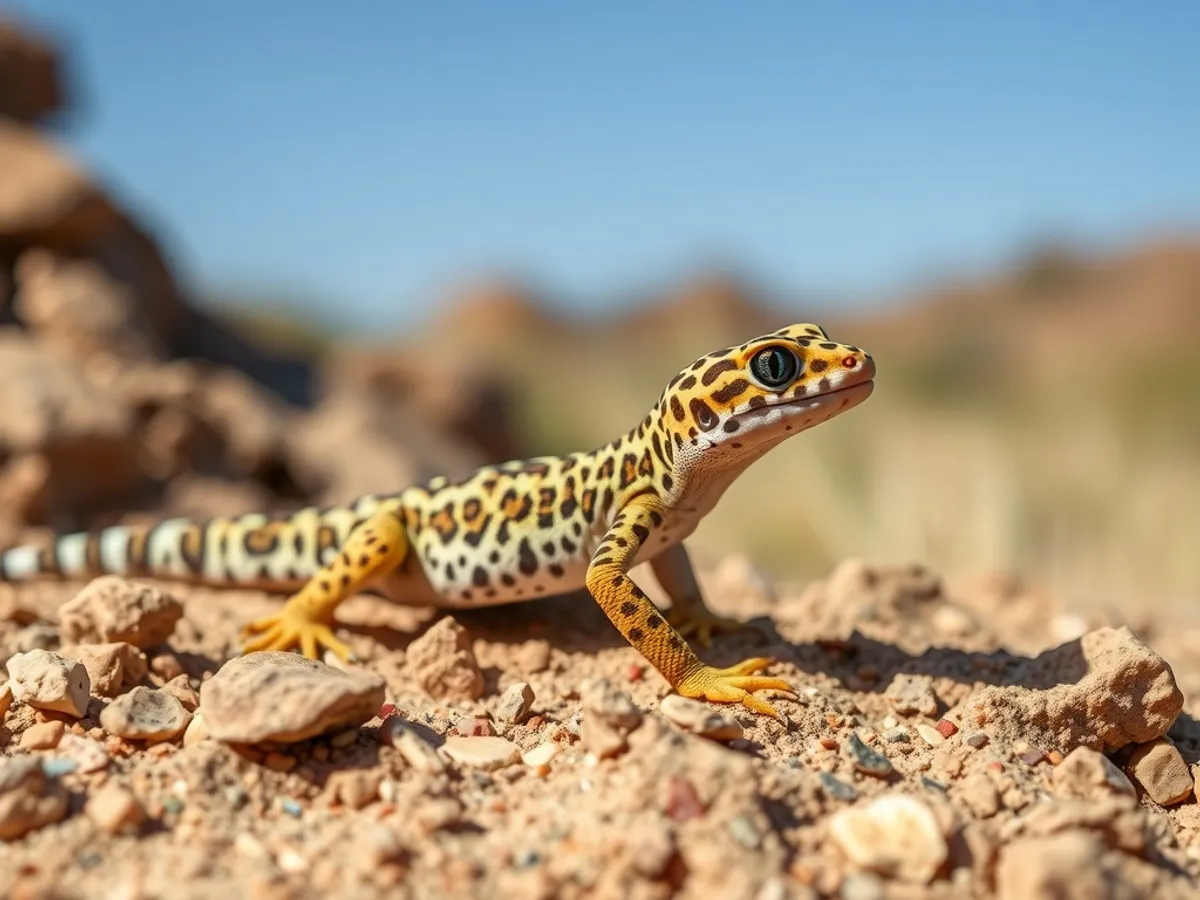
About the Leopard Gecko
The Leopard Gecko is a small, nocturnal lizard native to the arid and semi-arid regions of South Asia. Recognized for its distinctive spotted pattern resembling that of a leopard, this gecko has a robust body, movable eyelids, and a thick, fat-storing tail. Unlike many other geckos, it cannot climb smooth vertical surfaces due to the absence of adhesive toe pads. Leopard Geckos are popular pets due to their docile nature and relatively simple care requirements.
Fascinating facts
Movable Eyelids
Unlike most gecko species, Leopard Geckos have movable eyelids, allowing them to blink and keep their eyes clean and moist.
Desert Dwellers
They are native to arid and rocky regions, where they spend the day hiding under rocks or in burrows to avoid the heat.
Insectivorous Appetite
Leopard Geckos primarily eat insects such as crickets, mealworms, and roaches, hunting at night when temperatures are cooler.
Detailed description
The Leopard Gecko (Eublepharis macularius) is a medium-sized lizard, typically measuring 18–25 cm (7–10 inches) in length, with some large females and males reaching up to 28 cm. Adults weigh between 45–65 grams, though captive-bred morphs may be heavier. Its skin is covered in small, bumpy tubercles, providing a rough texture, and displays a striking pattern of dark spots or bands on a yellow to white background, which offers camouflage in its native habitat. Unlike most geckos, it possesses movable eyelids, an adaptation for its terrestrial lifestyle, and a thick, segmented tail used for fat storage and as a defense mechanism—capable of autotomy (tail dropping) to escape predators. The Leopard Gecko has well-developed limbs with clawed toes, lacking adhesive pads, which restricts it to ground-dwelling habitats. Its skull and jaw are robust, allowing it to consume a variety of invertebrate prey. Nocturnal by nature, it emerges at dusk to forage, relying on acute vision and chemosensory cues. Socially, Leopard Geckos are primarily solitary, though they may tolerate conspecifics in overlapping territories, especially during the breeding season. In the wild, their lifespan averages 6–8 years, but captive individuals can live 15–20 years, with some reports exceeding 25 years.
Did you know?
Leopard Geckos have movable eyelids, a rare feature among geckos that allows them to blink and close their eyes while sleeping.
Research & sources
Wikipedia summary
The leopard gecko or common leopard gecko is a ground-dwelling gecko native to the rocky dry grassland and desert regions of Afghanistan, Iran, Pakistan, India, and Nepal. The leopard gecko is a popular pet, and due to extensive captive breeding it is sometimes referred to as the first domesticated species of lizard.
Behaviour & social structure
Leopard Geckos are crepuscular to nocturnal, becoming active at dusk and throughout the night. During the day, they seek refuge in burrows, under rocks, or in crevices to avoid extreme temperatures and predators. Their hunting strategy is primarily ambush-based, remaining motionless and then striking quickly at passing prey such as insects, spiders, and occasionally small vertebrates. They use tongue-flicking to sample chemical cues from the environment, aiding in prey detection and territorial recognition. Social interactions are generally limited outside the breeding season, with individuals exhibiting territoriality, especially males, who may display aggressive postures or vocalizations (chirps, squeaks) to deter rivals. Females may cohabit in overlapping ranges, particularly in resource-rich areas. Leopard Geckos exhibit a regular shedding cycle, often consuming their shed skin to reclaim nutrients and reduce scent trails that could attract predators. Thermoregulation is achieved through behavioral means, such as basking near warm surfaces at dusk or dawn and retreating to cooler microhabitats during peak heat.
Reproduction & life cycle
Leopard Geckos are oviparous, with breeding typically occurring in the spring and early summer, triggered by increasing temperatures and photoperiod. Courtship involves males approaching females with tail vibrations and gentle nipping. After successful copulation, females lay clutches of 1–2 eggs every 15–22 days, producing up to 6–8 clutches per season. Eggs are deposited in moist, concealed locations such as under rocks or in burrows. Incubation lasts 35–89 days, depending on temperature, with higher temperatures (above 29°C/84°F) producing predominantly females and lower temperatures yielding males—a phenomenon known as temperature-dependent sex determination. Hatchlings are fully independent, measuring 7–10 cm at birth, and receive no parental care. Sexual maturity is reached at 12–18 months, with growth rates influenced by food availability and environmental conditions.
Adaptations & survival
Leopard Geckos exhibit several adaptations for arid environments: their thick, fat-storing tail serves as an energy reserve during food scarcity and can be autotomized to distract predators. Movable eyelids protect the eyes from dust and debris, a rare trait among geckos. Their coloration and patterning provide effective camouflage against rocky and sandy substrates. The absence of adhesive toe pads reflects their terrestrial lifestyle, while strong claws aid in digging and climbing over rough terrain. Their skin is relatively tough and sheds regularly to maintain health and minimize parasite load. Behavioral adaptations include nocturnality to avoid daytime heat and predation, and the ability to reduce metabolic rate during periods of drought or low food availability (aestivation).
Cultural significance
Leopard Geckos have limited direct cultural significance in their native range, though geckos in general are sometimes associated with good luck or omens in South Asian folklore. In the global context, the species has become an iconic pet reptile, often cited as the first lizard species to be widely domesticated due to its docile temperament, ease of care, and extensive captive breeding. This has led to a proliferation of color and pattern morphs, contributing to their popularity in herpetoculture. There are no known traditional medicinal or culinary uses for this species.
Recent research
Recent research on Leopard Geckos has focused on their genetics, particularly the inheritance of color and pattern morphs, and the mechanisms of temperature-dependent sex determination. Studies have examined their immune response, skin microbiome, and resistance to pathogens relevant to captive populations. Behavioral research includes investigations into learning, spatial memory, and social signaling via vocalizations and pheromones. Conservation genetics has been used to assess wild population structure and the impact of the pet trade. Ongoing research also explores the effects of environmental enrichment and diet on captive welfare, as well as the evolutionary history of the Eublepharidae family.
Videos
Habitat
Arid and semi-arid deserts, rocky grasslands


Conservation
The Leopard Gecko is currently classified as Least Concern on the IUCN Red List.
Threats & challenges
While the Leopard Gecko is currently listed as Least Concern by the IUCN, wild populations face localized threats from habitat degradation due to agriculture, overgrazing, and urban expansion. Collection for the international pet trade historically impacted some populations, though most pet geckos today are captive-bred. Climate change poses a potential long-term threat by altering habitat suitability and affecting reproductive success through temperature-dependent sex determination. Predation by introduced species and domestic animals (e.g., cats) is a minor but present risk. Conservation challenges include habitat fragmentation and ensuring sustainable land use in their native range. Population trends are generally stable, but ongoing monitoring is recommended.
Taxonomy
Scientific name
Eublepharis macularius
- Kingdom
- Animalia
- Phylum
- Chordata
- Class
- Reptilia
- Order
- Squamata
- Family
- Eublepharidae
- Genus
- Eublepharis
- Species
- macularius
Where to see a leopard gecko
7 zoos and aquariums in 2 countries are recorded as keeping this species.
 Belfast Zoo🇬🇧 Belfast, United Kingdom
 National Zoological Park🇺🇸 Washington, United States
- 🦁Big Bear Alpine Zoo🇺🇸 Big Bear Lake, United States
- 🦁Dakota Zoo🇺🇸 Bismarck, United States
- 🦁Cheyenne Mountain Zoo🇺🇸 United States
Community notes
Share your observations about the Leopard Gecko.
No community notes yet. Be the first!
Discover more wildlife
More fascinating animals from the encyclopedia.