
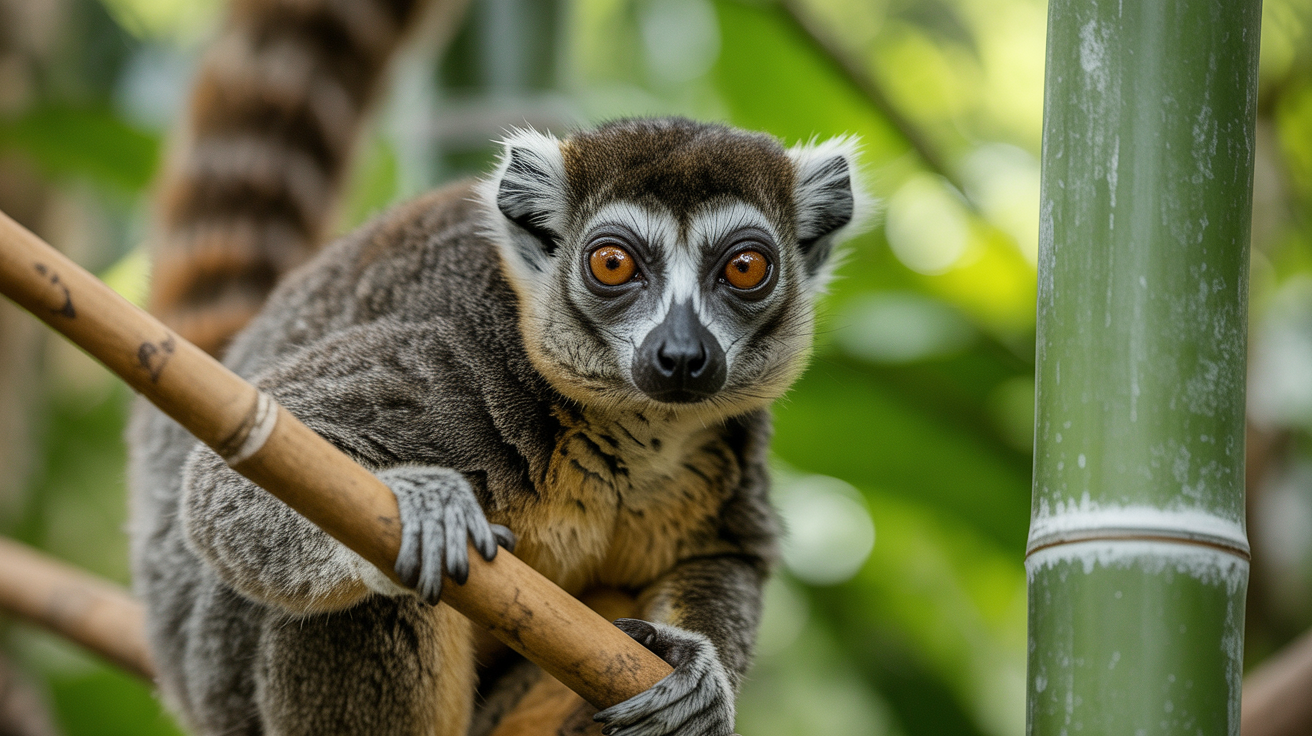
About the Lesser Bamboo Lemur
The Lesser Bamboo Lemur is a small, arboreal primate native to the forests of Madagascar. Recognizable by its grayish fur and short muzzle, this lemur is specially adapted to eating bamboo, a diet that few mammals can tolerate. It is primarily active during the early morning and late afternoon, exhibiting a crepuscular lifestyle. Social by nature, the Lesser Bamboo Lemur lives in small groups and is vital for the health of its forest ecosystem.
Fascinating facts
Bamboo Specialist
Lesser Bamboo Lemurs have evolved to digest cyanide-containing bamboo, which is toxic to most other animals.
Arboreal Lifestyle
These lemurs spend most of their time in dense bamboo thickets and rarely descend to the ground.
Group Living
They typically live in groups of 3 to 5 individuals, which helps them protect each other from predators.
Detailed description
The Lesser Bamboo Lemur (Hapalemur griseus) is a small, agile primate endemic to Madagascar, with adults typically weighing between 700 and 900 grams and measuring 26–28 cm in body length, with a tail nearly as long as the body. Its dense, woolly fur is predominantly gray with subtle olive or brownish tinges, and it has a short, rounded muzzle, large forward-facing eyes, and small, rounded ears—features that enhance its arboreal lifestyle. The species is highly specialized for life in bamboo thickets, possessing robust jaws and unique gut flora that allow it to digest bamboo shoots and leaves, which contain cyanogenic compounds toxic to most mammals. Lesser Bamboo Lemurs are primarily crepuscular, being most active at dawn and dusk, and spend the majority of their time in the mid- to upper-canopy, moving quadrupedally and occasionally leaping between bamboo stems. Socially, they form cohesive groups of 3 to 5 individuals, typically consisting of a dominant female, several males, and their offspring, with strong social bonds maintained through grooming and vocal communication. Their vocal repertoire includes soft grunts, clicks, and alarm calls, which are crucial for group cohesion and predator avoidance. Reproduction is seasonal, with births synchronized to the rainy season when bamboo is most abundant. The species plays a key ecological role as both a seed disperser and a regulator of bamboo growth, contributing to forest health and diversity. Despite their adaptability, Lesser Bamboo Lemurs are increasingly threatened by habitat loss, hunting, and fragmentation, leading to their current classification as Vulnerable by the IUCN.
Did you know?
Despite their small size, Lesser Bamboo Lemurs can consume up to 500 grams of bamboo each day—almost their whole body weight!
Research & sources
Behaviour & social structure
Lesser Bamboo Lemurs exhibit a crepuscular activity pattern, foraging primarily during the early morning and late afternoon to avoid midday heat and predation. Their diet is highly specialized, consisting mainly of bamboo species such as Bambusa madagascariensis and Cephalostachyum viguieri, but they may also consume other grasses, fruits, and occasionally fungi. Feeding involves careful selection of young bamboo shoots and leaves, which are less toxic and more nutritious. Social interactions are characterized by frequent grooming, which reinforces group cohesion and reduces stress. Group members communicate through a variety of vocalizations, including contact calls, alarm calls, and soft grunts, as well as through scent-marking using glands located on the wrists and genital regions. Territorial disputes are rare but may involve vocal displays and chasing. Resting sites are typically in dense bamboo clumps, providing concealment from predators such as the fossa (Cryptoprocta ferox) and birds of prey. Daily routines include periods of foraging, social interaction, resting, and vigilant scanning for predators.
Reproduction & life cycle
The reproductive cycle of the Lesser Bamboo Lemur is closely tied to environmental conditions, with mating occurring at the onset of the rainy season (typically October to December). Females exhibit a brief estrus period and are receptive for only a few days. After successful mating, gestation lasts approximately 135–150 days, culminating in the birth of a single offspring, though twins are rare. Births are highly synchronized within groups, usually occurring between March and May when food resources are at their peak. Neonates are altricial, weighing about 30–40 grams at birth, and are initially carried by the mother, later riding on her back as they grow. Maternal care is intensive, with the mother providing warmth, grooming, and protection; other group members may also participate in alloparental care. Weaning occurs at 4–5 months, but juveniles remain dependent on the group for social learning and protection for up to a year. Sexual maturity is reached at 18–24 months.
Adaptations & survival
The Lesser Bamboo Lemur exhibits several remarkable adaptations for its specialized bamboo diet. Its robust, procumbent incisors and powerful jaw muscles enable it to strip tough bamboo stems, while its digestive system harbors symbiotic bacteria capable of breaking down cellulose and detoxifying cyanogenic glycosides present in bamboo. Behavioral adaptations include selective feeding on less toxic bamboo parts and temporal avoidance of predators through crepuscular activity. Morphologically, its prehensile hands and feet, with opposable thumbs and toes, facilitate grasping slender bamboo stems and navigating dense thickets. The species also demonstrates cryptic coloration, aiding in camouflage among bamboo foliage. Socially, strong group cohesion and coordinated vigilance reduce predation risk. Evolutionarily, these traits represent a classic example of dietary specialization and niche adaptation among Madagascar’s lemur fauna.
Cultural significance
While the Lesser Bamboo Lemur does not feature prominently in Malagasy folklore compared to some larger lemur species, it is occasionally referenced in local traditions as a symbol of forest health and resilience. In some regions, lemurs are considered sacred (fady) and are protected by traditional taboos, though these protections are not universal. The species has become an ambassador for conservation education in Madagascar, highlighting the importance of bamboo forests and the unique biodiversity they support. Ecotourism initiatives in protected areas, such as Ranomafana National Park, have increased awareness of the species and its ecological role.
Recent research
Recent research has focused on the physiological mechanisms by which Hapalemur griseus detoxifies cyanide compounds in bamboo, with studies identifying specific gut microbiota involved in this process. Ongoing field studies are using radio-collaring and genetic sampling to assess population structure, dispersal patterns, and the impact of habitat fragmentation. Behavioral ecology research has documented flexible group composition and social dynamics in response to resource availability. Conservation genetics studies are underway to evaluate genetic diversity across isolated populations, informing translocation and habitat corridor initiatives. Additionally, the species is being studied as a model for understanding the evolutionary consequences of dietary specialization among primates.
Videos
Habitat
Tropical rainforest and bamboo forest


Conservation
The Lesser Bamboo Lemur is currently classified as Vulnerable on the IUCN Red List.
Threats & challenges
The primary threats to the Lesser Bamboo Lemur are habitat destruction due to slash-and-burn agriculture (tavy), illegal logging, and conversion of forest to rice paddies and other crops. Fragmentation of bamboo forests isolates populations, reducing genetic diversity and increasing vulnerability to stochastic events. Hunting for bushmeat, though less common than for larger lemurs, poses a localized threat. Climate change may also impact bamboo growth cycles, further stressing populations. Current population trends indicate a decline, with estimates suggesting fewer than 10,000 mature individuals remaining in fragmented subpopulations. Conservation challenges include enforcing protected area boundaries, promoting sustainable agriculture, and engaging local communities in conservation efforts. The species is listed as Vulnerable on the IUCN Red List, with ongoing habitat loss being the most significant driver of decline.
Taxonomy
Scientific name
Hapalemur griseus
- Kingdom
- Animalia
- Phylum
- Chordata
- Class
- Mammalia
- Order
- Primates
- Family
- Lemuridae
- Genus
- Hapalemur
- Species
- griseus
Community notes
Share your observations about the Lesser Bamboo Lemur.
No community notes yet. Be the first!
Discover more wildlife
More fascinating animals from the encyclopedia.