
About the Lined Shore Crab
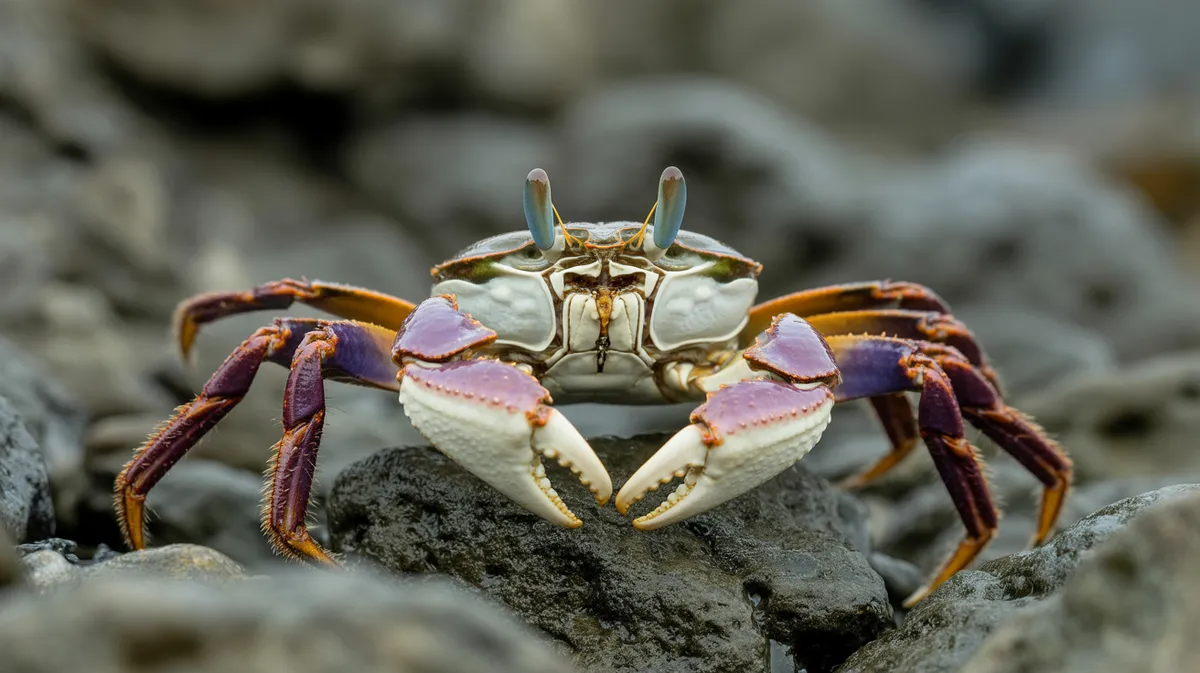
The lined shore crab is a small, robust crab native to the Pacific coasts of North America, ranging from Alaska to Baja California. Its carapace is squarish and typically olive green or brown, adorned with distinct purple, red, or white lines running across it. Adapted to life in the intertidal zone, this agile crab scuttles among rocks and crevices, often seen during low tide. It plays an important ecological role as both a predator and scavenger, helping to maintain the balance of its coastal ecosystem.
Fascinating facts
Distinctive Patterns
The lined shore crab's carapace features striking colored lines, which help distinguish it from similar species.
Intertidal Expert
This crab thrives in areas exposed to both air and water, adapting to fluctuating tides and temperatures.
Opportunistic Feeder
Lined shore crabs eat algae, detritus, and small animals, contributing to the health of their shoreline habitats.
Detailed description
The Lined Shore Crab (Pachygrapsus crassipes) is a medium-sized intertidal crab with a carapace width typically ranging from 2.5 to 4.5 cm (1–1.75 inches), though individuals may reach up to 5 cm. Its carapace is nearly square, slightly wider than long, and is characterized by a smooth surface marked with distinctive transverse lines or striations in hues of purple, red, or white, contrasting with its olive-green to brown background. The chelae (claws) are relatively short and robust, often showing a purplish tint, and the walking legs are flattened, aiding in maneuverability among rocks. The eyes are set on short stalks, providing a wide field of vision to detect predators and prey. Pachygrapsus crassipes is highly agile, capable of rapid sideways movement and adept at clinging to vertical and overhanging surfaces, even in strong wave action. It is primarily active during low tide, retreating to crevices or under rocks when threatened or during high tide. The species is omnivorous, feeding on algae, detritus, small invertebrates, and carrion. Socially, it is often found in high densities, with individuals displaying both aggressive and tolerant interactions, especially in resource-rich microhabitats. Reproduction occurs seasonally, with females carrying fertilized eggs on their pleopods until hatching. The species exhibits remarkable physiological adaptations to withstand desiccation, temperature fluctuations, and salinity changes typical of the intertidal environment.
Did you know?
Despite their small size, lined shore crabs can climb vertical rock faces using the tiny, hooked hairs on their legs.
Research & sources
Behaviour & social structure
Lined Shore Crabs are diurnal, most active during daylight low tides when they emerge from hiding to forage. They exhibit opportunistic feeding, scraping algae from rocks with their chelae, scavenging dead organic matter, and preying on small invertebrates such as amphipods, isopods, and juvenile mollusks. Their feeding behavior is flexible, shifting with food availability and tidal cycles. Social interactions are complex; while individuals may aggregate in favorable microhabitats, they defend prime shelter sites through displays such as claw waving, posturing, and, occasionally, direct combat. They are highly responsive to visual and tactile stimuli, quickly retreating to shelter at signs of danger. During high tide or at night, crabs remain hidden to avoid aquatic predators and desiccation.
Reproduction & life cycle
Breeding typically occurs from late spring through early autumn, with peak reproductive activity varying by latitude. Males locate receptive females through chemical cues and may guard them prior to molting, as mating occurs shortly after the female molts and her exoskeleton is soft. Fertilization is internal, and females carry fertilized eggs (up to several thousand) attached to their pleopods beneath the abdomen for 2–4 weeks, depending on water temperature. The eggs are brooded until they hatch into planktonic zoea larvae, which undergo several molts in the water column before settling as juvenile crabs. There is no parental care post-hatching, but females may exhibit defensive behaviors while brooding eggs.
Adaptations & survival
Pachygrapsus crassipes possesses numerous adaptations for intertidal life. Its flattened, robust body and legs facilitate movement in narrow crevices and provide resistance against wave forces. The exoskeleton is thick and resistant to desiccation, while specialized gill chambers allow for limited aerial respiration during low tide. Behavioral adaptations include seeking shaded or moist microhabitats to reduce water loss and clustering in groups to minimize exposure. The species can tolerate wide fluctuations in temperature and salinity, an evolutionary advantage in the variable intertidal zone. Its omnivorous diet and flexible feeding strategies further enhance its ecological success.
Cultural significance
While not a major food source, the Lined Shore Crab has been used as bait in recreational fishing and is a familiar species to coastal communities and educators. It features in local tidepool ecology programs and is often highlighted in environmental education as a representative of intertidal biodiversity. There is limited direct cultural or mythological significance, but it plays an important role in fostering public appreciation for coastal ecosystems.
Recent research
Recent research on Pachygrapsus crassipes has focused on its physiological tolerance to environmental stressors, such as temperature and salinity extremes, providing insights into climate change resilience. Studies have also investigated its role as a keystone species in structuring intertidal communities, particularly through its grazing and predatory impacts. Genetic analyses have revealed population connectivity along the Pacific coast, with some evidence of cryptic speciation. Ongoing research examines the impacts of urbanization and pollution on its health and reproductive success, as well as its interactions with invasive species such as the European green crab (Carcinus maenas).
Sources
The Biology of Grapsid Shore Crabs: Pachygrapsus crassipes
J.S. Garth & S.H. Crozier (1966)
scientificThe Biology of Grapsid Crabs: Adaptations to Intertidal Life
Schubart, C.D., Cuesta, J.A., Felder, D.L. (2002)
scientificVideos
Habitat
Rocky intertidal zones along the Pacific coastline

Conservation
The Lined Shore Crab is currently classified as Least Concern on the IUCN Red List.
Threats & challenges
Currently, the Lined Shore Crab is classified as Least Concern, with stable populations throughout its range. However, local threats include habitat disturbance from coastal development, pollution (especially oil spills and heavy metals), and trampling by humans in popular tidepool areas. Climate change poses emerging risks, such as increased frequency of extreme heat events, ocean acidification, and altered intertidal zonation. While the species is resilient, long-term monitoring is necessary to detect potential population declines or shifts in distribution.
Taxonomy
Scientific name
Pachygrapsus crassipes
- Kingdom
- Animalia
- Phylum
- Arthropoda
- Class
- Malacostraca
- Order
- Decapoda
- Family
- Grapsidae
- Genus
- Pachygrapsus
- Species
- crassipes
Community notes
Share your observations about the Lined Shore Crab.
No community notes yet. Be the first!
Discover more wildlife
More fascinating animals from the encyclopedia.