
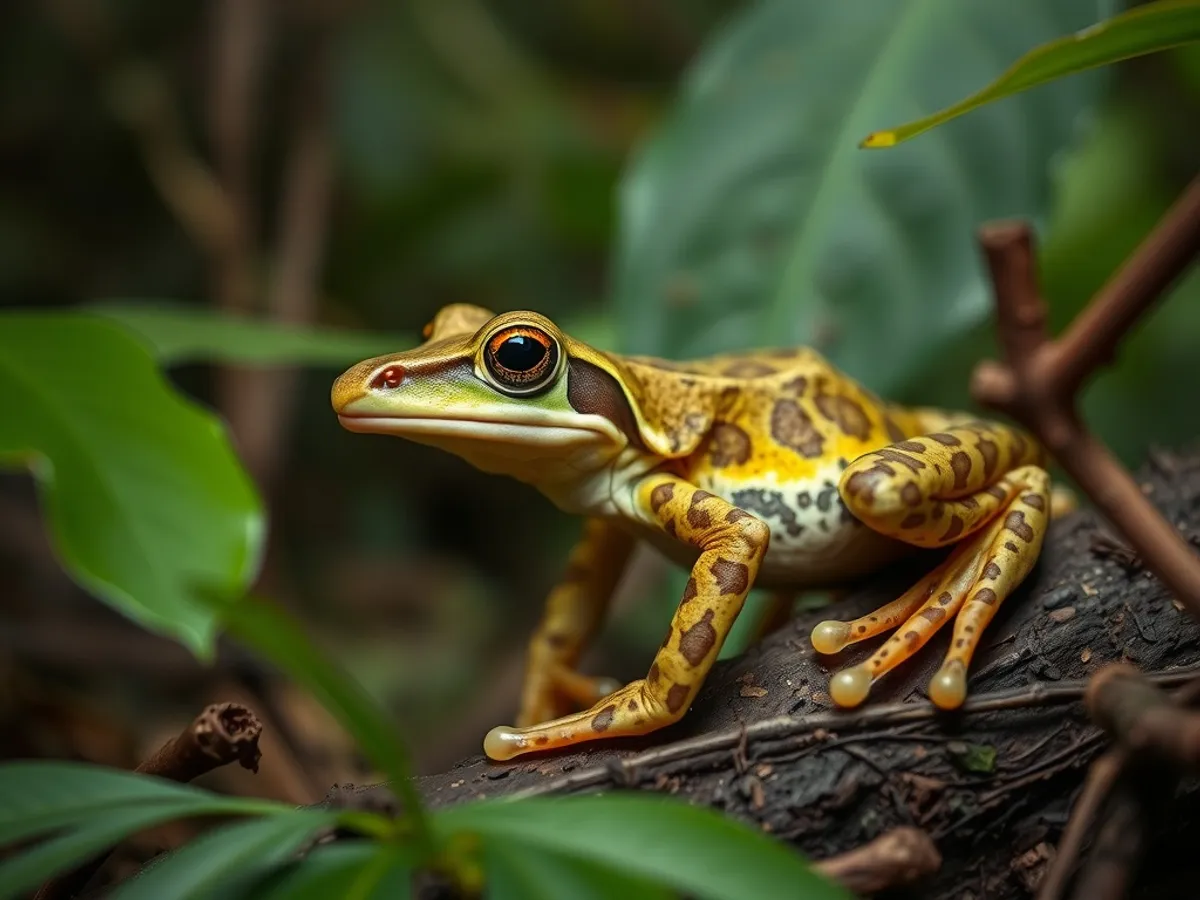
About the Long-nosed Horned Frog
The Long-nosed Horned Frog, also known as the Malayan Horned Frog, is a remarkable amphibian distinguished by its elongated, horn-like projections above its eyes and snout. This cryptic frog is a master of camouflage, mimicking dead leaves on the forest floor to evade predators and ambush prey. Native to Southeast Asia, it is primarily found in lowland and montane rainforests, where it relies on its powerful legs to leap and burrow into leaf litter. Its unique appearance and fascinating behavior make it a favorite among herpetologists and amphibian enthusiasts.
Fascinating facts
Leaf Camouflage
The frog's cryptic coloration and horn-like projections perfectly mimic dead leaves, making it exceptionally difficult to spot among forest litter.
Ambush Predator
It is a sit-and-wait predator, remaining motionless until unsuspecting insects or small animals come close enough to catch with a sudden leap.
Distinctive Call
Their mating call is a loud, duck-like 'quack' that can be heard echoing through the rainforest during the breeding season.
Detailed description
The Long-nosed Horned Frog (Pelobatrachus nasutus), formerly Megophrys nasuta, is a medium to large-sized amphibian, with adults ranging from 75 to 120 mm in snout-vent length, females typically being larger than males. Its most distinctive feature is the pronounced, triangular 'horn' formed by elongated skin flaps above the eyes and a pointed, leaf-like extension of the snout, which, along with cryptic brown and mottled coloration, provides exceptional camouflage among leaf litter. The body is robust, with muscular hind limbs adapted for powerful leaps and burrowing. The dorsal surface is rough and warty, enhancing its resemblance to decaying leaves, while the ventral side is lighter and smoother. The species has large, forward-facing eyes with vertical pupils, providing excellent night vision for its predominantly nocturnal lifestyle. The tympanum (external eardrum) is distinct, aiding in acoustic communication. The frog's mouth is wide, allowing it to consume a variety of prey. Tadpoles are slender with a specialized oral disc adapted for feeding in fast-flowing streams. Adults are solitary and highly territorial, using both visual and acoustic signals to defend their space. Their cryptic appearance and sedentary behavior make them difficult to spot in the wild, contributing to their elusive reputation.
Did you know?
Despite its fierce appearance, the Long-nosed Horned Frog spends most of its life hidden and is rarely seen by humans in the wild.
Research & sources
Wikipedia summary
The long-nosed horned frog, also known as the Malayan horned frog or Malayan leaf frog is a species of frog restricted to the rainforest areas of southern Thailand and Peninsular Malaysia to Singapore, Sumatra, and Borneo. However, records from Thailand to the Sunda Shelf may apply to another, possibly unnamed species.
Behaviour & social structure
Long-nosed Horned Frogs are primarily nocturnal ambush predators, remaining motionless for extended periods while partially buried in leaf litter or soil, awaiting unsuspecting prey. Their diet consists mainly of invertebrates such as insects, spiders, and worms, but larger individuals have been observed consuming small vertebrates, including other frogs and lizards. They employ a sit-and-wait strategy, relying on sudden, rapid lunges to capture prey with their sticky, protrusible tongues. Social interactions are minimal outside the breeding season; individuals are generally solitary and may display aggressive behaviors if territories overlap. Males are known to produce low-pitched, guttural calls from concealed positions near streams to attract females and deter rival males. During the day, they remain hidden and inactive, conserving energy and avoiding diurnal predators.
Reproduction & life cycle
Breeding typically coincides with the rainy season, when males congregate near slow-moving streams or temporary pools and call to attract females. Amplexus (the mating embrace) is axillary, with the male grasping the female behind her forelimbs. Females lay clutches of 100–300 eggs in gelatinous strings attached to submerged vegetation or debris in shallow water. Embryonic development is rapid, with eggs hatching within 7–10 days depending on temperature and humidity. The tadpoles are adapted to lotic (flowing water) environments, possessing streamlined bodies and specialized mouthparts for clinging to rocks and feeding on detritus and algae. Metamorphosis into juvenile frogs occurs after 40–60 days, though this can vary with environmental conditions. There is no parental care post-oviposition; survival of offspring depends on environmental stability and predation rates.
Adaptations & survival
The species exhibits remarkable morphological adaptations for camouflage, including its horn-like skin projections and leaf-mimicking coloration, which reduce predation risk by visually oriented predators such as birds and snakes. The rough, irregular dorsal surface further enhances its resemblance to decaying foliage. Its sedentary, ambush-based hunting strategy minimizes energy expenditure and exposure. Tadpoles possess a suctorial oral disc, allowing them to cling to substrates in fast-flowing water, reducing the risk of being swept away. The frog's highly sensitive vision and acute hearing facilitate nocturnal hunting and communication. Additionally, their skin secretes mild toxins that may deter some predators.
Cultural significance
While not a major figure in regional folklore, the Long-nosed Horned Frog's unique appearance has made it a subject of fascination among local communities and ecotourists. In some Southeast Asian cultures, frogs are generally regarded as symbols of fertility and rain, though there are no specific myths associated with this species. Its striking camouflage and rarity have contributed to its popularity in the exotic pet trade and among herpetological enthusiasts. Educational programs in Malaysia and Borneo sometimes feature the species to highlight rainforest biodiversity and the importance of amphibian conservation.
Recent research
Recent molecular studies have suggested that populations currently assigned to Pelobatrachus nasutus may represent a complex of cryptic species, particularly those from Thailand and the Sunda Shelf, indicating the need for further taxonomic revision. Ongoing research is focused on bioacoustics (male call variation), larval ecology, and the impacts of habitat fragmentation on genetic diversity. Studies on the frog's skin secretions have identified bioactive compounds with potential antimicrobial properties. Conservation biologists are also monitoring the effects of chytrid fungus (Batrachochytrium dendrobatidis), which has devastated amphibian populations elsewhere, though no major outbreaks have been reported in this species to date.
Sources
Amphibian Species of the World 6.1: Pelobatrachus nasutus
Frost, D.R. (American Museum of Natural History) (2024)
scientificA taxonomic revision of the Asian horned frogs (Megophryidae: Megophrys) with molecular evidence
Mahony, S. et al. (2017)
scientificVideos
Habitat
Tropical rainforest
 Tropical Regions
Rainforest
Dense, wet forests with the highest biodiversity on Earth, containing more than half of the world's plant and animal species.
 Global
Forest
Wooded areas with significant tree cover and diverse plant and animal communities.
 Global
Freshwater
Lakes, rivers, and wetlands with diverse aquatic ecosystems.
Conservation
The Long-nosed Horned Frog is currently classified as Least Concern on the IUCN Red List.
Threats & challenges
Although currently listed as Least Concern by the IUCN, the Long-nosed Horned Frog faces ongoing threats from habitat loss due to deforestation, logging, and conversion of rainforest to agriculture and plantations, particularly palm oil. Fragmentation of populations and degradation of stream habitats can negatively impact breeding success and larval development. Collection for the pet trade, while not currently a major threat, could become significant if not regulated. Climate change poses additional risks by altering rainfall patterns and stream flow, potentially disrupting breeding cycles. Population trends remain stable in protected areas, but declines have been noted in regions experiencing rapid habitat alteration.
Taxonomy
Scientific name
Megophrys nasuta
- Kingdom
- Animalia
- Phylum
- Chordata
- Class
- Amphibia
- Order
- Anura
- Family
- Megophryidae
- Genus
- Megophrys
- Species
- nasuta
Community notes
Share your observations about the Long-nosed Horned Frog.
No community notes yet. Be the first!
Discover more wildlife
More fascinating animals from the encyclopedia.