
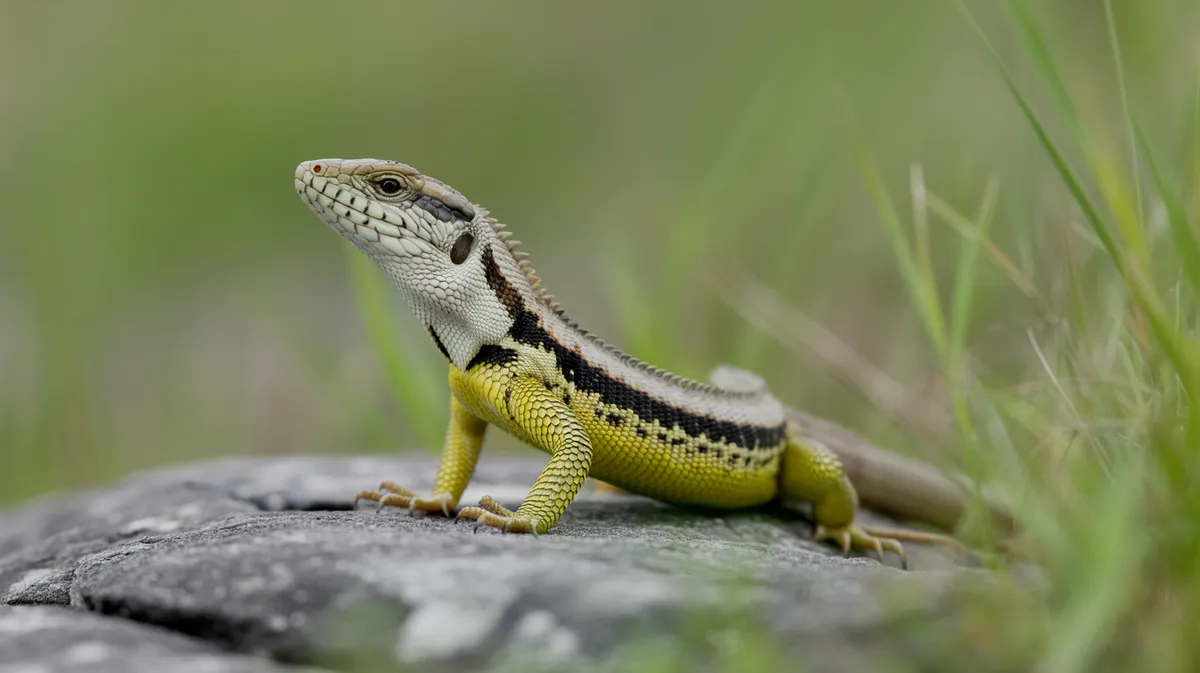
About the Long-tailed Grass Lizard
The Long-tailed Grass Lizard is a slender and agile reptile renowned for its extraordinarily long tail, which can be three times the length of its body. Found across much of Southeast Asia, these lizards are well adapted to life in grassy and shrubby environments, where their coloration provides excellent camouflage. They are diurnal, spending much of their time foraging for insects and basking in the sun. Their quick reflexes and elongated tail help them evade predators and navigate through dense vegetation.
Fascinating facts
Super Long Tail
The tail of this lizard can be up to three times longer than its body, aiding in balance and agility.
Expert Climber
Long-tailed Grass Lizards are adept at climbing grasses and shrubs, allowing them to hunt for insects and avoid predators.
Insect Hunter
Their diet consists mainly of small insects and arthropods, which they catch with impressive speed.
Detailed description
The Long-tailed Grass Lizard (Takydromus sexlineatus) is a small, slender lacertid reptile distinguished by its exceptionally elongated tail, which can reach up to 30 cm, often three to four times the length of its body (snout-vent length typically 6–8 cm). Its dorsal coloration ranges from olive green to brown, often with six pale longitudinal stripes running from head to tail, providing effective camouflage among grasses and shrubs. The body is laterally compressed, aiding swift movement through dense vegetation. Limbs are long and delicate, with elongated toes that facilitate agile climbing and rapid sprints. This species is diurnal and highly active, relying on keen vision to detect prey and predators. The tail, which is autotomous (capable of being shed), serves both as a decoy to distract predators and as a balance aid during high-speed pursuits. Takydromus sexlineatus is primarily insectivorous, preying on a variety of arthropods. Its alert and skittish nature, combined with cryptic coloration, makes it difficult to observe in the wild. The species is distributed widely across Southeast Asia, including southern China, Thailand, Vietnam, Malaysia, Indonesia, and parts of India, inhabiting open grasslands, forest edges, and cultivated fields. Its adaptability to disturbed habitats contributes to its stable population status.
Did you know?
Despite their delicate appearance, Long-tailed Grass Lizards are highly adaptable and have established populations in urban parks and gardens.
Research & sources
Behaviour & social structure
Long-tailed Grass Lizards are solitary and territorial, with individuals maintaining small home ranges. They are most active during the early morning and late afternoon, basking to regulate body temperature before foraging. Their hunting strategy is primarily 'sit-and-wait,' punctuated by rapid dashes to capture prey such as ants, beetles, grasshoppers, and spiders. When threatened, they exhibit tail autotomy, sacrificing the tail to escape predation; the tail regenerates over several months but is usually shorter and less colorful. These lizards communicate through body postures and rapid tail movements, especially during territorial disputes or courtship. They are adept climbers, often seen perching on grass stems or low shrubs to survey their surroundings. Nocturnal activity is rare, as they seek shelter under leaf litter or within dense grass at night.
Reproduction & life cycle
Takydromus sexlineatus is oviparous, with breeding typically occurring during the wet season (April to August) when food is abundant. Courtship involves males displaying vibrant coloration and performing tail-waving displays to attract females. Females lay 2–10 elongated, leathery eggs per clutch, often in concealed, moist microhabitats such as under logs or within dense vegetation. Incubation lasts approximately 40–60 days, depending on ambient temperature and humidity. There is no parental care post-oviposition; hatchlings are independent and exhibit adult-like behaviors immediately. In favorable conditions, females may produce multiple clutches per breeding season.
Adaptations & survival
The most striking adaptation is the extremely long, autotomous tail, which acts as both a predator decoy and a counterbalance during agile movements. The lateral compression of the body and elongated limbs enhance maneuverability in dense grassland habitats. Cryptic coloration and striping break up the lizard's outline, providing camouflage from both aerial and terrestrial predators. Acute vision enables precise prey detection and predator avoidance. Behavioral thermoregulation, such as basking and seeking shade, allows the lizard to maintain optimal body temperature for metabolic efficiency. Rapid sprinting and climbing abilities are crucial for both hunting and evasion.
Cultural significance
While not a major figure in folklore or mythology, the Long-tailed Grass Lizard is sometimes kept as a pet in parts of Southeast Asia due to its striking appearance and manageable size. In some rural communities, it is regarded as a beneficial insectivore, helping to control pest populations in agricultural fields. There are no significant traditional uses or symbolic associations documented in the scientific literature.
Recent research
Recent studies have focused on the biomechanics of tail autotomy and regeneration, revealing insights into tissue regeneration and evolutionary trade-offs between tail length and survival. Genetic research has clarified the phylogenetic relationships within the genus Takydromus, supporting the species' wide distribution and genetic diversity. Ecological studies have examined the species' role in grassland food webs and its adaptability to anthropogenic landscapes. Ongoing research is investigating the impact of habitat modification and climate change on population dynamics and reproductive success.
Sources
Tail Autotomy and Regeneration in the Long-tailed Grass Lizard (Takydromus sexlineatus)
Lin, L.H., Qu, Y.F., et al. (2012)
scientificTakydromus sexlineatus: The IUCN Red List of Threatened Species 2010
IUCN SSC Amphibian Specialist Group
conservationSystematics and natural history of Takydromus sexlineatus (Sauria: Lacertidae) in Southeast Asia
Arnold, E.N. (1997)
scientificVideos
Habitat
Grassland


Conservation
The Long-tailed Grass Lizard is currently classified as Least Concern on the IUCN Red List.
Threats & challenges
Currently, Takydromus sexlineatus faces few significant threats due to its wide distribution and adaptability to disturbed habitats. Localized threats include habitat loss from agricultural expansion, pesticide use reducing prey availability, and collection for the pet trade. However, populations remain stable across most of its range, and the species is classified as Least Concern by the IUCN. Climate change and increasing habitat fragmentation could pose future challenges, particularly in areas where grasslands are converted to monoculture plantations or urban developments.
Taxonomy
Scientific name
Takydromus sexlineatus
- Kingdom
- Animalia
- Phylum
- Chordata
- Class
- Reptilia
- Order
- Squamata
- Family
- Lacertidae
- Genus
- Takydromus
- Species
- sexlineatus
Community notes
Share your observations about the Long-tailed Grass Lizard.
No community notes yet. Be the first!
Discover more wildlife
More fascinating animals from the encyclopedia.