
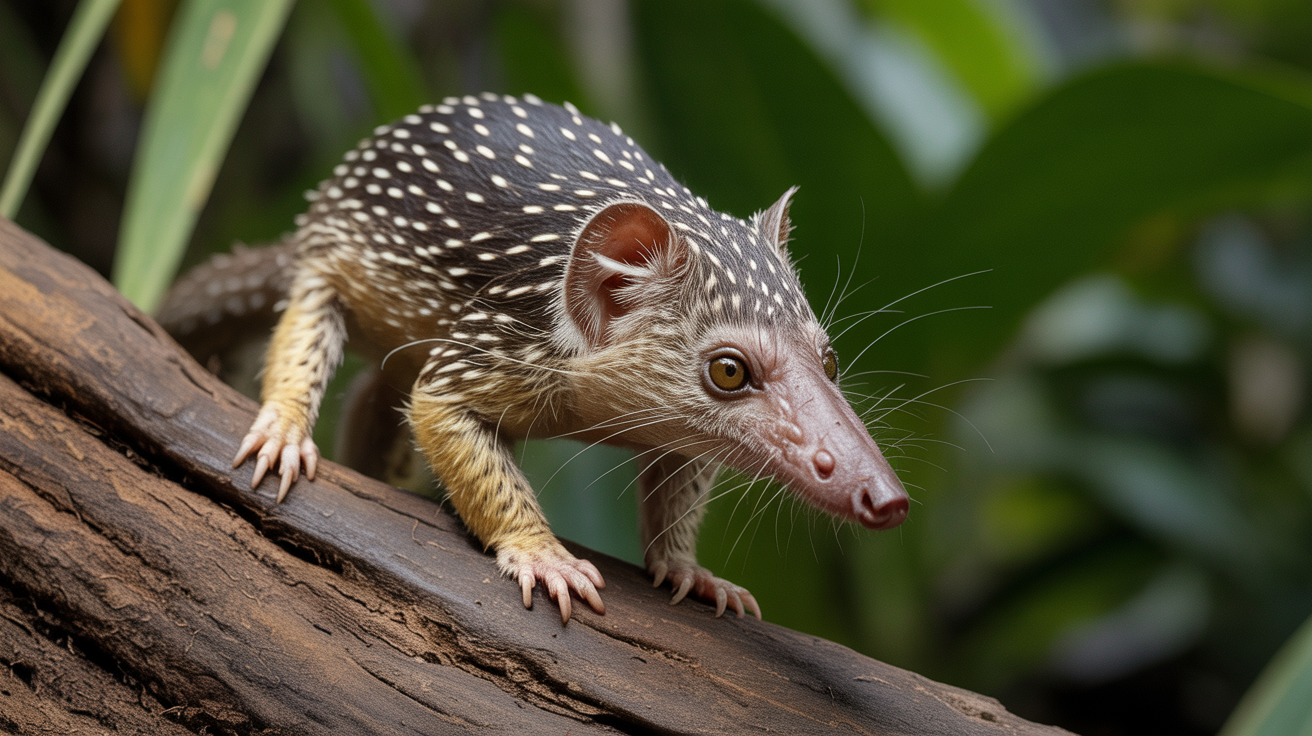
About the Lowland Streaked Tenrec
Hemicentetes semispinosus of Madagascar's eastern rainforests looks like a small black-and-yellow hedgehog and is not remotely related to one - it is an afrotherian tenrec, and its resemblance to hedgehogs is convergence. What makes it genuinely unique is a set of specialised quills in a patch on its mid-back: the animal rubs them rapidly against one another, producing a high-frequency ultrasonic chirp. This is stridulation, the mechanism crickets and grasshoppers use, and the streaked tenrec is the only mammal known to do it. The sound carries only a short distance, and it is used to keep family groups in contact in dense undergrowth - streaked tenrecs are unusually social for tenrecs, living in groups of up to twenty, which forage together and need to stay coordinated in vegetation where nothing can see anything. The animal also has detachable barbed quills on the crown and flanks which it drives into an attacker with a sharp upward jerk of the head, and it uses its long snout to root out earthworms, which make up most of its diet. It can enter torpor and lower its body temperature drastically when food is short, and unlike most tenrecs it is active by day as well as night.
Fascinating facts
Unique Quills
The Lowland Streaked Tenrec has modified quills on its back that it rubs together to create a sound for communication and predator deterrence.
Rainforest Specialist
This tenrec thrives in the humid, dense rainforests of eastern Madagascar, burrowing in soft, damp soil.
Earthworm Diet
Its primary diet consists of earthworms and other small invertebrates, which it locates using its sensitive snout.
Detailed description
The Lowland Streaked Tenrec (Hemicentetes semispinosus) is a small, semi-fossorial mammal endemic to the humid lowland rainforests of eastern and northern Madagascar. Adults typically measure 14–19 cm in total length and weigh between 125–280 grams. Its most distinctive feature is the striking pattern of black fur interspersed with vivid yellow or orange longitudinal stripes and a crown of detachable, barbed quills on the back and nape, which serve as both camouflage and defense. The snout is elongated and highly mobile, adapted for probing soil and leaf litter in search of prey. The limbs are short and robust, with strong claws for digging. Unlike most mammals, the Lowland Streaked Tenrec has a low and variable body temperature, often ranging from 28–35°C, reflecting its primitive thermoregulatory abilities. It is one of the few mammals known to communicate using stridulation, producing high-pitched sounds by rubbing specialized quills together—a behavior unique among terrestrial mammals. The species is primarily nocturnal and crepuscular, emerging at dusk and dawn to forage. Socially, it exhibits a degree of group living unusual for tenrecs, with family groups sharing complex burrow systems. Its diet is dominated by earthworms, but it also consumes insects, larvae, and other invertebrates, playing a key role in soil aeration and invertebrate population control within its ecosystem.
Did you know?
Unlike most mammals, the Lowland Streaked Tenrec can communicate using sound made by its body quills, not its vocal cords.
Research & sources
Wikipedia summary
The lowland streaked tenrec is a small tenrec found in Madagascar. It belongs to the family Tenrecidae in the order Afrosoricida, and more specifically to the subfamily of the spiny tenrecs Tenrecinae. Its natural habitats are in tropical lowland rain forests in northern and eastern parts of Madagascar.
Behaviour & social structure
Lowland Streaked Tenrecs are primarily nocturnal, with peak activity during the early night and late afternoon. They are adept diggers, using their forelimbs and snouts to excavate shallow burrows and search for prey beneath leaf litter and soil. Foraging is typically solitary, but individuals may return to communal nests. When threatened, they erect their quills and may use the detachable barbed spines as a defensive mechanism against predators such as snakes and birds of prey. Stridulation is used both for intraspecific communication—especially between mothers and offspring—and as an alarm signal. Social groups often consist of a breeding female and her offspring, with cooperative nest maintenance observed. Tenrecs are known to enter periods of torpor during cooler or drier months, reducing metabolic activity to conserve energy.
Reproduction & life cycle
Breeding in H. semispinosus is seasonal, typically coinciding with the onset of the rainy season (October to December), when food resources are most abundant. Females are polyestrous and may produce one or two litters per year. After a gestation period of approximately 55–63 days, the female gives birth to litters ranging from 5 to 8 young, though litters of up to 11 have been recorded. Neonates are altricial, born blind and hairless, and remain in the nest for several weeks. Maternal care is pronounced; the mother nurses and grooms the young, with weaning occurring at around 18–25 days. Juveniles remain with the family group for several weeks post-weaning, gradually becoming independent. Male parental involvement is minimal or absent.
Adaptations & survival
The Lowland Streaked Tenrec exhibits several remarkable adaptations. Its elongated, sensitive snout is equipped with vibrissae for tactile exploration. The detachable barbed quills are a unique anti-predator adaptation, capable of inflicting painful wounds. Stridulation, achieved by rubbing specialized quills together, is an evolutionary novelty among mammals, likely evolved for communication in dense undergrowth. The species’ low and flexible body temperature is an adaptation to Madagascar’s variable climate, allowing energy conservation. Their semi-fossorial lifestyle is supported by strong forelimbs and claws, while their cryptic coloration provides camouflage among forest debris. The ability to enter torpor during adverse conditions is another key survival strategy.
Cultural significance
The Lowland Streaked Tenrec holds a modest place in Malagasy folklore, often regarded as a curious and harmless forest dweller. Its striking appearance and unusual behaviors have made it a subject of interest among local communities and ecotourists. In some regions, tenrecs are occasionally hunted for food, but H. semispinosus is less targeted than larger tenrec species. There are no significant medicinal or ritual uses documented, but the animal’s unique stridulation has inspired local myths about its ability to 'sing' or ward off evil spirits.
Recent research
Recent research has focused on the biomechanics and evolutionary origins of stridulation in H. semispinosus, revealing convergent evolution with certain insect groups. Genetic studies have clarified its phylogenetic position within Tenrecidae, supporting the monophyly of the subfamily Tenrecinae. Ongoing ecological studies are investigating its role in soil health and invertebrate community dynamics. Conservation genetics projects are underway to assess population structure and connectivity across fragmented habitats. The species is also used as a model for studying primitive mammalian thermoregulation and the evolution of sociality in Afrotherian mammals.
Videos
Habitat
Tropical rainforest


Conservation
The Lowland Streaked Tenrec is currently classified as Least Concern on the IUCN Red List.
Threats & challenges
Although currently classified as Least Concern by the IUCN, the Lowland Streaked Tenrec faces localized threats from habitat destruction due to slash-and-burn agriculture (tavy), logging, and expansion of human settlements. Fragmentation of rainforest habitat can isolate populations, increasing vulnerability to stochastic events. While not widely hunted, tenrecs may be captured for bushmeat in some regions. Climate change poses a long-term threat by altering rainfall patterns and forest structure. Despite these pressures, the species remains relatively adaptable and persists in secondary forests and disturbed habitats, but ongoing monitoring is recommended.
Taxonomy
Scientific name
Hemicentetes semispinosus
- Kingdom
- Animalia
- Phylum
- Chordata
- Class
- Mammalia
- Order
- Afrosoricida
- Family
- Tenrecidae
- Genus
- Hemicentetes
- Species
- semispinosus
Community notes
Share your observations about the Lowland Streaked Tenrec.
No community notes yet. Be the first!
Discover more wildlife
More fascinating animals from the encyclopedia.