
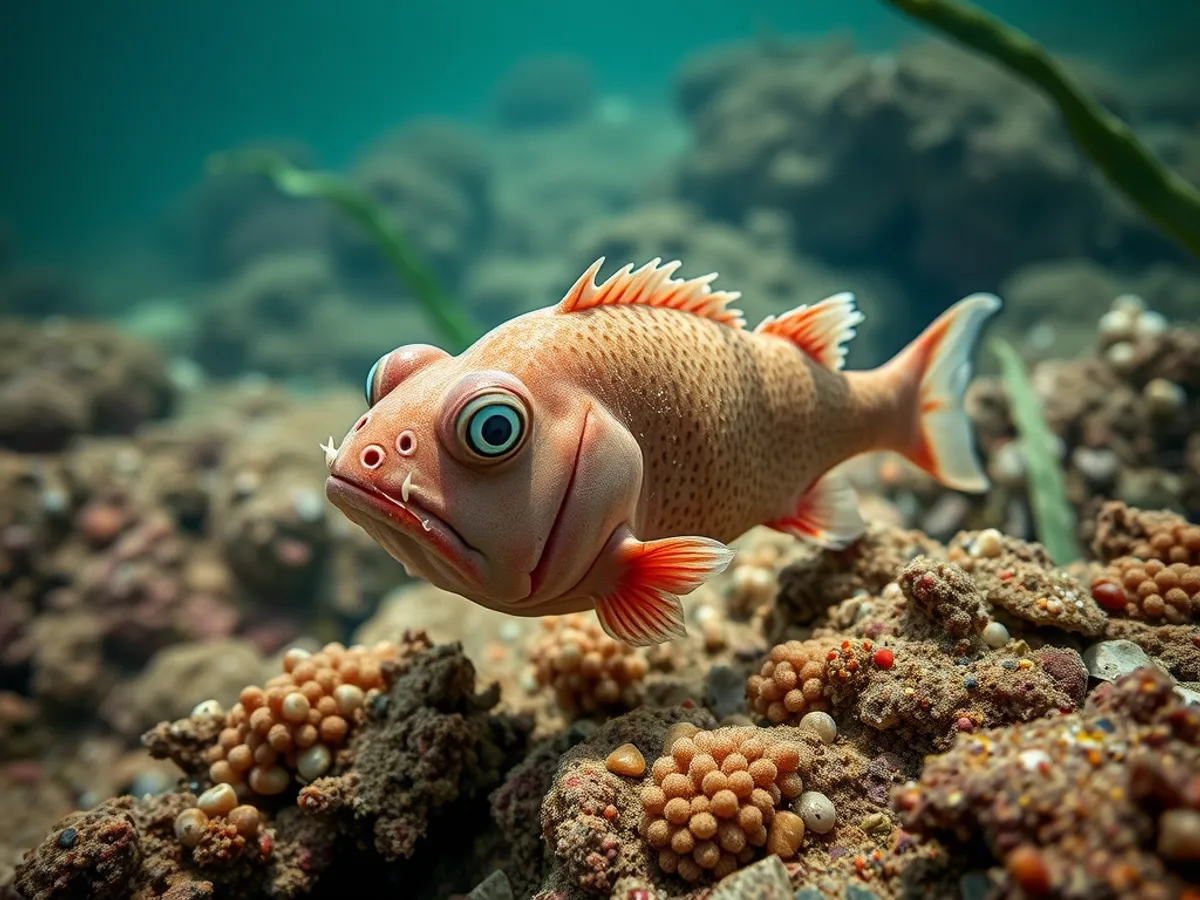
About the Lumpfish
Cyclopterus lumpus is a lumpy, warty, near-globular fish of the cold North Atlantic that is a poor swimmer by design: the pelvic fins are fused into a broad adhesive disc on its underside, which it uses to clamp onto rocks and kelp and hold station against surge that would sweep a normal fish away. Males take on a startling red belly in the breeding season, then guard the eggs - clumps of tens or hundreds of thousands laid in shallow water - for six to ten weeks, fanning them with the pectoral fins and defending them against crabs and other fish, staying with the nest even as the tide leaves them exposed. Lumpfish roe is harvested and dyed black or red as a cheap caviar substitute, and the flesh is little used, so historically the fishery was wasteful. In the last fifteen years the fish has taken on a wholly new economic role: lumpfish are now farmed in the millions and stocked into Norwegian, Scottish and Icelandic salmon cages as "cleaner fish", where they pick sea lice off the salmon, replacing chemical delousing. Their welfare in that role is now a substantial concern, since mortality in the cages is high. Females can reach 60 cm; males stay much smaller.
Fascinating facts
Suction Disc
Lumpfish have a unique suction disc formed from their pelvic fins, allowing them to cling to rocks and kelp even in rough seas.
Caviar Source
The roe of female lumpfish is harvested and processed as a less expensive alternative to sturgeon caviar.
Cleaner Fish
Lumpfish are used in salmon farms to naturally remove parasitic sea lice from farmed salmon, reducing the need for chemical treatments.
Detailed description
The lumpfish (Cyclopterus lumpus) is a robust, globular marine fish characterized by its nearly spherical body, thick skin covered in prominent tubercles (bony nodules), and a gelatinous, scaleless texture. Adults typically measure 30–50 cm in length, with females generally larger than males, and can weigh up to 5 kg. The most distinctive feature is the modified pelvic fins, which form a powerful suction disc on the ventral surface, allowing the fish to adhere tightly to rocks, kelp, or other substrates in turbulent coastal waters. Lumpfish exhibit sexual dimorphism: males are often more brightly colored, especially during breeding season, displaying hues of orange or red, while females tend to be blue-grey or greenish. Their small, upturned mouths are adapted for picking small invertebrates from surfaces. The dorsal fin is short and set far back, while the pectoral fins are large and rounded, aiding in maneuverability rather than speed. Lumpfish lack a swim bladder, which, combined with their dense bodies, limits their buoyancy and contributes to their benthic lifestyle. Their skin secretes a thick mucus layer, possibly serving as protection against parasites and abrasion. Juveniles are pelagic, drifting in open water before settling to the benthos as they mature.
Did you know?
Lumpfish are increasingly being used in aquaculture as 'cleaner fish' to control sea lice in salmon farms.
Research & sources
Wikipedia summary
The Cyclopteridae are a family of marine fishes, commonly known as lumpsuckers or lumpfish, in the order Scorpaeniformes. They are found in the cold waters of the Arctic, North Atlantic, and North Pacific oceans. The greatest number of species are found in the North Pacific. The family name Cyclopteridae derives from the Greek words κύκλος (kyklos), meaning "circle", and πτέρυξ (pteryx), meaning "wing" or "fin", in reference to the circle-shaped pectoral fins of most of the fish in this family.
Behaviour & social structure
Lumpfish are primarily solitary and exhibit sedentary behavior, spending much of their time attached to hard substrates using their suction disc. They are poor swimmers, moving in short, awkward bursts when necessary. Feeding occurs mostly at dawn and dusk (crepuscular), targeting a variety of benthic invertebrates such as crustaceans, polychaete worms, mollusks, and occasionally small fish. Lumpfish use their sensitive mouths to probe crevices and graze on sessile organisms. During the breeding season, males become territorial and aggressively guard nesting sites. Outside of spawning, social interactions are minimal, with individuals maintaining distance from conspecifics. Lumpfish are known to migrate from deeper offshore waters to shallower coastal areas to spawn, sometimes traveling hundreds of kilometers.
Reproduction & life cycle
Lumpfish are oviparous, with spawning typically occurring from late winter to early spring, depending on latitude. Females migrate to shallow, rocky coastal areas to lay large clutches of adhesive eggs (up to 200,000 per female) in crevices or among seaweed. After spawning, females return to deeper waters, leaving the males to guard the eggs. Male lumpfish exhibit intense parental care, fanning the eggs with their fins to oxygenate them and protect them from predators and fungal infection. Incubation lasts 3–8 weeks, depending on water temperature. Upon hatching, larvae are planktonic and remain pelagic for several months before settling to the benthic habitat. Sexual maturity is reached at 3–5 years, and the species is believed to have a lifespan of up to 10 years.
Adaptations & survival
Key adaptations include the ventral suction disc, which enables lumpfish to withstand strong currents and wave action in exposed coastal environments. Their thick, mucous-covered skin provides protection against abrasion and parasites. The absence of a swim bladder reduces buoyancy, facilitating a benthic lifestyle. Their cryptic coloration offers camouflage among rocks and kelp, reducing predation risk. The production of large, adhesive eggs and male parental care increase offspring survival in harsh intertidal zones. Seasonal migrations allow lumpfish to exploit different habitats for feeding and reproduction, optimizing resource use and minimizing competition.
Cultural significance
Lumpfish roe has been harvested and consumed in northern Europe for centuries, especially in Scandinavian and Baltic countries, where it is valued as an affordable alternative to sturgeon caviar. The fish itself is rarely eaten due to its gelatinous texture but is sometimes used in traditional dishes. In recent years, lumpfish have gained economic importance as cleaner fish in aquaculture, reflecting a shift in their cultural and commercial relevance. There are few mythological or symbolic associations, but the species is occasionally referenced in folklore as an oddity of the sea.
Recent research
Recent research has focused on lumpfish genetics, population structure, and their role as cleaner fish in aquaculture. Studies have investigated the efficacy and welfare of lumpfish in controlling sea lice infestations on farmed salmon, with ongoing work to improve their survivability and reduce stress in captivity. Genetic analyses have revealed significant population differentiation across the North Atlantic, informing management and conservation strategies. Research into lumpfish reproductive biology and larval development aims to enhance captive breeding programs and reduce reliance on wild-caught individuals. Environmental DNA (eDNA) techniques are being developed to monitor lumpfish distribution and abundance non-invasively.
Videos
Habitat
Cold marine coastal waters

Conservation
The Lumpfish is currently classified as Least Concern on the IUCN Red List.
Threats & challenges
Lumpfish populations are currently classified as Least Concern by the IUCN, but they face several localized threats. Overfishing for roe, which is marketed as a caviar substitute, has led to population declines in some regions. Bycatch in commercial fisheries, particularly gillnets and trawls, poses an ongoing threat. Habitat degradation from coastal development and pollution can impact spawning grounds. Climate change, particularly ocean warming and acidification, may alter distribution patterns and reproductive success. In recent years, lumpfish have been increasingly used as 'cleaner fish' in salmon aquaculture to control sea lice, raising concerns about disease transmission and escape into non-native habitats.
Taxonomy
Scientific name
Cyclopterus lumpus
- Kingdom
- Animalia
- Phylum
- Chordata
- Class
- Actinopterygii
- Order
- Scorpaeniformes
- Family
- Cyclopteridae
- Genus
- Cyclopterus
- Species
- lumpus
Community notes
Share your observations about the Lumpfish.
No community notes yet. Be the first!
Discover more wildlife
More fascinating animals from the encyclopedia.