
About the Luzon Horned Frog
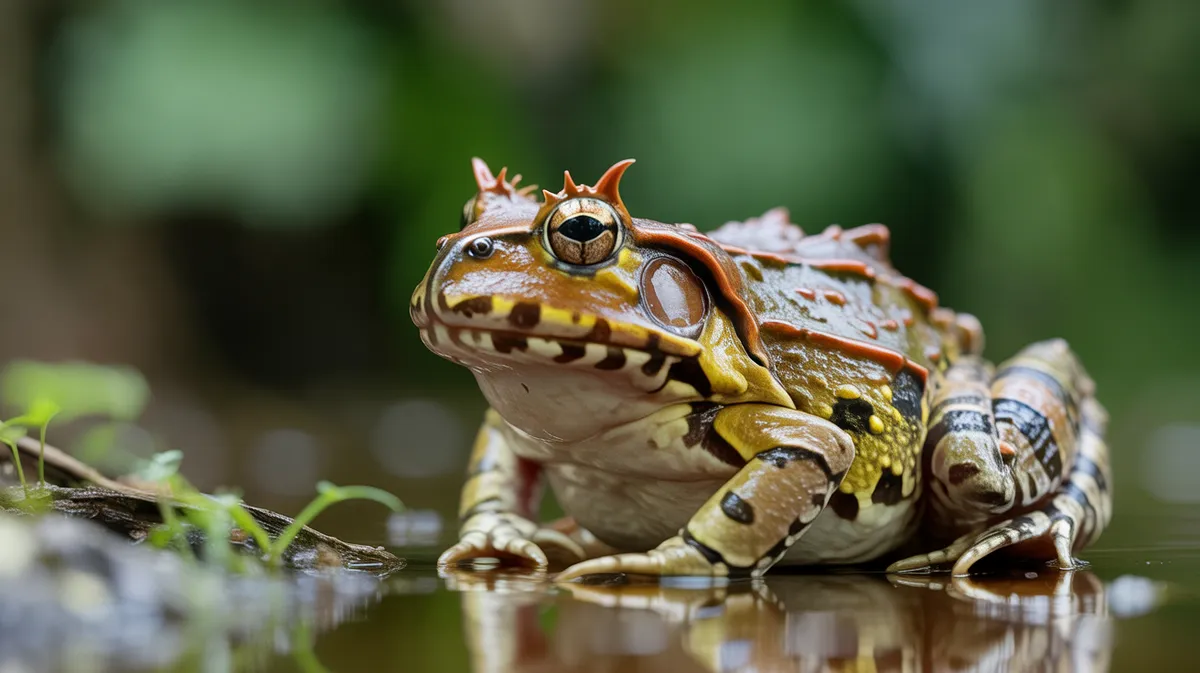
The Luzon Horned Frog is a remarkable amphibian endemic to the island of Luzon in the Philippines. It is known for its distinctive horn-like projections above its eyes, which help it blend seamlessly into the leaf litter of the forest floor. This cryptic coloration and unusual morphology provide it with excellent camouflage against predators. The species primarily inhabits montane and lowland forests and is rarely seen due to its secretive, nocturnal lifestyle. Its population is at risk due to habitat loss and degradation.
Fascinating facts
Leaf Mimicry
Its body shape, coloration, and 'horns' make it almost indistinguishable from dead leaves on the forest floor.
Nocturnal Hunter
The Luzon Horned Frog is primarily active at night, hunting insects and other small invertebrates under the cover of darkness.
Endemic Species
This species is found only on the island of Luzon in the Philippines, making it especially vulnerable to habitat changes.
Detailed description
The Luzon Horned Frog (Megophrys stejnegeri) is a medium-sized amphibian, with adults typically measuring 65–100 mm in snout-vent length, exhibiting pronounced sexual dimorphism—females are generally larger than males. Its most distinctive anatomical feature is the pair of triangular, horn-like projections above each eye, formed by elongated upper eyelid skin, which, along with its angular snout and cryptic brown coloration, mimics dead leaves on the forest floor. The dorsal surface is mottled with shades of brown, tan, and black, enhancing camouflage, while the ventral side is paler with irregular dark markings. The limbs are robust, with well-developed webbing on the toes, aiding in both terrestrial locomotion and swimming. The tympanum (external eardrum) is visible, and the eyes are large, providing excellent night vision. This species is primarily terrestrial, spending most of its life concealed in leaf litter, emerging at dusk to forage. It is a sit-and-wait predator, relying on stealth and sudden lunges to capture prey. The Luzon Horned Frog is solitary outside of the breeding season, exhibiting minimal social interaction. Reproduction occurs in forest streams, where males call to attract females, and eggs are deposited in water. The species' cryptic morphology and nocturnal habits make it elusive and difficult to observe in the wild.
Did you know?
The Luzon Horned Frog can remain motionless for hours, relying on its exceptional camouflage to avoid both predators and prey.
Research & sources
Behaviour & social structure
The Luzon Horned Frog is predominantly nocturnal, remaining inactive and hidden during the day under leaf litter or among roots and rocks. At night, it becomes active, employing a sit-and-wait predatory strategy. It feeds on a variety of invertebrates, including insects, spiders, and occasionally small vertebrates such as other frogs or lizards. The frog remains motionless for extended periods, relying on its camouflage to avoid detection by both prey and predators. When threatened, it may flatten its body and remain still, further enhancing its resemblance to a dead leaf. Social interactions are limited, with individuals maintaining solitary territories except during the breeding season. Males vocalize with low, guttural calls near streams to establish territories and attract females. Aggressive encounters between males are rare but may involve physical displays or wrestling.
Reproduction & life cycle
Breeding in Megophrys stejnegeri is closely tied to the rainy season, typically from June to September, when increased rainfall creates suitable aquatic habitats for egg deposition. Males congregate near slow-moving forest streams and produce distinctive advertisement calls to attract females. Amplexus is axillary, with the male grasping the female behind her forelimbs. Females lay clutches of 100–300 eggs in shallow water, attaching them to submerged vegetation or leaf litter. Embryonic development is rapid, with eggs hatching within 7–14 days depending on temperature and humidity. The tadpoles are benthic, feeding on detritus and organic matter, and undergo metamorphosis after 2–3 months. There is no parental care post-oviposition; both adults leave the breeding site soon after egg-laying.
Adaptations & survival
The Luzon Horned Frog exhibits several remarkable adaptations for survival in the leaf-litter environment. Its cryptic coloration and leaf-like body shape provide exceptional camouflage from both predators and prey. The 'horns' above the eyes disrupt the outline of the head, making it difficult for visual predators to detect. Its large eyes and sensitive tympanum enhance nocturnal hunting and predator detection. The robust limbs and webbed toes facilitate both terrestrial movement and swimming during breeding. Behaviorally, its sit-and-wait predation strategy conserves energy and reduces exposure to predators. Tadpoles possess specialized mouthparts for scraping detritus from submerged surfaces, an adaptation to the nutrient-poor, shaded streams of montane forests.
Cultural significance
While the Luzon Horned Frog does not hold significant prominence in Philippine folklore or traditional medicine, its unusual appearance has made it a subject of curiosity among local communities and naturalists. It is occasionally featured in environmental education programs highlighting the biodiversity of Luzon's forests. The frog's cryptic form and rarity have also made it a symbol of the hidden diversity within the Philippines' threatened montane ecosystems.
Recent research
Recent research on Megophrys stejnegeri has focused on its phylogenetic relationships within the Megophryidae family, with molecular studies revealing significant genetic divergence from related species in Southeast Asia. Ongoing field studies are investigating its microhabitat preferences, reproductive ecology, and response to environmental changes. Surveys using environmental DNA (eDNA) are being developed to better assess population distribution and abundance, given the species' elusive nature. There is also interest in studying its skin secretions for potential antimicrobial compounds, as with other amphibians. Conservation genetics projects are underway to evaluate genetic diversity and inform management strategies.
Sources
A review of the genus Megophrys (Amphibia: Megophryidae) in the Philippines, with descriptions of new species
Brown, R.M., Siler, C.D., Diesmos, A.C., & Alcala, A.C. (2010)
scientificMegophrys stejnegeri: The IUCN Red List of Threatened Species 2020
IUCN SSC Amphibian Specialist Group
conservationAmphibian Species of the World: Megophrys stejnegeri
Frost, D.R., American Museum of Natural History (2024)
scientificVideos
Habitat
Moist tropical forests
 Elevated Terrain
Mountain
High-altitude environments with varying climates and specialized wildlife adapted to rugged terrain and thin air.
 Global
Forest
Wooded areas with significant tree cover and diverse plant and animal communities.
 Global
Freshwater
Lakes, rivers, and wetlands with diverse aquatic ecosystems.
Conservation
The Luzon Horned Frog is currently classified as Near Threatened on the IUCN Red List.
Threats & challenges
The primary threat to Megophrys stejnegeri is habitat loss due to deforestation, agricultural expansion, and infrastructure development on Luzon. Logging and conversion of forests to farmland have fragmented populations and reduced available breeding sites. Pollution of streams from agricultural runoff and mining further degrades habitat quality. The species is also potentially vulnerable to chytridiomycosis, a fungal disease affecting amphibians globally, though its impact on this population is not yet fully understood. Collection for the pet trade is a minor but emerging threat. Population trends indicate a decline, particularly in lowland areas, prompting its Near Threatened status on the IUCN Red List. Conservation efforts are hampered by limited ecological data and the frog's secretive nature.
Taxonomy
Scientific name
Megophrys stejnegeri
- Kingdom
- Animalia
- Phylum
- Chordata
- Class
- Amphibia
- Order
- Anura
- Family
- Megophryidae
- Genus
- Megophrys
- Species
- stejnegeri
Community notes
Share your observations about the Luzon Horned Frog.
No community notes yet. Be the first!
Discover more wildlife
More fascinating animals from the encyclopedia.