
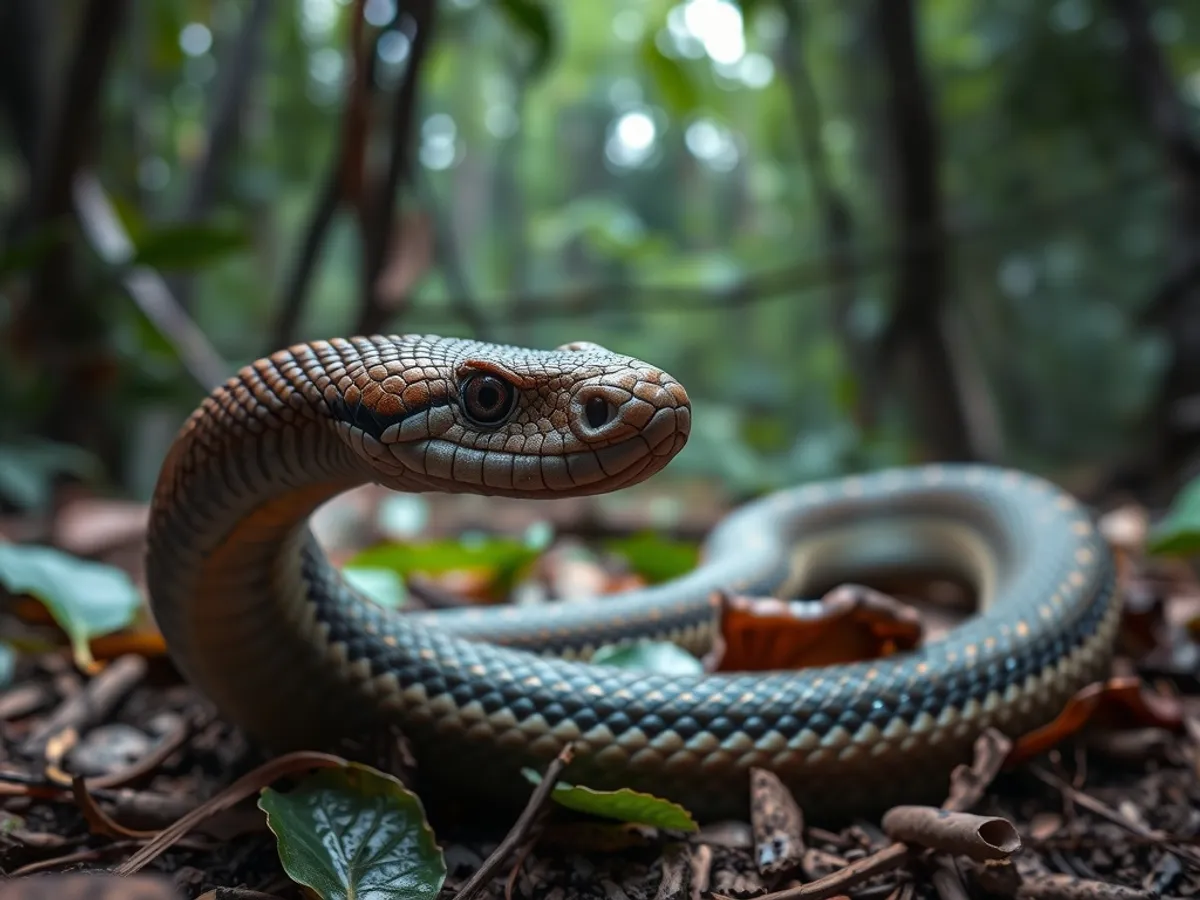
About the Madagascar Leaf-nosed Snake
The Madagascar Leaf-nosed Snake is a slender, arboreal reptile known for its distinctive elongated snout, which resembles a leaf or twig and aids in camouflage. Endemic to Madagascar, this snake exhibits pronounced sexual dimorphism, with males and females having differently shaped snouts and coloration. It inhabits forests, where it spends much of its time among branches, blending seamlessly with its surroundings. The species is mildly venomous and primarily preys on small reptiles and amphibians, using its cryptic appearance to ambush prey. Despite its unique appearance, it remains elusive and is rarely seen in the wild.
Fascinating facts
Leaf-like Snout
The Madagascar Leaf-nosed Snake's snout mimics a dead leaf or twig, providing excellent camouflage in the forest canopy.
Sexual Dimorphism
Males have a long, narrow, pointed snout, while females have a shorter, wider, and serrated snout, a rare trait among snakes.
Ambush Predator
This snake remains motionless and sways gently, blending in with foliage to ambush unsuspecting lizards and frogs.
Detailed description
The Madagascar Leaf-nosed Snake (Langaha madagascariensis) is a medium-sized, highly specialized arboreal colubrid endemic to the forests of Madagascar. Adults typically reach lengths of 80–100 cm, with a slender, laterally compressed body that enhances their ability to navigate narrow branches. The most striking feature is the pronounced rostral appendage: in males, this takes the form of a long, pointed, leaf-like projection, while females possess a shorter, broader, and more serrated snout. This sexual dimorphism extends to coloration, with males displaying a brownish to yellowish dorsal surface and females exhibiting a mottled gray or brown pattern. The species has large eyes with vertical pupils, providing excellent vision for detecting prey and predators in dappled forest light. Its scales are smooth, aiding in silent movement through foliage. The snake is mildly venomous, possessing rear fangs (opisthoglyphous dentition) used to subdue prey, though its venom is not considered dangerous to humans. Primarily diurnal, Langaha madagascariensis is an ambush predator, relying on its cryptic appearance to remain undetected by both prey and predators. Its arboreal lifestyle is supported by a prehensile tail and strong musculature, enabling it to grip branches securely. Despite its distinctive appearance, the species is elusive and rarely encountered, often remaining motionless for extended periods to avoid detection.
Did you know?
This snake is one of the few reptiles in the world with such extreme sexual dimorphism, making males and females look almost like different species.
Research & sources
Behaviour & social structure
Langaha madagascariensis is a solitary and secretive species, spending most of its life in the mid- to upper canopy of primary and secondary forests. It is primarily diurnal, becoming most active during the early morning and late afternoon when it hunts. The snake employs a sit-and-wait predation strategy, remaining motionless and using its leaf-like snout as camouflage to blend with twigs and leaves. When prey such as lizards (notably chameleons and geckos) or frogs approach, it strikes rapidly, using its rear fangs to inject mild venom. Feeding events are infrequent, and the snake can go several days between meals. Defensive behaviors include remaining motionless, swaying gently to mimic vegetation, and, if threatened, inflating the body and opening the mouth to display a dark oral cavity as a warning. Social interactions are limited to the breeding season; otherwise, individuals avoid each other. There is no evidence of territoriality, and home ranges may overlap.
Reproduction & life cycle
Reproduction in Langaha madagascariensis is oviparous, with mating typically occurring at the onset of the rainy season (November to January). Courtship involves the male approaching the female and engaging in tactile stimulation with his snout. Females lay clutches of 3–6 elongated, leathery eggs in concealed locations such as tree hollows or leaf litter. The incubation period lasts approximately 60–70 days, depending on ambient temperature and humidity. There is no evidence of parental care after egg deposition; hatchlings are fully independent upon emergence and already possess the characteristic snout shape of their sex. Sexual maturity is reached at approximately 2–3 years of age.
Adaptations & survival
The Madagascar Leaf-nosed Snake exhibits several remarkable adaptations for arboreal life and camouflage. The sexually dimorphic rostral appendage mimics leaves or twigs, providing both concealment from predators and an advantage in ambushing prey. Its slender, laterally compressed body and prehensile tail facilitate movement through dense foliage and across narrow branches. Smooth scales reduce friction and noise, enhancing stealth. The vertical pupils allow for precise depth perception and improved vision in the variable light conditions of the forest canopy. Its mildly venomous bite, delivered via rear fangs, is specialized for subduing small, agile prey. Behavioral adaptations include swaying in the breeze to mimic vegetation and remaining motionless for long periods.
Cultural significance
The Madagascar Leaf-nosed Snake is not widely featured in Malagasy folklore or traditional practices, likely due to its elusive nature and limited interactions with humans. However, its unusual appearance has made it a subject of fascination among herpetologists and ecotourists. In some local communities, snakes in general are viewed with suspicion or fear, but there are no specific myths or uses associated with this species. Its distinctive morphology has made it an emblematic species for Madagascar’s unique biodiversity in scientific and conservation literature.
Recent research
Recent research has focused on the evolutionary origins of the snake’s sexual dimorphism and the functional significance of its rostral appendage. Molecular phylogenetic studies suggest that Langaha madagascariensis is part of a distinct Malagasy colubrid lineage, with its closest relatives also exhibiting arboreal habits. Ongoing ecological studies are investigating its role in controlling populations of arboreal lizards and amphibians. There is also interest in the chemical composition of its venom and its potential effects on prey. Camera trap and radio telemetry studies are being used to better understand its movement patterns and habitat use, given its cryptic behavior and low detectability.
Sources
A Review of the Genus Langaha in Madagascar (Serpentes: Pseudoxyrhophiidae)
Glaw, F. & Vences, M. (2007)
scientificLangaha madagascariensis: The IUCN Red List of Threatened Species 2011
IUCN SSC Amphibian and Reptile Specialist Group
conservationA new species of Langaha from Madagascar, with comments on sexual dimorphism in the genus
Glaw, F. & Vences, M. (2011)
scientificLangaha madagascariensis: The IUCN Red List of Threatened Species 2011
IUCN SSC Amphibian and Reptile Specialist Group
conservationVideos
Habitat
Tropical and subtropical forests


Conservation
The Madagascar Leaf-nosed Snake is currently classified as Least Concern on the IUCN Red List.
Threats & challenges
Although currently listed as Least Concern by the IUCN, Langaha madagascariensis faces ongoing threats from habitat loss due to deforestation, slash-and-burn agriculture, and logging in Madagascar. Fragmentation of forest habitats may isolate populations and reduce genetic diversity. The species is occasionally collected for the international pet trade, though this is not considered a major threat at present. Climate change poses a potential long-term risk by altering the structure and composition of Madagascar’s forests. Despite these challenges, the species persists in several protected areas, but continued monitoring is necessary to detect any future population declines.
Taxonomy
Scientific name
Langaha madagascariensis
- Kingdom
- Animalia
- Phylum
- Chordata
- Class
- Reptilia
- Order
- Squamata
- Family
- Lamprophiidae
- Genus
- Langaha
- Species
- madagascariensis
Community notes
Share your observations about the Madagascar Leaf-nosed Snake.
No community notes yet. Be the first!
Discover more wildlife
More fascinating animals from the encyclopedia.