
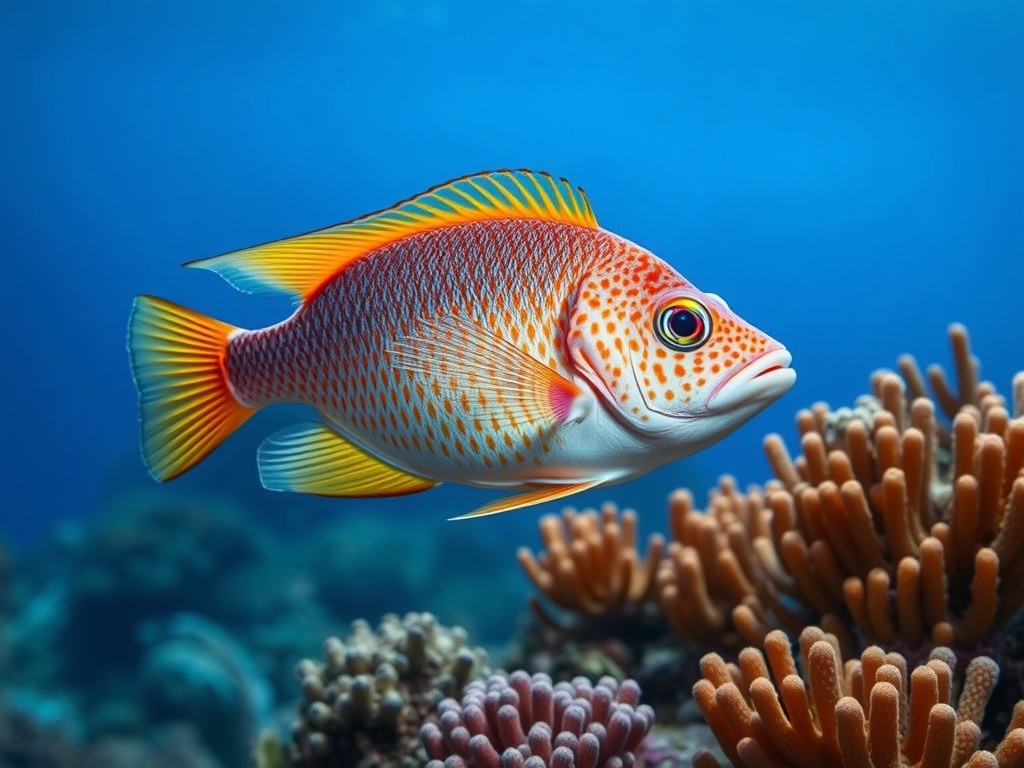
About the Mandarinfish
Synchiropus splendidus is a small dragonet of Pacific reefs whose blue is not made the way almost every other blue in nature is made. Nearly all blue animals produce the colour structurally, by scattering light; the mandarinfish is one of only two fish known - the other is the closely related psychedelic mandarin - to possess cyanophores, cells containing a genuine blue cellular pigment. So its blue is chemically blue, an extreme rarity in vertebrates. It also has no scales at all. In their place it secretes a thick, foul-smelling, bitter mucus layer packed with toxins, which serves both as a defence and as protection against parasites, and which is why the fish can be so conspicuously coloured with impunity. Mandarinfish live low in the reef among rubble, are secretive, and are slow, hovering swimmers propelled by fluttering pectoral fins. Their mating is a nightly ritual at dusk: females gather at a display site, a male raises his fins, and a chosen pair rise together off the bottom, pressed side by side, in a slow vertical ascent of a few tens of centimetres before releasing eggs and sperm at the apex and darting back down. Males may spawn with several females a night; a female typically spawns once.
Fascinating facts
Dazzling Colors
The Mandarinfish is one of the only vertebrates whose blue color is produced by cellular pigment cells called cyanophores, making its hues especially vivid.
Chemical Defense
Instead of scales, Mandarinfish secrete a bitter, toxic mucus that deters would-be predators and acts as an antimicrobial shield.
Twilight Spawning
Mandarinfish are known for their elaborate mating rituals, which take place at dusk and involve synchronized swimming and spawning above the reef.
Detailed description
The Mandarinfish (Synchiropus splendidus) is a diminutive marine fish, typically reaching 6–8 cm in length, and is renowned for its striking, psychedelic coloration—an intricate mosaic of blue, orange, green, and yellow. Unlike most fish, its vivid blue hue is produced by unique cellular pigments called cyanophores, rather than structural coloration. The body is elongated and laterally compressed, with two dorsal fins and large, fan-like pelvic fins that allow the fish to 'walk' along the substrate. Mandarinfish possess a scaleless, mucous-covered skin, which secretes a foul-smelling, bitter-tasting substance as a defense against predators. Their large, protruding eyes provide excellent vision in the dim light of their preferred habitats—sheltered lagoons and coral rubble zones at depths of 1–18 meters. Mandarinfish are crepuscular, emerging at dusk and dawn to forage for small crustaceans, polychaete worms, and other benthic invertebrates. They are generally solitary or found in loose aggregations, with males defending small territories. Reproduction involves elaborate courtship displays, culminating in a synchronized spawning ascent. This species is highly specialized for life among coral rubble, relying on cryptic behavior and chemical defenses rather than speed or aggression.
Did you know?
Mandarinfish lack traditional fish scales and instead secrete a protective mucus coating that helps ward off disease and predators.
Research & sources
Behaviour & social structure
Mandarinfish are primarily crepuscular, being most active at dawn and dusk when they emerge from hiding to feed. Their foraging behavior involves methodically searching the substrate and coral rubble for small prey, using their protrusible mouths to suck up copepods, amphipods, and other tiny invertebrates. They exhibit site fidelity, often remaining within a small home range. Socially, mandarinfish are loosely territorial; males maintain and defend small territories, especially during the breeding season, while females roam more widely. Aggressive interactions between males are typically ritualized, involving displays of fin extension and color intensification rather than physical combat. Mandarinfish are shy and secretive, spending daylight hours concealed among coral and rubble to avoid predators. They communicate visually during courtship and through chemical cues in their mucous secretions.
Reproduction & life cycle
Mandarinfish exhibit a unique and elaborate courtship ritual, usually occurring at dusk. Males display to females by intensifying their coloration and performing a series of undulating movements. Once a female selects a mate, the pair ascends together into the water column, aligning their bodies side by side. Simultaneously, they release eggs and sperm into the open water—a behavior known as pelagic spawning. A single spawning event can produce 200–300 eggs, which are buoyant and drift with the currents. There is no parental care; eggs hatch within 18–24 hours, and the planktonic larvae remain in the water column for several weeks before settling onto the reef. Spawning typically occurs daily during the breeding season, which in the wild often coincides with warmer months and lunar cycles.
Adaptations & survival
Mandarinfish possess several notable adaptations for survival. Their scaleless skin is covered in a thick mucous layer containing toxins and foul-tasting chemicals, deterring most predators. The vibrant coloration serves as aposematic (warning) signaling, advertising their unpalatability. Their small, protrusible mouths are specialized for picking tiny prey from crevices. The large pelvic fins allow for precise maneuvering and 'walking' along the substrate, aiding in cryptic movement. Their excellent vision is adapted for low-light conditions, supporting their crepuscular lifestyle. The species' reproductive strategy—broadcast spawning—maximizes genetic mixing and dispersal of offspring, increasing survival chances in a dynamic reef environment.
Cultural significance
The Mandarinfish is highly prized in the marine aquarium trade for its extraordinary beauty and peaceful demeanor, symbolizing exoticism and rarity. In some Asian cultures, its vibrant colors and graceful movements are associated with good fortune and prosperity. The species is occasionally featured in art, jewelry, and popular media as an emblem of the coral reef's biodiversity. However, there are no known traditional medicinal or culinary uses due to its small size and chemical defenses.
Recent research
Recent research has focused on the unique pigment cells (cyanophores) responsible for the Mandarinfish's blue coloration, a rare trait among vertebrates. Studies have also examined the chemical composition of their skin mucous, identifying novel toxins with potential biomedical applications. Ongoing behavioral research explores their complex courtship rituals and the role of visual and chemical cues in mate selection. Population genetics studies are underway to assess the impact of the aquarium trade and habitat fragmentation on genetic diversity. Conservation biologists are monitoring the effects of coral reef decline on Mandarinfish distribution and abundance.
Videos
Habitat
Coral reefs and lagoons

Conservation
The Mandarinfish is currently classified as Least Concern on the IUCN Red List.
Threats & challenges
While the Mandarinfish is currently listed as Least Concern by the IUCN, it faces localized threats from habitat degradation, particularly coral reef loss due to climate change, ocean acidification, and destructive fishing practices. Collection for the aquarium trade, although regulated, can also impact wild populations if not managed sustainably. The species is sensitive to water quality and habitat disturbance, making it vulnerable to pollution and coastal development. Despite these challenges, populations remain stable in many areas, but ongoing monitoring is recommended to detect potential declines.
Taxonomy
Scientific name
Synchiropus splendidus
- Kingdom
- Animalia
- Phylum
- Chordata
- Class
- Actinopterygii
- Order
- Syngnathiformes
- Family
- Callionymidae
- Genus
- Synchiropus
- Species
- splendidus
Where to see a mandarinfish
1 zoo and aquarium in 1 country are recorded as keeping this species.

Community notes
Share your observations about the Mandarinfish.
No community notes yet. Be the first!
Discover more wildlife
More fascinating animals from the encyclopedia.