
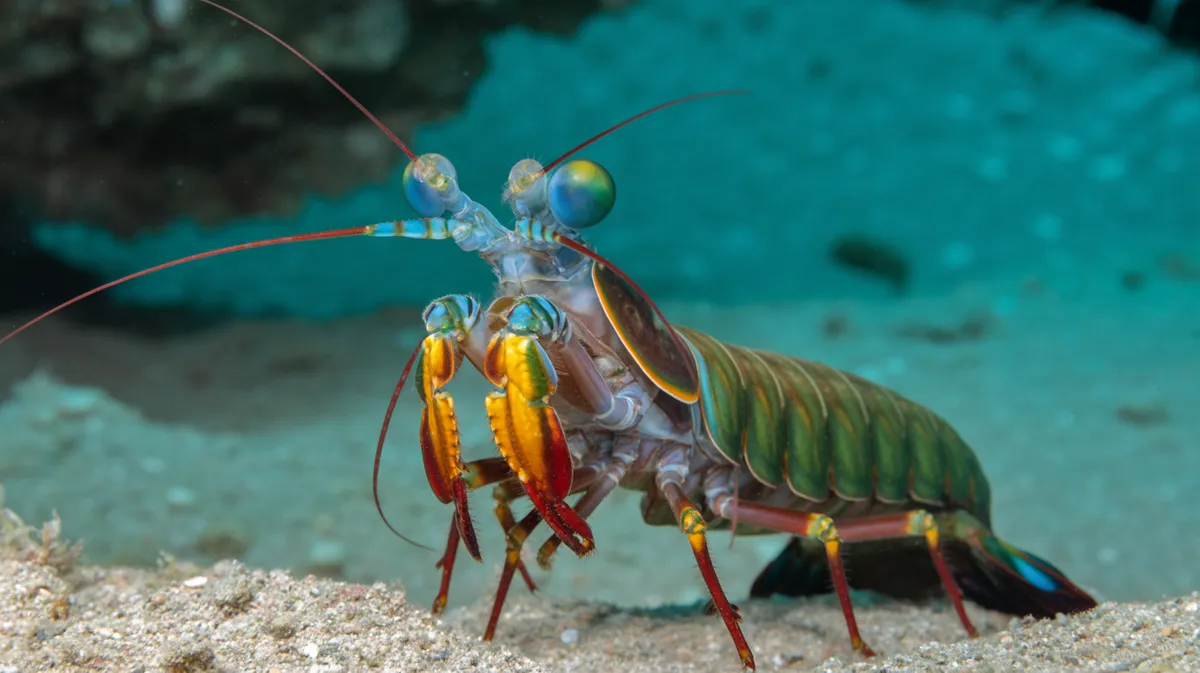
About the Mantis Shrimp
The mantis shrimp is not a shrimp, and its fame rests on a limb that behaves like a piece of engineering. "Smashers" store energy in a spring-loaded latch in the forelimb and release it to swing a club at accelerations comparable to a bullet — fast enough that the water in front of it boils from the sudden drop in pressure, collapsing into a cavitation bubble that strikes the prey a second time, with a flash of light and a burst of heat. The victim is hit twice for a single punch, and aquarium glass has been broken by it. "Spearers", the other main group, impale soft prey with bladed limbs instead. Its eyes are equally strange — mounted on stalks, moving independently, and carrying twelve to sixteen types of photoreceptor where humans have three. But the popular claim that this grants an unimaginably rich colour world turns out to be wrong: experiments show mantis shrimp actually discriminate colours worse than we do. The many receptors appear instead to let it recognise colour almost instantly, skipping the costly comparison our brains perform — speed rather than subtlety, which is precisely what an animal that fights in milliseconds needs.
Fascinating facts
Super Vision
Mantis shrimp have trinocular vision in each eye, allowing them to gauge depth accurately and perceive ultraviolet, visible, and polarized light.
Incredible Punch
The smashing appendages of some mantis shrimp species can deliver blows at speeds of up to 80 km/h (50 mph), making them one of the fastest movements in the animal kingdom.
Rainbow Colors
Many mantis shrimp species are noted for their dazzling, iridescent coloration, making them one of the most colorful marine animals.
Detailed description
Mantis shrimp (order Stomatopoda) are highly specialized marine crustaceans, ranging in size from about 2 cm to over 40 cm, with most species measuring between 10 and 20 cm in length. Their bodies are elongated and laterally compressed, featuring a robust carapace that covers only the head and first four thoracic segments. The most distinctive anatomical feature is their raptorial second pair of thoracic appendages, which are adapted either for smashing hard-shelled prey ('smashers') or for spearing soft-bodied animals ('spearers'). Mantis shrimp are renowned for their extraordinary vision: each compound eye is mounted on a stalk and can move independently, containing up to 16 types of photoreceptor cells (compared to three in humans), allowing them to detect ultraviolet, visible, and polarized light. Behaviorally, they are solitary and territorial, often constructing and defending burrows in sandy or rubble substrates of shallow tropical and subtropical reefs. Their daily activity patterns vary by species, with some being diurnal and others nocturnal. Social interactions are generally limited to aggressive encounters over territory or during mating. Reproduction involves complex courtship rituals, and in some species, monogamous pairs form long-term bonds. Mantis shrimp exhibit remarkable parental care, with females or both parents guarding eggs until hatching. Their rapid, forceful strikes can break aquarium glass and generate cavitation bubbles that momentarily reach temperatures near 4,700°C. These adaptations make them apex predators within their ecological niche.
Did you know?
A mantis shrimp’s punch accelerates as fast as a bullet, briefly causing water to boil through a process called supercavitation.
Research & sources
Wikipedia summary
Mantis shrimp are carnivorous marine crustaceans of the order Stomatopoda. Stomatopods branched off from other members of the class Malacostraca around 400 million years ago, with more than 520 extant species of mantis shrimp known. All living species are in the suborder Unipeltata, which arose around 250 million years ago. They are among the most important predators in many shallow, tropical and subtropical marine habitats. Despite being common in their habitats, they are poorly understood, as many species spend most of their lives sheltering in burrows and holes.
Behaviour & social structure
Mantis shrimp are ambush predators, relying on stealth and the element of surprise. Smashers use their club-like appendages to deliver blows at speeds up to 23 m/s, shattering mollusk shells, crab carapaces, or even aquarium glass. Spearers, on the other hand, possess sharp, barbed appendages for impaling soft-bodied prey such as fish. They use their acute vision to detect prey movement and polarization patterns, often waiting motionless at the entrance of their burrow before striking. Territorial disputes are common, with ritualized displays and, if necessary, physical combat using their raptorial limbs. Daily routines include burrow maintenance, hunting, and, in some species, cleaning their eyes with specialized grooming appendages. Communication involves visual signals, body postures, and, in some cases, substrate drumming or tapping.
Reproduction & life cycle
Mantis shrimp exhibit diverse reproductive strategies. Many species are gonochoric (separate sexes), though some display sequential hermaphroditism. Courtship often involves complex visual displays, with males presenting vibrant coloration or performing ritualized dances. Fertilization is internal, and females lay clutches of eggs, which are either carried under the female's thorax or deposited in the burrow. Incubation periods vary by species and temperature but typically last several weeks. Parental care is pronounced: females (and sometimes males) aerate and clean the eggs, protecting them from predators and fungal infection. After hatching, larvae are planktonic and undergo several molts before settling to the benthic habitat. Some species breed seasonally, while others reproduce year-round in stable tropical environments.
Adaptations & survival
Key adaptations include the highly specialized raptorial appendages, which have evolved biomechanical linkages and spring-loaded mechanisms to amplify strike speed and force. The exoskeleton of the striking limb is composed of a unique, helicoid microstructure that resists fracturing. Their eyes are among the most complex in the animal kingdom, capable of trinocular vision (depth perception with each eye), color vision extending into the ultraviolet, and the ability to detect circularly polarized light. Burrowing behavior provides protection from predators and environmental stressors. Some species exhibit rapid color changes for camouflage or signaling. Their aggressive territoriality and rapid regeneration of lost limbs further enhance survival.
Cultural significance
Mantis shrimp have a notable presence in various cultures, particularly in Asia and the Indo-Pacific, where they are sometimes harvested for food and considered a delicacy. In traditional folklore, their striking power and vibrant coloration have inspired myths and symbolic associations with strength and agility. In modern popular culture, mantis shrimp are celebrated for their unique vision and powerful strikes, often featured in documentaries and internet memes. Their visual system has inspired research in optics and materials science.
Recent research
Recent studies have focused on the biomechanics of the mantis shrimp's strike, revealing a complex system of energy storage and rapid release that has influenced the design of advanced materials and robotics. Ongoing research into their visual system has uncovered unique photoreceptor proteins and neural processing pathways, with potential applications in imaging technology. Genetic studies are beginning to unravel the evolutionary history of stomatopods, shedding light on their divergence from other malacostracan crustaceans. Ecological research is expanding our understanding of their role as keystone predators in reef ecosystems.
Sources
Videos
Habitat
Shallow tropical and subtropical ocean reefs

Conservation
The Mantis Shrimp is currently classified as Least Concern on the IUCN Red List.
Threats & challenges
Although mantis shrimp are generally classified as Least Concern, they face localized threats from habitat destruction (particularly coral reef degradation), pollution, and collection for the aquarium trade. Coastal development and destructive fishing practices can reduce available habitat. Climate change, leading to ocean acidification and warming, may affect their prey availability and reproductive success. Population trends are not well-documented for most species due to their cryptic lifestyle, but some localized declines have been reported.
Taxonomy
Scientific name
Odontodactylus scyllarus
- Kingdom
- Animalia
- Phylum
- Arthropoda
- Class
- Malacostraca
- Order
- Stomatopoda
- Family
- Odontodactylidae
- Genus
- Odontodactylus
- Species
- scyllarus
Community notes
Share your observations about the Mantis Shrimp.
No community notes yet. Be the first!
Discover more wildlife
More fascinating animals from the encyclopedia.