
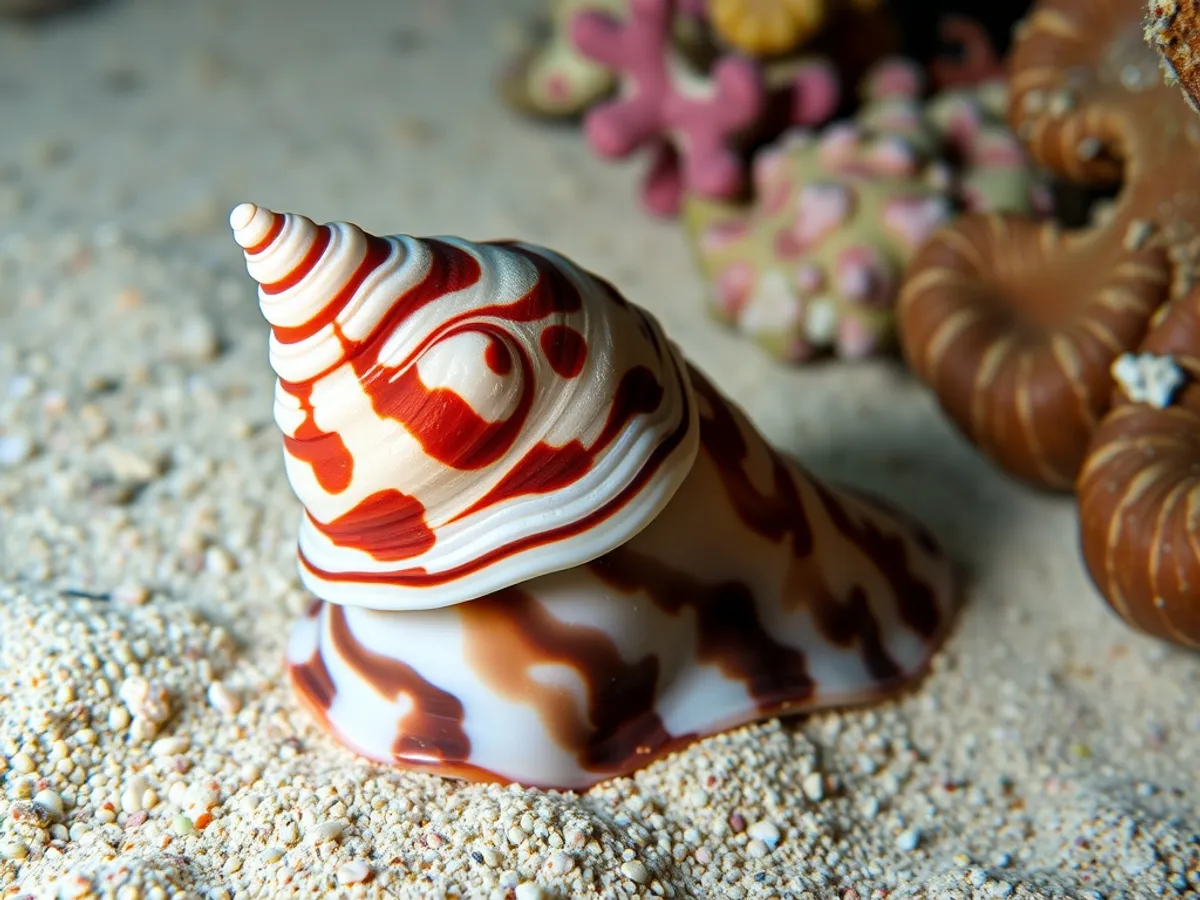
About the Marbled Cone Snail
The cone snail is a predatory sea snail that hunts fish, and it kills with a harpoon. A modified tooth, hollow and barbed, is loaded from an internal quiver, driven down the extended proboscis and fired into the prey with venom already flowing through it. What comes next is chemistry of extraordinary sophistication: cone snail venom is not one toxin but a cocktail of hundreds of small peptides called conotoxins, each targeting a different nerve or muscle channel, and some are timed to work in sequence — first a fast, seizing paralysis to stop the fish escaping, then a slower, deeper shutdown. Some species have gone further still and release insulin into the water, crashing the blood sugar of nearby fish and leaving them stupefied before the harpoon is even fired. That precision is exactly what makes the venom valuable to medicine: one conotoxin has been developed into a painkiller far more potent than morphine and non-addictive. A large cone snail can kill a human, and there is no antivenom.
Fascinating facts
Venomous Hunter
The Marbled Cone Snail uses a specialized radula tooth as a harpoon to immobilize prey with a potent neurotoxic venom.
Indo-Pacific Range
This species is distributed throughout the warm waters of the Indo-Pacific, often found in shallow coral reefs and sandy lagoons.
Danger to Humans
Although beautiful, the Marbled Cone Snail's sting has been known to cause serious or even fatal reactions in humans, making it one of the most dangerous snails.
Detailed description
The Marbled Cone Snail (Conus marmoreus) is a medium to large marine gastropod, with adult shell lengths typically ranging from 40 to 100 mm. Its shell is robust, conical, and highly polished, displaying a striking pattern of white or cream-colored spots and blotches on a dark brown or black background—an adaptation that provides camouflage among coral and rocky substrates. The snail's soft body is mostly hidden within the shell, but when active, a muscular foot extends to facilitate slow, gliding locomotion. The head bears two tentacles with eyes at their bases, providing limited vision. A distinctive feature is its highly specialized radular tooth, which functions as a venomous harpoon used to immobilize prey. The venom apparatus is connected to a large venom gland, capable of delivering a complex cocktail of neurotoxins. C. marmoreus is primarily nocturnal, emerging from crevices at night to hunt. Unlike many cone snails, this species preys predominantly on other mollusks, including smaller cone snails, but will also consume marine worms. Reproduction is sexual, with separate male and female individuals engaging in internal fertilization. Females lay egg capsules that are attached to hard substrates, from which planktonic larvae eventually emerge. The species is solitary, exhibiting little social interaction outside of mating.
Did you know?
The Marbled Cone Snail can deliver one of the fastest strikes in the animal kingdom, using its harpoon-like radula tooth to inject venom in under a second.
Research & sources
Wikipedia summary
Conus marmoreus, common name the marbled cone, is a species of predatory sea snail, a marine gastropod mollusk in the family Conidae, the cone snails, cone shells or cones. It is the type species for the genus Conus, which is the type genus of the family. This is a species which is believed to feed mostly on marine molluscs including other cone snails. This snail is venomous, like all cone snails.
Behaviour & social structure
Marbled Cone Snails are ambush predators, relying on stealth and their cryptic coloration to approach prey undetected. They use chemoreceptors on their siphon to detect chemical cues from potential prey, often lying partially buried in sand or hidden among coral rubble. When a suitable target is within range, the snail rapidly extends its proboscis, firing a barbed radular tooth loaded with venom. Prey is subdued almost instantly, then engulfed whole. Feeding events are infrequent, as digestion is slow and energy requirements are modest. C. marmoreus is generally solitary, with individuals maintaining separate hunting territories. Activity peaks at night or during low-light periods, reducing predation risk from fish and other predators. There is no evidence of cooperative behavior or social hierarchies.
Reproduction & life cycle
Conus marmoreus exhibits separate sexes (gonochorism), with internal fertilization. Courtship is minimal, typically involving tactile contact between individuals. After mating, females deposit clusters of egg capsules onto hard substrates such as rocks or coral. Each capsule contains dozens to hundreds of eggs, depending on the female's size and condition. Embryonic development occurs within the capsule for 10–20 days, after which free-swimming planktonic larvae (veligers) are released into the water column. These larvae drift with currents for several weeks, feeding on plankton before settling to the substrate and metamorphosing into juvenile snails. There is no parental care after egg-laying. Breeding is thought to occur year-round in tropical regions, with potential seasonal peaks linked to water temperature and food availability.
Adaptations & survival
The Marbled Cone Snail's most notable adaptation is its sophisticated venom delivery system, which includes a replaceable, hollow radular tooth and a large venom gland. The venom contains a diverse array of conotoxins—small, highly specific peptides that target neural receptors, causing rapid paralysis in prey. This adaptation allows the snail to subdue agile or well-defended prey with minimal risk. The cryptic shell pattern provides camouflage, reducing predation risk. The muscular foot enables the snail to anchor itself in strong currents or burrow into sand for protection. The planktonic larval stage facilitates wide dispersal, enhancing gene flow and colonization of new habitats. Slow metabolism and infrequent feeding are further adaptations to the often unpredictable availability of prey.
Cultural significance
The Marbled Cone Snail's beautiful shell has made it a sought-after item in shell collections and jewelry, especially in Southeast Asia and the Pacific. In some cultures, cone shells have been used as currency, ornaments, or ceremonial objects. The species is also significant in biomedical research: its venom contains conotoxins that have inspired the development of novel painkillers and neurological drugs. However, the snail's venomous reputation has also led to cautionary tales and local folklore warning against handling live specimens.
Recent research
Recent research on Conus marmoreus has focused on the molecular diversity of its venom peptides, with several novel conotoxins identified that show promise for pharmaceutical applications, particularly as analgesics and neuroprotective agents. Genomic studies have begun to elucidate the evolutionary mechanisms underlying conotoxin diversity and prey specialization. Ecological studies have examined the snail's role in reef food webs and its interactions with other mollusks. Ongoing research is also investigating the impacts of environmental change on larval dispersal and population genetics. The species continues to serve as a model organism for studying venom evolution and marine chemical ecology.
Videos
Habitat
Coral reefs and sandy seafloors

Conservation
The Marbled Cone Snail is currently classified as Least Concern on the IUCN Red List.
Threats & challenges
Currently assessed as Least Concern by the IUCN, Conus marmoreus faces relatively few direct threats. However, localized population declines have been reported due to habitat degradation, particularly from coral reef destruction, pollution, and coastal development. Overcollection for the shell trade poses a minor risk in some areas, as the species' attractive shell is highly prized by collectors. Climate change, ocean acidification, and rising sea temperatures may threaten long-term survival by impacting coral reef health and larval development. There are no major targeted conservation actions, but the species benefits from the protection of marine reserves and sustainable harvesting regulations in some regions.
Taxonomy
Scientific name
Conus marmoreus
- Kingdom
- Animalia
- Phylum
- Mollusca
- Class
- Gastropoda
- Order
- Neogastropoda
- Family
- Conidae
- Genus
- Conus
- Species
- marmoreus
Community notes
Share your observations about the Marbled Cone Snail.
No community notes yet. Be the first!
Discover more wildlife
More fascinating animals from the encyclopedia.