
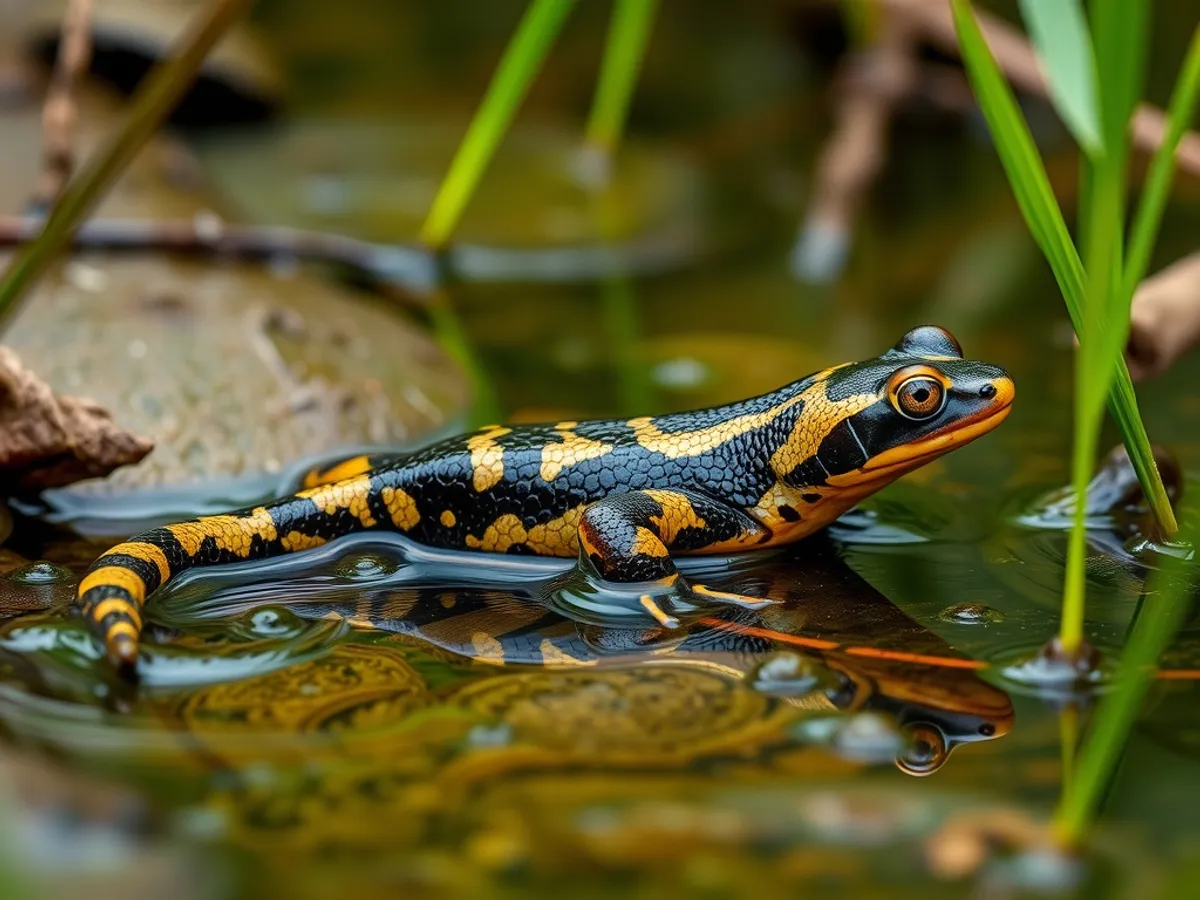
About the Marbled Newt
The Marbled Newt is a striking amphibian native to western Europe, recognized for its vibrant green coloration marked with irregular black marbling along its back and sides. Males develop an impressive, wavy crest during the breeding season, which is used to attract females. Preferring humid, vegetated environments, this species is highly dependent on clean, still or slow-moving freshwater for breeding. Outside of the breeding period, Marbled Newts are primarily terrestrial, sheltering under logs, stones, or leaf litter.
Fascinating facts
Striking Pattern
The Marbled Newt's green and black marbled coloration helps it blend into mossy, leafy environments, providing effective camouflage from predators.
Aquatic Breeder
Marbled Newts return to ponds and other still waters each spring to breed, where males display their crests and perform elaborate courtship dances.
Tail Regeneration
Like many amphibians, Marbled Newts can regenerate lost tails and even parts of their limbs if injured by predators.
Detailed description
The Marbled Newt (Triturus marmoratus) is a medium-sized salamandrid amphibian, typically reaching 13–17 cm in total length, with females generally larger than males. Its most distinctive feature is the vivid green background coloration interspersed with irregular black marbling, providing excellent camouflage among moss and leaf litter. During the breeding season, males develop a tall, undulating dorsal crest that runs from the head to the tip of the tail, interrupted only at the base of the tail, and often edged in orange. The ventral surface is pale, usually yellowish or whitish, with scattered dark spots. The skin is granular, especially on the flanks, and the tail is laterally compressed to aid in swimming. Marbled Newts are primarily nocturnal, emerging at dusk to forage or migrate. Outside the breeding season, they are terrestrial, seeking shelter under logs, stones, or dense vegetation in humid environments. Their limbs are robust, adapted for both terrestrial locomotion and aquatic movement. The species exhibits marked sexual dimorphism during the breeding period, with males displaying brighter colors and the prominent crest, while females remain more cryptic. The Marbled Newt is a relatively long-lived amphibian, with individuals in the wild known to survive up to 12–15 years.
Did you know?
Marbled Newt larvae have external gills and look very different from adults until they metamorphose after several months.
Research & sources
Wikipedia summary
The marbled newt is a mainly terrestrial newt native to western Europe. They are found in the Iberian Peninsula and France, where they typically inhabit mountainous areas.
Behaviour & social structure
Marbled Newts are solitary for most of the year, except during the breeding season when they congregate in aquatic habitats. Their activity is predominantly crepuscular and nocturnal, reducing predation risk and desiccation. Terrestrial individuals are secretive, spending daylight hours hidden under debris or in burrows. They are opportunistic carnivores, preying on a variety of invertebrates such as earthworms, insects, spiders, and mollusks. In the aquatic phase, they may also consume aquatic larvae and eggs, including those of other amphibians. Hunting is primarily by ambush, using rapid tongue projection to capture prey. Territoriality is observed among males during the breeding season, with ritualized displays and occasional physical confrontations. Outside of breeding, social interactions are minimal.
Reproduction & life cycle
Breeding occurs from late winter to early spring (typically February to May), triggered by increasing rainfall and temperature. Males arrive at breeding ponds first and establish territories, performing elaborate courtship displays involving tail-fanning and crest undulations to attract females. Fertilization is internal; the male deposits a spermatophore, which the female picks up with her cloaca. Females lay 200–400 eggs individually, attaching each to submerged vegetation. Embryonic development lasts 2–4 weeks depending on temperature. Larvae are aquatic, with external gills and a diet of small aquatic invertebrates. Metamorphosis occurs after 2–4 months, after which juveniles leave the water. There is no parental care post-oviposition. Sexual maturity is reached at 3–4 years.
Adaptations & survival
Triturus marmoratus exhibits several adaptations for its dual aquatic-terrestrial lifestyle. Its granular skin reduces water loss, and behavioral adaptations such as nocturnality and shelter-seeking further minimize desiccation. The striking marbled coloration provides camouflage in both aquatic and terrestrial habitats. The male’s breeding crest enhances visual signaling during courtship and may play a role in sexual selection. The laterally compressed tail improves swimming efficiency. The ability to aestivate during dry periods allows survival in fluctuating Mediterranean climates. Additionally, the species can regenerate lost limbs and tail tissue, an adaptation common among urodeles.
Cultural significance
While not a major figure in European folklore, the Marbled Newt has local significance as an indicator species for healthy aquatic and terrestrial ecosystems. It occasionally appears in regional conservation campaigns and environmental education programs. In some rural Iberian traditions, newts in general were considered omens of rain or fertility, but there is little evidence of direct use or symbolism specific to Triturus marmoratus.
Recent research
Recent research has focused on the genetic structure and hybrid zones between Triturus marmoratus and its close relative, the Northern Crested Newt (Triturus cristatus), particularly in western France where their ranges overlap. Studies using molecular markers have revealed limited gene flow and strong reproductive isolation. Ongoing ecological research investigates the effects of pond connectivity and landscape fragmentation on metapopulation dynamics. Conservation genetics is also a growing field, aiming to identify genetically distinct populations for targeted protection. The species is used as a model organism for studies on amphibian limb regeneration and the impacts of endocrine-disrupting chemicals in freshwater ecosystems.
Videos
Habitat
Forests and freshwater ponds in Western Europe


Conservation
The Marbled Newt is currently classified as Near Threatened on the IUCN Red List.
Threats & challenges
Major threats include habitat destruction and fragmentation, particularly the loss of breeding ponds due to agricultural intensification, urbanization, and forestry. Pollution from pesticides and fertilizers degrades water quality, impacting larval development. Introduction of predatory fish and invasive crayfish species poses significant risks to eggs and larvae. Climate change, leading to altered precipitation patterns and increased drought frequency, further threatens suitable breeding sites. Road mortality during seasonal migrations and disease (notably chytridiomycosis) are additional concerns. Populations are declining in many areas, leading to the species’ current IUCN status as Vulnerable.
Taxonomy
Scientific name
Triturus marmoratus
- Kingdom
- Animalia
- Phylum
- Chordata
- Class
- Amphibia
- Order
- Urodela
- Family
- Salamandridae
- Genus
- Triturus
- Species
- marmoratus
Community notes
Share your observations about the Marbled Newt.
No community notes yet. Be the first!
Discover more wildlife
More fascinating animals from the encyclopedia.