
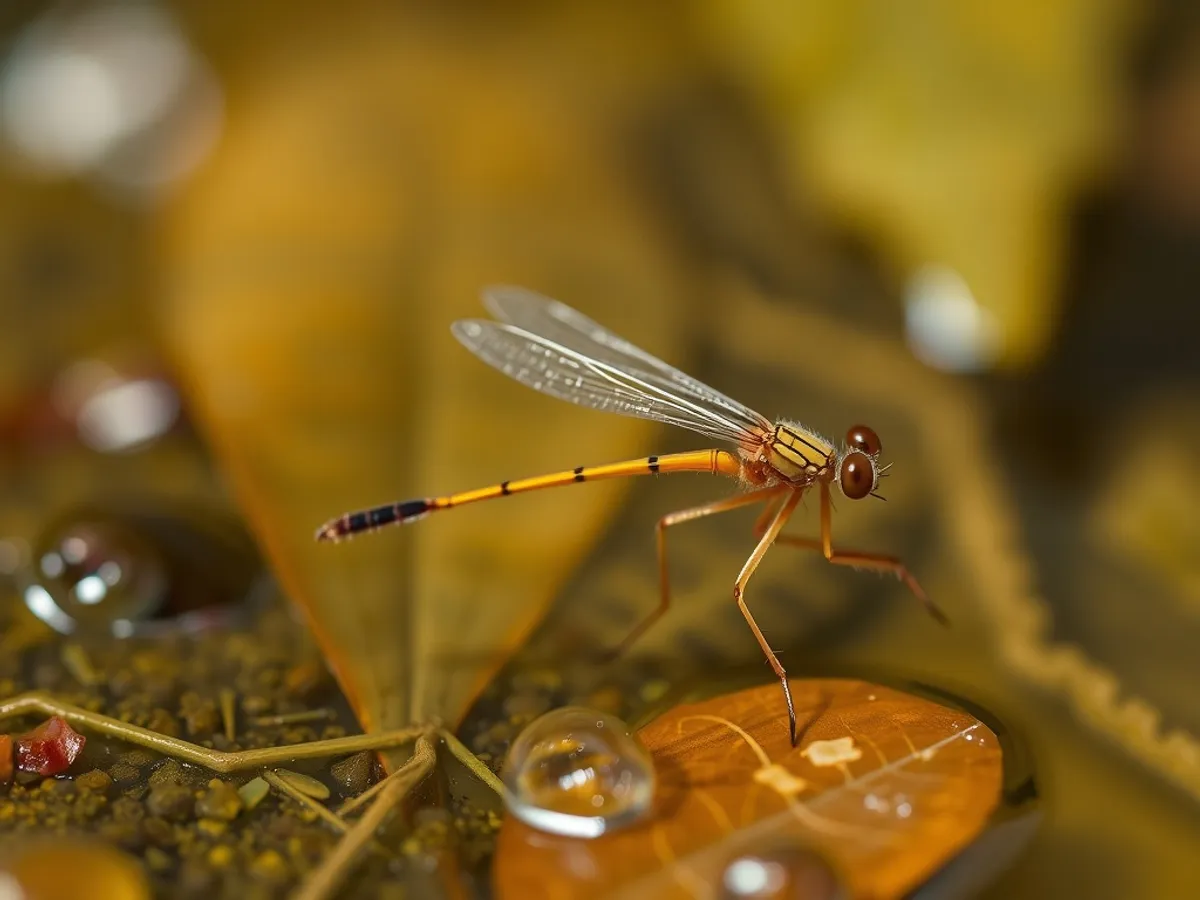
About the Mayfly
Mayflies (order Ephemeroptera) are the oldest winged insects still alive, a lineage stretching back over 300 million years, and they retain an anatomical feature no other living insect has: they moult after their wings are fully formed. The winged sub-adult, called a subimago or "dun" by anglers, emerges from the water, flies to a perch, and then sheds its skin one more time - wings, legs, and all - to become the sexually mature adult, the spinner. Nothing else in the insect world does this. The adult stage is famously brief: adults have vestigial, non-functional mouthparts and a shrunken gut filled with air, so they cannot eat at all, and many species live a single day, some only minutes. That brevity is misleading, though, because the aquatic nymph stage lasts months to two years - the mayfly's real life is spent under water, and the winged phase is purely a reproductive burst. Because nymphs need clean, oxygenated water, mayfly diversity is a standard index of stream health, and their disappearance is one of the first signs of pollution. Mass emergences can be enormous: on the Tisza river in Hungary, the "Tisza blooming" of Palingenia longicauda draws crowds, and swarms over the Mississippi have been dense enough to register on weather radar.
Fascinating facts
Ephemeral Adults
Adult mayflies live only long enough to mate and reproduce, sometimes surviving for just a few hours.
Aquatic Nymphs
Mayfly larvae, called nymphs or naiads, spend 1-3 years underwater before emerging as adults.
Unique Life Cycle
Mayflies are the only insects that molt once after developing functional wings, transitioning from subimago to imago.
Detailed description
Ephemera danica, commonly known as the green drake mayfly, is one of the largest and most conspicuous European mayflies, with adults typically measuring 15–25 mm in body length and wingspans reaching up to 40 mm. The species is characterized by its delicate, elongated body, two or three long, filamentous cerci (tails), and large, triangular, translucent wings with intricate venation—the forewings being much larger than the hindwings. The nymphs, or naiads, are robust and dorsoventrally flattened, adapted for life in the benthic substrates of clean, well-oxygenated streams and rivers. Mayfly nymphs possess gills along the sides of their abdomen, facilitating aquatic respiration. Adults are ephemeral, living only a few hours to a few days, during which they do not feed, relying entirely on energy reserves accumulated during the nymphal stage. Their compound eyes are highly developed, especially in males, aiding in mate location during aerial swarming. The life cycle includes a unique subimago stage—a winged, sexually immature form that molts once more to become a fully mature imago. Mayflies are vital components of freshwater food webs, serving as prey for fish, amphibians, and birds, and their presence is a strong indicator of high water quality.
Did you know?
Some mayfly species' entire adult lives last less than 24 hours, making them some of the shortest-lived animals on Earth.
Research & sources
Wikipedia summary
Mayflies are aquatic insects belonging to the order Ephemeroptera. This order is part of an ancient group of insects termed the Palaeoptera, which also contains dragonflies and damselflies. Over 3,000 species of mayfly are known worldwide, grouped into over 400 genera in 42 families.
Behaviour & social structure
Ephemera danica exhibits a complex life cycle with distinct behavioral phases. Nymphs are primarily detritivores and herbivores, feeding on organic debris, algae, and plant material on the riverbed. They are mostly sedentary but can burrow into soft substrates for protection and feeding. Emergence typically occurs en masse during late spring and early summer, often synchronized to maximize reproductive success and overwhelm predators. Adult mayflies engage in characteristic mating swarms, with males performing vertical flight displays to attract females. After mating, females fly low over the water surface to deposit eggs, often dipping their abdomen repeatedly. Adults are non-feeding and exhibit minimal social interaction beyond mating, with their brief terrestrial phase focused solely on reproduction. Daily activity peaks during warm, calm evenings when emergence and mating flights are most likely.
Reproduction & life cycle
Reproduction in Ephemera danica is highly synchronized and seasonal, with emergence and mating typically taking place from May to July, depending on latitude and local climate. Males form dense swarms above water, where they intercept and mate with females in flight. Copulation is brief, lasting only a few seconds. Females lay between 4,000 and 8,000 eggs, which are released onto the water surface and sink to the substrate. There is no parental care; eggs develop independently, hatching after several weeks. The nymphal stage can last one to three years, depending on environmental conditions, with multiple molts (up to 20–30 instars) before reaching maturity. The unique subimago stage, lasting a few hours to a day, allows the insect to leave the water and complete its final molt to the sexually mature imago.
Adaptations & survival
Ephemera danica displays several adaptations for aquatic and aerial life. Nymphs possess lateral abdominal gills for efficient underwater respiration and flattened bodies for burrowing and resisting current. Their cryptic coloration provides camouflage against predators. The adult's lightweight, membranous wings and elongated tails enhance aerodynamic stability during flight. The subimago stage is a rare evolutionary adaptation among insects, providing a transitional phase that reduces predation risk during emergence. Males have hypertrophied eyes and elongated forelegs to better locate and grasp females during aerial mating. The synchronized mass emergence is an adaptive strategy to reduce individual predation risk (predator satiation).
Cultural significance
Mayflies, including Ephemera danica, have long held symbolic significance in human culture, representing ephemerality and the brevity of life due to their short adult lifespan. In European folklore, they are sometimes called 'dayflies' or 'one-day insects.' The species is highly valued by fly fishermen, who imitate its adult and nymphal forms in artificial fly patterns, especially during the 'mayfly hatch,' a major event in angling calendars. Mayflies also appear in art and literature as metaphors for transience and renewal.
Recent research
Recent research on Ephemera danica has focused on its role as a bioindicator for freshwater ecosystem health, examining its sensitivity to pollutants and habitat changes. Molecular studies have explored genetic diversity and population structure across Europe, revealing cryptic speciation and adaptation to local conditions. Advances in understanding the physiology of the subimago stage have provided insights into insect metamorphosis and evolutionary development. Ongoing studies are assessing the impacts of climate change on emergence phenology and population dynamics.
Videos
Habitat
Freshwater streams and rivers

Conservation
The Mayfly is currently classified as Least Concern on the IUCN Red List.
Threats & challenges
The primary threats to Ephemera danica are habitat degradation, water pollution (especially from agricultural runoff and pesticides), siltation, and river regulation (damming, channelization). Their sensitivity to dissolved oxygen and pollution makes them vulnerable to declines in water quality. Climate change may alter emergence timing and disrupt synchrony, potentially affecting reproductive success. While currently listed as Least Concern, local populations may be at risk where freshwater habitats are compromised. Conservation efforts focus on maintaining clean, well-oxygenated rivers and monitoring water quality.
Taxonomy
Scientific name
Ephemera danica
- Kingdom
- Animalia
- Phylum
- Arthropoda
- Class
- Insecta
- Order
- Ephemeroptera
- Family
- Ephemeridae
- Genus
- Ephemera
- Species
- danica
Community notes
Share your observations about the Mayfly.
No community notes yet. Be the first!
Discover more wildlife
More fascinating animals from the encyclopedia.