
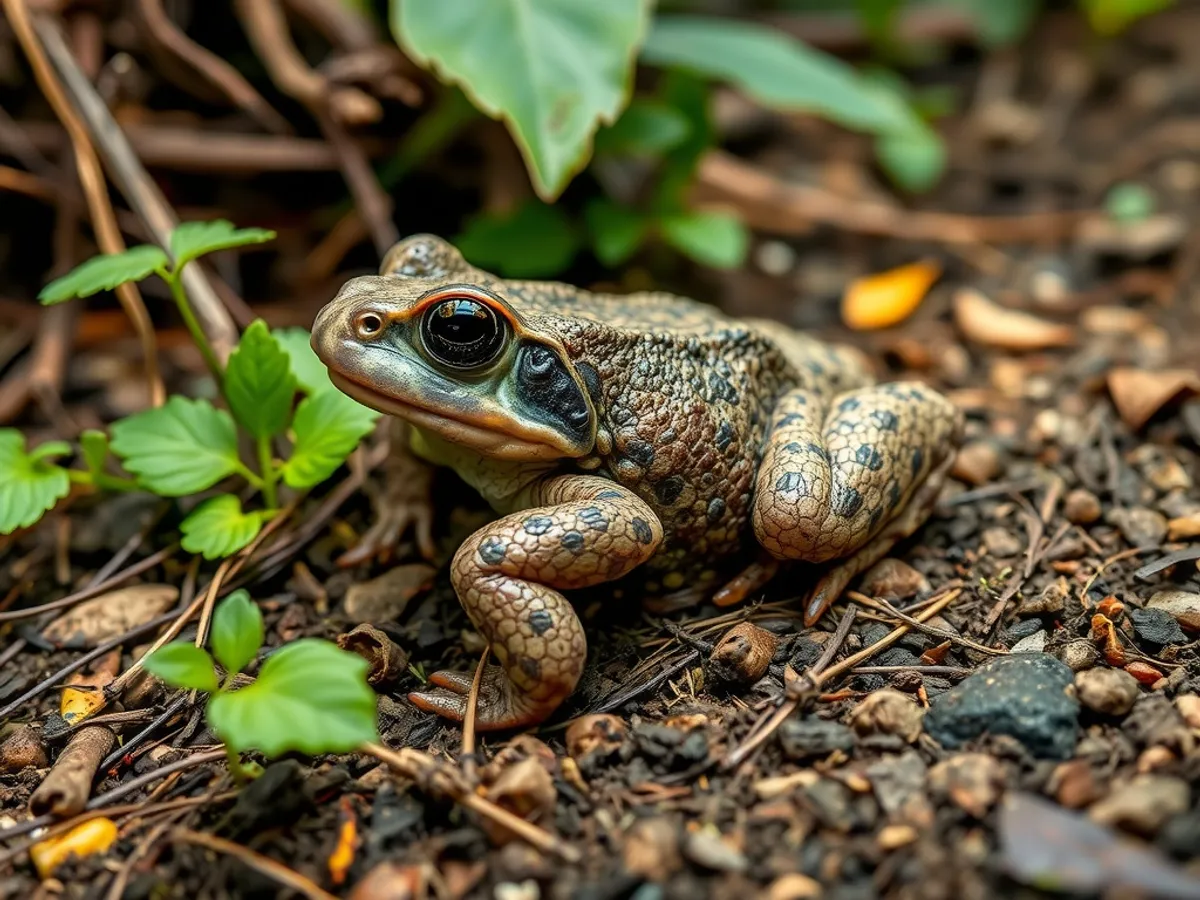
About the Mexican Burrowing Toad
The Mexican Burrowing Toad is a unique amphibian known for its rounded, almost balloon-like body and small, pointed snout. Adapted for a subterranean lifestyle, it spends most of its life underground, emerging primarily during heavy rains to breed in temporary pools. Its distinctive red and yellow markings and smooth, grayish skin make it easily recognizable. This species is the only living member of its family, making it an important evolutionary relic.
Fascinating facts
Expert Burrower
The Mexican Burrowing Toad spends most of its life underground, using its strong, shovel-like limbs to dig through loose soil in search of food and shelter.
Loud Calls
During the breeding season, males produce loud, low-pitched calls that resemble the sound of a distant foghorn to attract females.
Ant and Termite Specialist
Its diet consists almost entirely of ants and termites, which it catches with a highly specialized, sticky tongue.
Detailed description
The Mexican burrowing toad (Rhinophrynus dorsalis) is a robust, fossorial amphibian reaching 77–89 mm in snout–vent length, with females generally larger than males. Its body is nearly globular, with a width almost equal to its length, and it possesses a small, pointed snout adapted for burrowing. The skin is smooth and dark brown to black, adorned with a distinctive red or orange dorsal stripe and irregular yellow or orange spots along the flanks and limbs. The limbs are short and muscular, with the forelimbs lacking webbing and featuring keratinized tubercles that aid in digging. The hind feet are also modified for excavation, with spade-like inner metatarsal tubercles. The eyes are small and positioned dorsally, minimizing exposure during burrowing. Its tongue is highly specialized, projecting directly forward (rather than flipping out) to capture prey in confined underground spaces. The species is almost entirely subterranean, emerging only during heavy rains to breed. Its vocalizations are loud, low-pitched, and can be heard from considerable distances during breeding aggregations. As the sole extant member of the family Rhinophrynidae, it represents a unique evolutionary lineage dating back to the Cretaceous.
Did you know?
This toad only comes above ground for a few days each year, timing its emergence with heavy rains to breed in ephemeral pools.
Research & sources
Wikipedia summary
The Mexican burrowing toad is the single living representative of the family Rhinophrynidae. It is a unique species in its taxonomy and morphology, with special adaptations to assist them in digging burrows where they spend most of their time. These adaptations include a small pointed snout and face, keratinized structures and a lack of webbing on front limbs, and specialized tongue morphology to assist in feeding on ants and termites underground. The body is nearly equal in width and length. It is a dark brown to black color with a red-orange stripe on its back along with splotches of color on its body. The generic name Rhinophrynus means 'nose-toad', from rhino- (ῥῑνο-), the combining form of the Ancient Greek rhis and phrunē.
Behaviour & social structure
Mexican burrowing toads are primarily solitary and spend the majority of their lives underground, typically at depths of 30–60 cm, where they remain inactive during dry periods (aestivation). They are nocturnal when active, emerging en masse only after heavy rains to breed in temporary pools. Feeding occurs mostly underground, where they use their specialized tongue to capture ants and termites, their principal diet. Above ground, they move awkwardly due to their body shape but are capable of rapid, short bursts when threatened. Social interactions are largely limited to the breeding season, when males congregate in shallow water and produce a distinctive, low-frequency call to attract females. Outside of breeding, individuals are rarely encountered, and there is little evidence of territoriality or complex social structure.
Reproduction & life cycle
Breeding is highly explosive and synchronized with the onset of heavy seasonal rains, typically from May to September, depending on locality. Males arrive at temporary pools first and call to attract females. Amplexus is axillary, and females lay large clutches, often exceeding 2,000 eggs, directly into the water. Eggs hatch rapidly, usually within 24–48 hours, and the tadpoles develop quickly, completing metamorphosis in as little as 2–3 weeks to exploit the ephemeral nature of their aquatic habitat. There is no parental care post-oviposition. Tadpoles are filter feeders, forming dense schools in shallow water, and are morphologically distinct from those of other anurans, with specialized mouthparts for feeding on suspended organic matter.
Adaptations & survival
Rhinophrynus dorsalis exhibits several unique adaptations for a fossorial lifestyle. Its compact, rounded body and small, pointed snout facilitate movement through loose soil. The forelimbs are strong, with keratinized tubercles acting as digging tools, while the hind limbs are equipped with spade-like structures for backward burrowing. The absence of webbing on the forelimbs reduces resistance during digging. The tongue's direct projection mechanism is an evolutionary specialization for capturing prey in confined spaces underground. The skin is thick and resistant to desiccation, aiding survival during prolonged periods underground. Its explosive breeding strategy and rapid larval development are adaptations to unpredictable, short-lived aquatic habitats.
Cultural significance
While not a prominent figure in widespread folklore, the Mexican burrowing toad has been noted in some indigenous Mesoamerican cultures, where its emergence after rains was associated with fertility and agricultural abundance. Its unusual appearance and loud calls have made it a subject of curiosity and occasional superstition. In modern times, it is sometimes featured in educational programs highlighting evolutionary uniqueness and amphibian diversity.
Recent research
Recent molecular studies have confirmed the deep evolutionary divergence of Rhinophrynus dorsalis from other anurans, supporting its placement in a monotypic family. Fossil relatives dating to the Cretaceous have been described, providing insights into the ancient lineage of Rhinophrynidae. Ongoing research focuses on its reproductive ecology, larval development, and physiological adaptations to subterranean life. Studies on its tongue biomechanics have contributed to understanding anuran feeding evolution. Conservation research is monitoring the effects of habitat alteration and climate change on breeding success and population viability.
Videos
Habitat
Tropical and subtropical lowland forests, grasslands, and temporary wetlands
 Various Continental Regions
Grassland
Open areas dominated by grasses rather than trees, supporting numerous herbivores and their predators.
 Global
Forest
Wooded areas with significant tree cover and diverse plant and animal communities.
 Global
Freshwater
Lakes, rivers, and wetlands with diverse aquatic ecosystems.
Conservation
The Mexican Burrowing Toad is currently classified as Least Concern on the IUCN Red List.
Threats & challenges
Currently classified as Least Concern by the IUCN, the Mexican burrowing toad has a wide distribution from southern Texas through Mexico and into Central America as far south as Costa Rica. However, local populations may be threatened by habitat loss due to agriculture, urbanization, and drainage of temporary wetlands. Pesticide use and water pollution can impact breeding sites and larval survival. Climate change, with altered rainfall patterns, poses a potential future threat by disrupting breeding cycles. Despite these pressures, the species remains relatively adaptable due to its subterranean habits and broad ecological tolerance.
Taxonomy
Scientific name
Rhinophrynus dorsalis
- Kingdom
- Animalia
- Phylum
- Chordata
- Class
- Amphibia
- Order
- Anura
- Family
- Rhinophrynidae
- Genus
- Rhinophrynus
- Species
- dorsalis
Community notes
Share your observations about the Mexican Burrowing Toad.
No community notes yet. Be the first!
Discover more wildlife
More fascinating animals from the encyclopedia.