
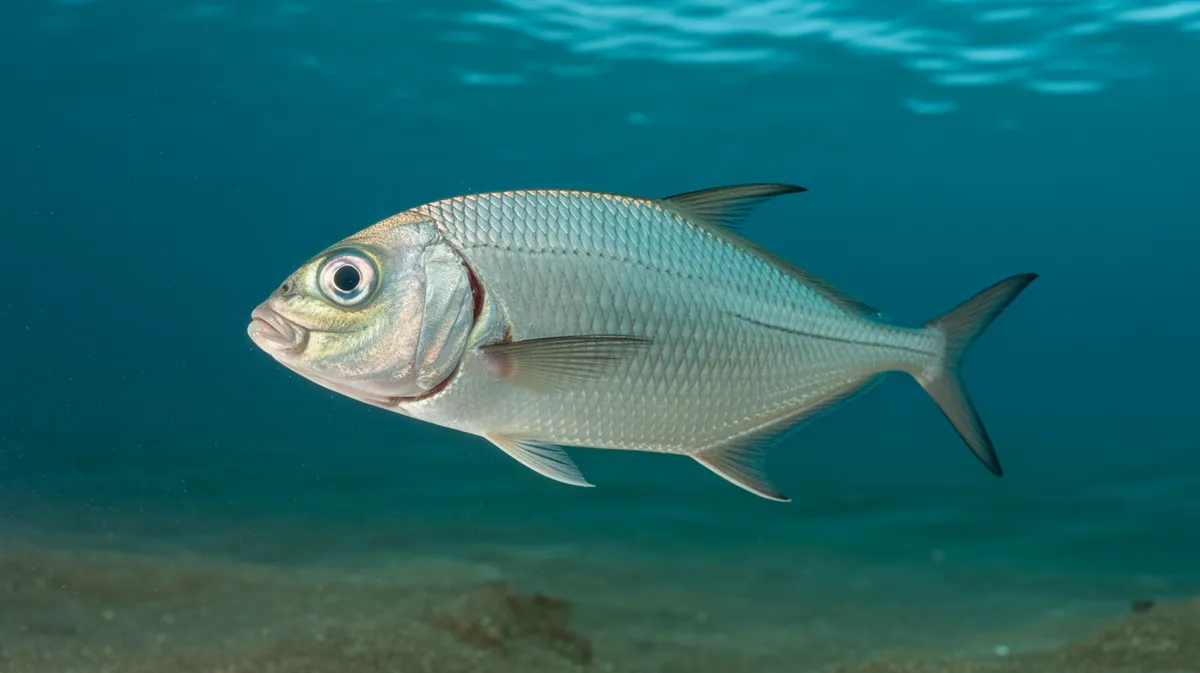
About the Milkfish
The milkfish is a silvery, streamlined fish native to the tropical and subtropical waters of the Indian and Pacific Oceans. It is well-known for its resilience and adaptability, thriving in coastal marine, brackish, and even freshwater habitats. Milkfish are important both ecologically and economically, being widely farmed in Southeast Asia for their mild, tender flesh. Juveniles, known as fry, often inhabit mangroves and estuaries before migrating to deeper ocean waters as adults. Their rapid growth and high tolerance for varying salinity make them a staple in aquaculture.
Fascinating facts
Aquaculture Favorite
Milkfish is one of the most commonly farmed fish species in Southeast Asia, especially in the Philippines and Indonesia.
Salinity Tolerance
This species can thrive in a wide range of salinities, from open ocean to brackish and even freshwater environments.
Egg-Laying Champion
A single female milkfish can lay up to several million eggs in one spawning event, usually in shallow coastal waters.
Detailed description
The milkfish (Chanos chanos) is a large, fusiform (spindle-shaped) fish, typically reaching lengths of 1 meter but occasionally growing up to 1.8 meters and weighing as much as 14 kg. Its body is covered in small, cycloid scales and is characterized by a deeply forked caudal (tail) fin, long pectoral fins, and a terminal mouth lacking teeth in adults—a feature associated with its specialized filter-feeding habits. The coloration is generally bright silver on the sides and ventral surface, with a bluish-green to olive dorsal region, providing camouflage in open water. The species possesses a single dorsal fin and lacks spines, contributing to its streamlined profile for efficient, sustained swimming. Milkfish are euryhaline, able to tolerate a wide range of salinities, which allows them to exploit diverse habitats from coastal marine waters to estuaries and even freshwater lakes. They are primarily diurnal and form large schools, especially during their juvenile stages, which offers protection from predators. Their digestive tract is notably long, an adaptation for processing a diet rich in detritus, algae, and small invertebrates. The species is known for its longevity, with individuals living up to 15 years in the wild. As the only extant member of the family Chanidae, milkfish represent a lineage that has persisted with little morphological change since the Paleocene, as evidenced by fossil records.
Did you know?
Milkfish can survive in environments ranging from full seawater to nearly freshwater, making them one of the most adaptable fish in aquaculture.
Research & sources
Wikipedia summary
The milkfish is a widespread species of ray-finned fish found throughout the Indo-Pacific. It is the sole living species in the family Chanidae, and the only living member of the genus Chanos. The repeating scientific name (tautonym) is from Greek khanos. They are grouped in the order Gonorhynchiformes and are most closely related to the Ostariophysi—freshwater fishes such as carps, catfish, and loaches.
Behaviour & social structure
Milkfish exhibit pronounced schooling behavior, particularly among juveniles and subadults, which helps reduce predation risk and increases foraging efficiency. Adults may form smaller groups or become more solitary, especially in offshore environments. They are continuous feeders, grazing throughout the day on phytoplankton, cyanobacteria, microalgae, and organic detritus, using their gill rakers to filter food from the water column or substrate. Feeding activity peaks during daylight hours, with reduced activity at night. Milkfish display migratory behavior, with juveniles moving from brackish nursery grounds to coastal and offshore waters as they mature. They are non-aggressive and exhibit minimal territoriality, relying on speed and group cohesion for defense. During spawning migrations, adults may travel considerable distances to reach offshore spawning sites.
Reproduction & life cycle
Milkfish are oviparous and exhibit broadcast spawning, releasing eggs and sperm into the open water, where fertilization occurs externally. Spawning typically takes place at night in offshore marine environments, often near the new or full moon, and is synchronized seasonally—usually during warmer months, varying by geographic location. Females are highly fecund, producing up to 5 million buoyant, pelagic eggs per spawning event. The eggs hatch within 24–36 hours, and the planktonic larvae drift with currents toward coastal and estuarine nursery habitats. There is no parental care post-spawning; survival of offspring depends on environmental conditions and predation rates. Sexual maturity is reached at 3–4 years of age, and adults may spawn multiple times per season.
Adaptations & survival
Milkfish possess several adaptations for survival in dynamic environments. Their euryhaline physiology enables them to osmoregulate efficiently, allowing for movement between fresh, brackish, and marine waters. The elongated gut facilitates digestion of plant material and detritus, maximizing nutrient extraction from low-calorie diets. The deeply forked tail and streamlined body support sustained, rapid swimming, which is crucial for long-distance migrations and predator avoidance. Their silvery coloration provides countershading, reducing visibility to both aerial and aquatic predators. Juveniles utilize mangroves and estuaries as nurseries, taking advantage of the shelter and abundant food resources these habitats provide.
Cultural significance
Milkfish holds significant cultural and economic value, especially in Southeast Asia. In the Philippines, where it is known as 'bangus,' it is the national fish and a staple in local cuisine, featured in numerous traditional dishes. The species has been farmed for centuries, with documented aquaculture practices dating back to the 16th century. Milkfish is also important in Indonesia, Taiwan, and other Indo-Pacific countries, supporting livelihoods and food security. In some cultures, milkfish is associated with abundance and prosperity, and its image appears in folk art and festivals. The fish's mild flavor and firm texture make it highly prized, though its numerous fine bones are a challenge for preparation.
Recent research
Recent paleontological studies (Guadarrama & Cantalice, 2025) have revealed remarkable morphological conservatism in the Chanos lineage since the Paleocene, suggesting evolutionary stability across mass extinction events. Advances in genomics have provided insights into the species' osmoregulatory mechanisms, informing selective breeding programs for aquaculture. Research on larval ecology and nutrition has led to improved hatchery techniques, reducing reliance on wild-caught fry. Environmental DNA (eDNA) monitoring is being explored to assess wild population dynamics and habitat use. Studies on the impact of climate change on spawning phenology and larval dispersal are ongoing, with implications for future management and conservation.
Videos
Habitat
Coastal marine waters, estuaries, and brackish lagoons


Conservation
The Milkfish is currently classified as Least Concern on the IUCN Red List.
Threats & challenges
While classified as Least Concern by the IUCN, wild milkfish populations face localized threats from habitat degradation, particularly the loss of mangroves and estuarine areas due to coastal development and pollution. Overfishing of wild fry for aquaculture seed stock can impact natural recruitment in some regions. Climate change poses emerging risks, including altered salinity regimes, sea-level rise, and ocean acidification, which may affect spawning success and larval survival. Disease outbreaks in intensive aquaculture systems also present challenges, necessitating improved management practices. Despite these pressures, the species' broad distribution, high fecundity, and adaptability have helped maintain stable global populations.
Taxonomy
Scientific name
Chanos chanos
- Kingdom
- Animalia
- Phylum
- Chordata
- Class
- Actinopterygii
- Order
- Gonorynchiformes
- Family
- Chanidae
- Genus
- Chanos
- Species
- chanos
Community notes
Share your observations about the Milkfish.
No community notes yet. Be the first!
Discover more wildlife
More fascinating animals from the encyclopedia.