
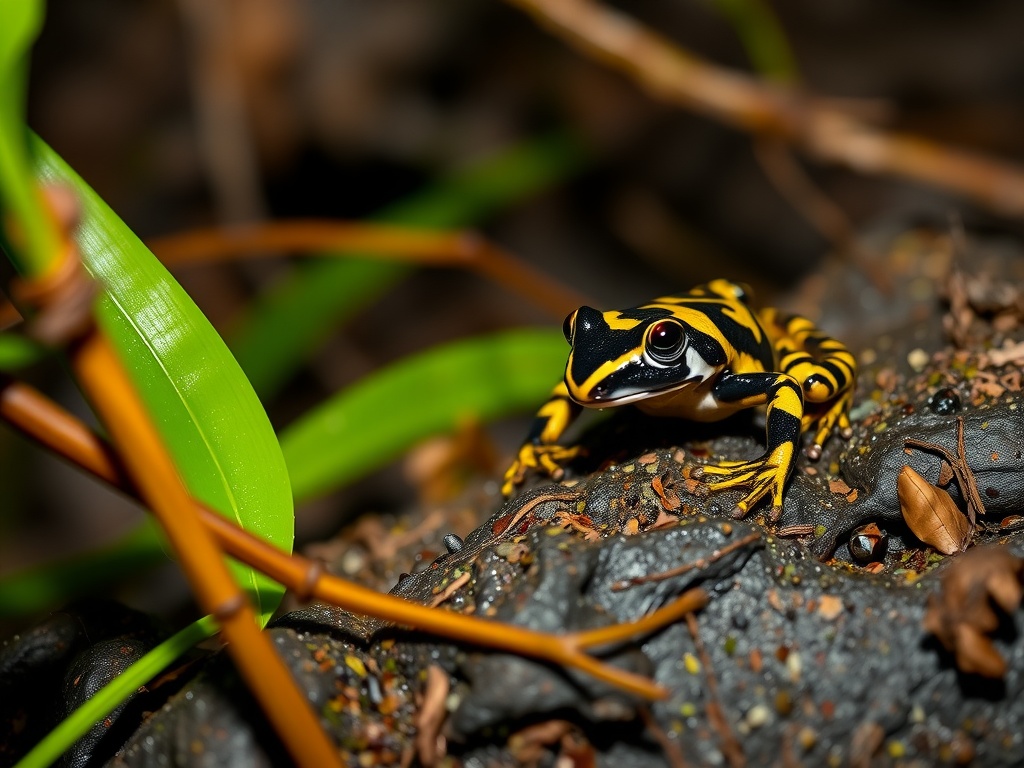
About the Mimic Poison Frog
Ranitomeya imitator is the animal that gave biologists their first clear proof of Mullerian mimicry in a vertebrate. Across the Peruvian Andes foothills, separate populations of this one species have each converged on the exact colour pattern of a different local poison frog — striped like R. variabilis in one valley, spotted like R. summersi in another, banded like R. fantastica elsewhere — so that predators in each area learn a single warning signal that protects both species. The frog is tiny, about 17 to 22 mm, roughly the size of a thumbnail. It is also one of the very few amphibians known to be genuinely monogamous: a pair bond persists across breeding cycles because a single parent cannot raise the tadpoles alone. The male carries each newly hatched tadpole on his back to its own water-filled bromeliad or leaf axil, then calls the female to the pool so she can deposit unfertilised eggs for the tadpole to eat. Those trophic eggs are the tadpole's only real food source, since the pools are too small to contain anything else. Experiments removing the female cause the tadpoles to starve, which is what locks the pair into monogamy.
Fascinating facts
Master Mimic
This frog can imitate the appearance of different local poison frog species, a rare form of Müllerian and Batesian mimicry in amphibians.
Parental Care
Both male and female Mimic Poison Frogs care for their tadpoles, with females feeding them unfertilized eggs as a food source.
Tiny Habitat Specialists
They inhabit bromeliads and other small water-filled plant structures, where they lay eggs and raise their young.
Detailed description
The Mimic Poison Frog (Ranitomeya imitator) is a diminutive dendrobatid amphibian, typically measuring 17–22 mm in snout-vent length, with a slender body and relatively long limbs adapted for agile climbing. Its skin exhibits aposematic coloration, with vivid patterns of yellow, orange, or green interspersed with black or dark brown, which vary geographically to mimic sympatric toxic frog species such as Ranitomeya variabilis and Ranitomeya fantastica. This polymorphism is a classic example of Müllerian mimicry, providing enhanced protection from visually oriented predators. The species is diurnal and highly territorial, with males defending small arboreal territories centered around bromeliads or leaf axils that collect water. R. imitator is notable for its complex social structure, including monogamous pair bonds and biparental care, rare among amphibians. Both parents participate in egg attendance, and after hatching, the female deposits unfertilized trophic eggs as food for the developing tadpoles. The frog’s skin secretes alkaloid toxins, acquired from its diet of small arthropods, though these are less potent than those of some relatives. Its vocalizations consist of high-pitched trills used for mate attraction and territory defense. The species is endemic to the lowland and montane rainforests of northern and central Peru, inhabiting elevations from 200 to 1200 meters, where it prefers humid microhabitats with abundant epiphytic plants.
Did you know?
Despite their bright and intimidating coloration, Mimic Poison Frogs are actually less toxic than many other poison frogs and rely on mimicry for protection rather than potent toxins.
Research & sources
Behaviour & social structure
Ranitomeya imitator is an active, diurnal species that spends much of its time navigating the vertical strata of the rainforest, particularly within bromeliads and other phytotelmata. Males are highly territorial, using distinctive calls and physical displays to ward off rivals and attract females. Foraging behavior is opportunistic, with individuals preying on small invertebrates such as ants, mites, springtails, and tiny beetles, often gleaned from leaf surfaces or within bromeliad tanks. Social interactions are complex, with established monogamous pairs exhibiting coordinated parental duties. Daily routines involve periods of foraging interspersed with territorial patrols and vocalizations. Aggressive encounters between males are typically resolved through display rather than physical combat, and pair bonds are maintained through frequent tactile and vocal communication.
Reproduction & life cycle
Breeding occurs year-round in the humid rainforest, though peaks may coincide with the rainy season. Courtship involves the male calling to attract a female, followed by a series of tactile interactions and mutual exploration of potential oviposition sites, usually within the leaf axils of bromeliads. Females lay clutches of 2–5 eggs, which are guarded and moistened by the male. After 10–14 days, the eggs hatch, and the male transports each tadpole on his back to separate water-filled phytotelmata. The female then returns periodically to deposit unfertilized eggs as a food source for the developing tadpoles, a behavior known as trophic egg feeding. Metamorphosis occurs after 60–80 days, depending on temperature and food availability. The high degree of parental investment, including biparental care and trophic egg provisioning, is exceptional among amphibians and is thought to be an adaptation to the nutrient-poor microhabitats used for tadpole development.
Adaptations & survival
Ranitomeya imitator exhibits several key adaptations for survival in its rainforest habitat. Its aposematic coloration and Müllerian mimicry reduce predation risk by signaling toxicity and mimicking more toxic sympatric species. The frog’s skin contains alkaloid toxins, derived from its arthropod diet, which deter predators. Its small size and adhesive toe pads facilitate movement through dense vegetation and allow access to narrow crevices and bromeliad tanks. The species’ unique biparental care system, including trophic egg feeding, enables successful reproduction in isolated, nutrient-poor water bodies, reducing competition and predation on larvae. Vocal communication is highly developed, with species-specific calls aiding in mate recognition and territory defense. Behavioral flexibility, including monogamy and coordinated parental roles, enhances offspring survival in the challenging microhabitats of the rainforest.
Cultural significance
The Mimic Poison Frog is not known to have significant traditional uses among indigenous peoples, likely due to its relatively mild toxicity compared to other dendrobatids. However, it holds considerable scientific and educational value as a model organism for studies of mimicry, parental care, and evolutionary biology. Its striking appearance and fascinating behaviors have made it popular in the exotic pet trade and in public education about rainforest conservation. The species is sometimes featured in ecotourism literature and conservation campaigns highlighting the biodiversity of Peruvian rainforests.
Recent research
Ranitomeya imitator has been the subject of extensive research into the evolution of mimicry and parental care. Notably, studies have demonstrated that its Müllerian mimicry is driven by both natural selection from predators and sexual selection within populations. Genetic analyses have revealed rapid divergence in coloration and patterning, correlating with the presence of model species in different geographic regions. Recent research has also focused on the neurobiology and hormonal regulation of biparental care, providing insights into the evolution of complex social behaviors in amphibians. Ongoing studies are examining the impacts of habitat fragmentation on gene flow and population viability, as well as the potential effects of climate change on microhabitat availability.
Sources
The evolution of parental care and monogamy in Ranitomeya imitator
Brown, J.L., Morales, V., Summers, K. (2010)
scientificMimicry and reproductive isolation in Ranitomeya imitator
Twomey, E., Vestergaard, J.S., Summers, K. (2016)
scientificRanitomeya imitator: The IUCN Red List of Threatened Species 2020
IUCN SSC Amphibian Specialist Group
conservationMimicry and reproductive isolation in Ranitomeya imitator
Twomey, E.M., Vestergaard, J.S., Summers, K. (2014)
scientificVideos
Habitat
Tropical rainforest
 Tropical Regions
Rainforest
Dense, wet forests with the highest biodiversity on Earth, containing more than half of the world's plant and animal species.
 Global
Forest
Wooded areas with significant tree cover and diverse plant and animal communities.
 Global
Freshwater
Lakes, rivers, and wetlands with diverse aquatic ecosystems.
Conservation
The Mimic Poison Frog is currently classified as Least Concern on the IUCN Red List.
Threats & challenges
Although currently listed as Least Concern by the IUCN, R. imitator faces localized threats from habitat loss due to deforestation, agricultural expansion, and illegal collection for the international pet trade. Fragmentation of rainforest habitat can isolate populations and reduce genetic diversity. The species’ reliance on specific microhabitats, such as bromeliads, makes it vulnerable to changes in forest structure and microclimate. While populations remain stable in protected areas, ongoing habitat degradation in unprotected regions poses a risk. Disease, such as chytridiomycosis caused by the fungus Batrachochytrium dendrobatidis, has not been reported as a major threat to this species but remains a concern for Neotropical amphibians in general.
Taxonomy
Scientific name
Ranitomeya imitator
- Kingdom
- Animalia
- Phylum
- Chordata
- Class
- Amphibia
- Order
- Anura
- Family
- Dendrobatidae
- Genus
- Ranitomeya
- Species
- imitator
Where to see a mimic poison frog
1 zoo and aquarium in 1 country are recorded as keeping this species.

Community notes
Share your observations about the Mimic Poison Frog.
No community notes yet. Be the first!
Discover more wildlife
More fascinating animals from the encyclopedia.