
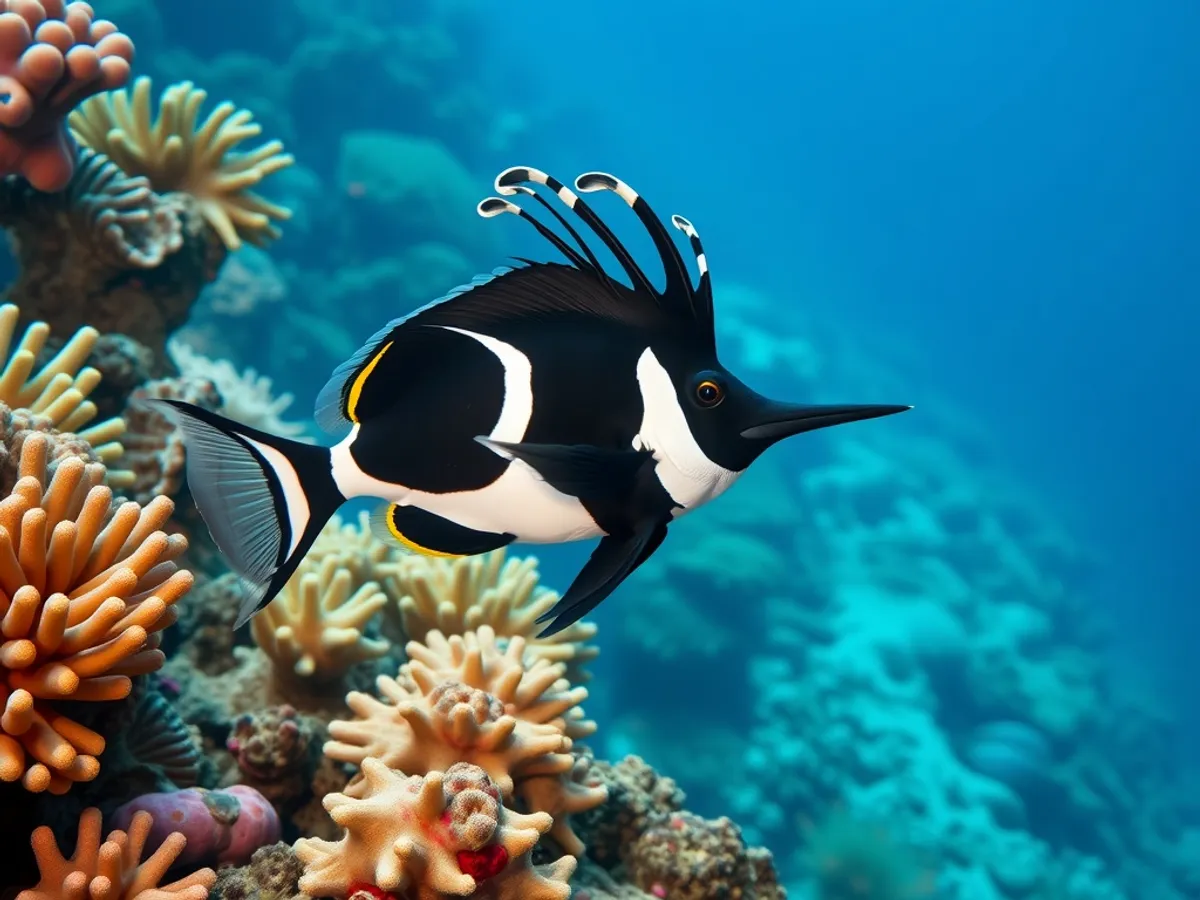
About the Moorish idol
Zanclus cornutus is the sole living member of its family, Zanclidae, and it is one of the great cautionary tales of the marine aquarium trade: it is beautiful, it is common on Indo-Pacific reefs from the Red Sea and East Africa to Hawaii and the eastern Pacific, and it almost always dies in a tank. The problem is diet. In the wild it feeds primarily on sponges — a tough, silica-spiculed, chemically defended food that few fish can process — and it does so by working its long, tubular, forceps-like snout into narrow crevices in the reef. Very few captive specimens will accept substitute food, and even those that do usually decline over months. It is often mistaken for the pennant coralfish or bannerfish, which are butterflyfish and look similar but are unrelated. Moorish idols are surgeonfish relatives, in the order Acanthuriformes, but they lack the scalpel on the tail peduncle that gives surgeonfish their name. They have an extraordinarily long pelagic larval stage — the transparent, disc-shaped acronurus larva can drift for months — which is why the species has one of the widest distributions of any reef fish. Adults are often seen in pairs or small groups and may be monogamous.
Fascinating facts
Vivid Colors
Moorish idols have a distinctive coloration of black, white, and yellow stripes, which makes them one of the most recognizable reef fish.
Unique Family
They are the only living species in the family Zanclidae, setting them apart from other similar-looking reef fish.
Picky Eaters
Moorish idols feed on sponges, coral polyps, tunicates, and other benthic invertebrates, which makes them particularly hard to sustain in captivity.
Detailed description
The Moorish idol (Zanclus cornutus) is a highly distinctive marine fish, easily recognized by its laterally compressed, disc-shaped body and striking coloration: alternating bands of black, white, and yellow. Adults typically reach a length of 20–23 cm (8–9 in), with the most prominent feature being the elongated, filamentous extension of the dorsal fin, which can add an additional 15–20 cm (6–8 in) to its height. The snout is long and tubular, ending in a small mouth equipped with numerous bristle-like teeth adapted for grazing. The species possesses small, horn-like projections above each eye, which are more pronounced in adults. Moorish idols are diurnal, spending daylight hours actively foraging along coral reefs, rocky outcrops, and lagoons at depths from 3 to 180 meters, though they are most common in shallow waters. They are agile swimmers, capable of maneuvering through complex reef structures with ease. Social structure varies: individuals may be solitary, found in pairs (especially during breeding), or occasionally in small groups, particularly in areas with abundant food resources. Their diet is highly specialized, consisting mainly of sponges, coral polyps, tunicates, and other benthic invertebrates, supplemented with algae. The species is the sole extant representative of the family Zanclidae, with no close living relatives, and is often confused with butterflyfishes (family Chaetodontidae) due to superficial similarities. Moorish idols are known for their sensitivity to environmental changes, making them challenging to maintain in captivity.
Did you know?
Unlike many reef fish, the Moorish idol is the sole extant species in its family, Zanclidae.
Research & sources
Wikipedia summary
The Moorish idol is a species of marine ray-finned fish belonging to the family Zanclidae. It is the only member of the monospecific genus Zanclus and the only extant species within the Zanclidae. This species is found on reefs in the Indo-Pacific region.
Behaviour & social structure
Moorish idols are primarily diurnal and spend most of the day actively foraging along reef surfaces and rocky substrates. Their feeding behavior involves using their elongated snouts and small, bristle-like teeth to pick at sponges, tunicates, and encrusting invertebrates, often probing into crevices inaccessible to other fish. They exhibit both solitary and social behaviors: while adults are frequently observed alone or in pairs (especially during breeding), juveniles and non-breeding adults may form loose aggregations, particularly in areas with abundant food. Territoriality is generally low, though individuals may defend small feeding areas. Moorish idols are highly mobile, covering large areas of the reef each day. At night, they seek shelter within reef crevices or under ledges to avoid nocturnal predators. Communication is primarily visual, relying on body postures and color displays, as vocalizations are absent. Their graceful swimming and constant movement are thought to reduce predation risk and facilitate efficient foraging.
Reproduction & life cycle
Moorish idols are oviparous, with external fertilization. Spawning typically occurs in pairs, often during dusk or at night, coinciding with lunar cycles and warmer water temperatures. Courtship involves synchronized swimming and color intensification. During spawning, eggs and sperm are released into the water column, where fertilization occurs. The eggs are pelagic, buoyant, and hatch within 24–48 hours, depending on temperature. The larval stage, known as the acronurus stage, is prolonged and planktonic, lasting several weeks to months, during which larvae drift with ocean currents and undergo significant morphological changes before settling onto reefs as juveniles. There is no parental care post-spawning. Breeding seasons vary geographically but often peak during warmer months. Sexual maturity is reached at approximately 2–3 years of age.
Adaptations & survival
The Moorish idol exhibits several adaptations for reef life. Its laterally compressed body and elongated dorsal fin filament allow for agile maneuvering among coral branches and rocky crevices, aiding in both foraging and predator evasion. The long, tubular snout and specialized dentition enable extraction of food from narrow spaces, giving it access to dietary resources unavailable to many competitors. The bold coloration and contrasting bands serve as both camouflage among coral shadows and as a warning to potential predators, possibly mimicking the appearance of less palatable species. The species’ pelagic larval stage facilitates wide dispersal across the Indo-Pacific, promoting genetic diversity and colonization of new habitats. Physiologically, Moorish idols are sensitive to water quality and require stable, well-oxygenated environments, reflecting their adaptation to pristine reef systems.
Cultural significance
The Moorish idol holds cultural importance in several Indo-Pacific societies. Its name derives from the Moors of North Africa, who believed the fish brought happiness and good fortune, though this association is more mythological than historical. In Polynesian and Hawaiian cultures, the fish is sometimes seen as a symbol of beauty and grace, and features in local art and folklore. Its striking appearance has made it a popular motif in marine-themed artwork and a sought-after species in the aquarium trade, despite its husbandry challenges. The Moorish idol’s iconic look has also influenced popular media, most notably as the character 'Gill' in the animated film 'Finding Nemo.'
Recent research
Recent research on Zanclus cornutus has focused on its phylogenetic placement, confirming it as the only extant member of Zanclidae and revealing its evolutionary divergence from butterflyfishes and surgeonfishes. Studies using mitochondrial DNA have clarified its biogeographic patterns, showing high gene flow across the Indo-Pacific, facilitated by its long pelagic larval stage. Ongoing ecological research investigates its role in reef trophic dynamics, particularly its impact on sponge and tunicate populations. Conservation studies are monitoring the effects of climate change and habitat loss on population stability. Additionally, advances in larval rearing techniques are being explored to improve captive breeding success, which could reduce wild collection pressures.
Videos
Habitat
Coral reefs and lagoons

Conservation
The Moorish idol is currently classified as Least Concern on the IUCN Red List.
Threats & challenges
While currently listed as Least Concern by the IUCN, Moorish idols face several localized threats. Habitat degradation due to coral reef destruction, pollution, and climate change-induced bleaching events poses significant risks. Overcollection for the aquarium trade is a concern, as the species is notoriously difficult to acclimate to captivity and has high mortality rates in transport and holding. Additionally, ocean acidification and declining reef health may reduce food availability and suitable habitat. Population trends are generally stable across most of their range, but declines have been noted in areas with intense reef exploitation or environmental stress.
Taxonomy
Scientific name
Zanclus cornutus
- Kingdom
- Animalia
- Phylum
- Chordata
- Class
- Actinopterygii
- Order
- Perciformes
- Family
- Zanclidae
- Genus
- Zanclus
- Species
- cornutus
Community notes
Share your observations about the Moorish idol.
No community notes yet. Be the first!
Discover more wildlife
More fascinating animals from the encyclopedia.