
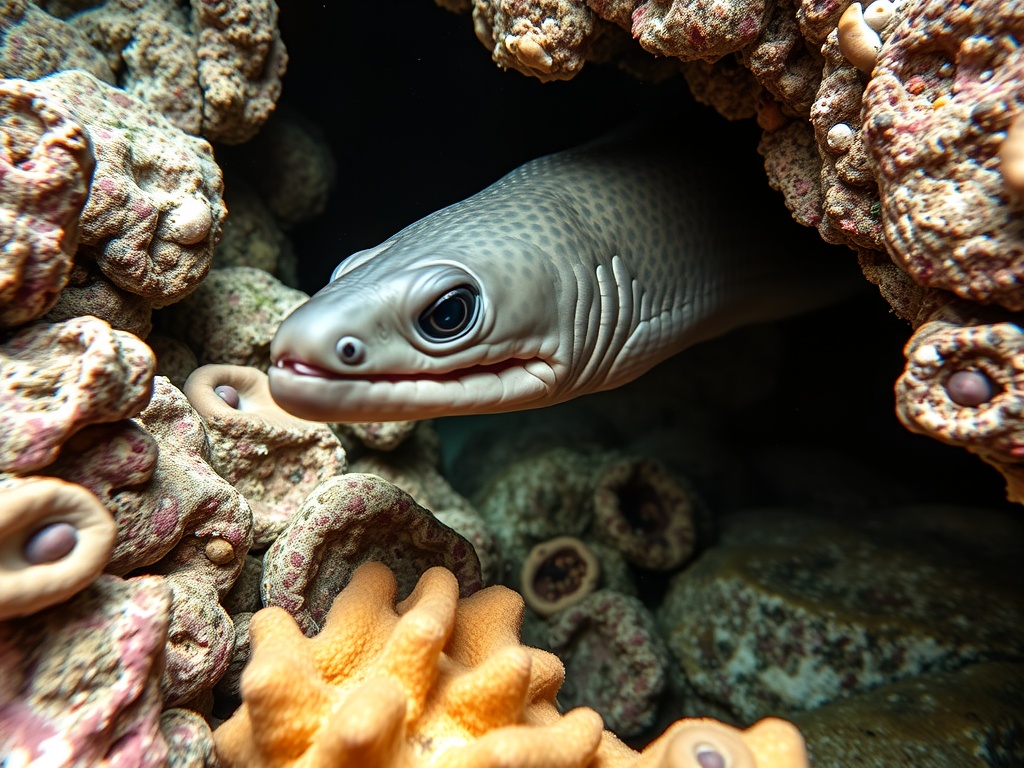
About the Moray Eel
Morays are the only animals known to hunt with a second, mobile set of jaws deep in the throat. Because a moray lives in a crevice, it cannot do what most fish do and create suction by rapidly expanding its mouth — there is no room to gulp a bolus of water. Instead, its pharyngeal jaws, studded with backward-curving teeth, shoot forward into the mouth cavity, seize prey and drag it back into the gullet. The behaviour was only filmed and described in 2007, and it is the closest thing in nature to the creature from Alien. The perpetual open-mouthed gape that makes morays look aggressive is not a threat display either; with no gill covers to speak of, only two small circular openings, the eel must hold its mouth open to pump water over its gills. Morays have terrible eyesight and hunt almost entirely by smell, with tubular nostrils that give some species a nostril-flared, prong-nosed look. There are roughly 200 species, from 11 cm dwarf morays to the giant moray at nearly 3 m and the slender ribbon eel. Their skin produces a thick, sometimes toxic mucus rather than scales.
Fascinating facts
Double Jaws
Moray eels possess a second pair of jaws, called pharyngeal jaws, that extend forward to grasp and pull prey into their throat.
Nocturnal Hunters
Most moray eels are active at night, emerging from their hiding places to ambush unsuspecting prey.
Team Players
Some moray eels cooperate with reef fish like groupers to herd and capture prey together, demonstrating remarkable interspecies teamwork.
Detailed description
Moray eels (family Muraenidae) are a diverse group of elongated, scaleless fishes characterized by their muscular bodies, which can range in length from about 15 cm (such as the Snyder’s moray, Anarchias leucurus) to over 3 meters (notably the giant moray, Gymnothorax javanicus). Their skin is thick and often covered in a protective mucus layer that may contain toxins, providing defense against parasites and predators. Morays lack pectoral and pelvic fins, resulting in a serpentine, ribbon-like appearance that allows them to navigate narrow crevices within coral reefs and rocky substrates. Their heads are broad with large mouths filled with sharp, backward-pointing teeth, specialized for grasping slippery prey. A unique anatomical feature is their pharyngeal jaws—an additional set of jaws within the throat that rapidly extends forward to seize and transport prey into the esophagus, a trait rare among fishes. Moray eels exhibit cryptic coloration and patterning, often matching their environment for camouflage. Most species are solitary and nocturnal, spending daylight hours hidden and emerging at night to hunt. Their sensory systems are highly developed, with an acute sense of smell compensating for relatively poor eyesight. Morays are found in tropical and subtropical seas worldwide, with a few species inhabiting brackish and even freshwater environments. They play an important ecological role as mid-level predators, influencing the population dynamics of reef communities.
Did you know?
Despite their intimidating look, moray eels have poor eyesight and rely heavily on their keen sense of smell to find prey.
Research & sources
Wikipedia summary
Moray eels, or Muraenidae, are a family of eels whose members are found worldwide. There are approximately 200 species in 15 genera which are almost exclusively marine, but several species are regularly seen in brackish water, and a few are found in fresh water.
Behaviour & social structure
Moray eels are primarily solitary and territorial, occupying specific crevices or burrows within reefs or rocky areas. They are ambush predators, remaining motionless with only their heads protruding from shelter, waiting for prey to approach. When hunting, morays rely on stealth and a rapid strike, using their powerful jaws to seize fish, crustaceans, and cephalopods. Their pharyngeal jaws then pull prey into the throat. Some species, such as the giant moray, have been observed engaging in cooperative hunting with other predatory fish like groupers, where each species exploits its own hunting strengths. Morays are generally nocturnal, with peak activity during the night, though some species may be active during the day in areas with low human disturbance. They communicate aggression or territoriality through open-mouth displays and body posturing. Social interactions are limited, with occasional tolerance of conspecifics in overlapping territories, especially during breeding periods.
Reproduction & life cycle
Moray eels are oviparous, with external fertilization. Spawning typically occurs seasonally, often synchronized with lunar cycles and water temperature increases, though timing varies by species and region. During courtship, males and females engage in entwining behaviors, releasing eggs and sperm into the water column simultaneously. Females can produce thousands to millions of buoyant eggs per spawning event. The eggs hatch into leptocephalus larvae—transparent, ribbon-like forms that drift in the plankton for several months, sometimes up to a year, before metamorphosing into juvenile eels and settling into benthic habitats. There is no parental care after spawning. Sexual maturity is reached at varying ages depending on species, generally between 2 and 4 years.
Adaptations & survival
Moray eels exhibit several key adaptations: their elongated, flexible bodies and reduced fins allow them to navigate tight crevices and ambush prey. The thick, mucous-covered skin protects against abrasion and infection, and in some species, the mucus contains toxins that deter predators. The pharyngeal jaws are a unique feeding adaptation, enabling efficient prey capture and ingestion. Their acute olfactory sense compensates for poor vision, aiding in prey detection and navigation in low-light environments. Cryptic coloration and patterning provide camouflage within complex reef structures. Some species have evolved specialized dentition for crushing hard-shelled prey, while others have needle-like teeth for grasping fish.
Cultural significance
Moray eels have held a place in human culture for centuries. In ancient Rome, they were considered delicacies and kept in elaborate fishponds. In Pacific Island cultures, morays are often featured in folklore and mythology, sometimes revered as guardians or feared as omens. In Hawaiian tradition, the moray eel (puhi) is associated with the shark god and considered an aumakua (ancestral spirit). Their striking appearance makes them popular in public aquaria, and they are sometimes depicted in art and literature as mysterious or dangerous sea creatures. However, their actual threat to humans is minimal unless provoked.
Recent research
Recent research has focused on the biomechanics of moray eel feeding, particularly the function and evolution of their pharyngeal jaws, which have inspired biomimetic engineering studies. Studies on moray-grouper cooperative hunting have provided insights into interspecies communication and mutualism among reef predators. Genetic analyses are refining the taxonomy and evolutionary relationships within the Muraenidae family, revealing cryptic species diversity. Ongoing ecological research examines the role of morays in reef trophic dynamics and their responses to environmental change. Conservation studies are increasingly important as reef habitats face global decline.
Videos
Habitat
Coral reefs, rocky crevices, and coastal marine environments

Conservation
The Moray Eel is currently classified as Least Concern on the IUCN Red List.
Threats & challenges
While most moray eel species are currently listed as Least Concern by the IUCN, they face several threats. Habitat degradation, particularly the loss and bleaching of coral reefs, poses a significant risk to their populations. Overfishing and bycatch, both targeted (for food and the aquarium trade) and incidental, can impact local populations. Pollution and climate change, leading to ocean acidification and temperature shifts, further threaten their habitats. Some larger species are occasionally hunted for food, but their flesh can accumulate ciguatoxins, making them hazardous to eat. Population trends are generally stable, but localized declines have been reported in areas with heavy reef disturbance.
Taxonomy
Scientific name
Muraenidae
- Kingdom
- Animalia
- Phylum
- Chordata
- Class
- Actinopterygii
- Order
- Anguilliformes
- Family
- Muraenidae
- Genus
- Varies (e.g., Gymnothorax, Echidna, Muraena)
- Species
- Varies (over 200 species)
Community notes
Share your observations about the Moray Eel.
No community notes yet. Be the first!
Discover more wildlife
More fascinating animals from the encyclopedia.