
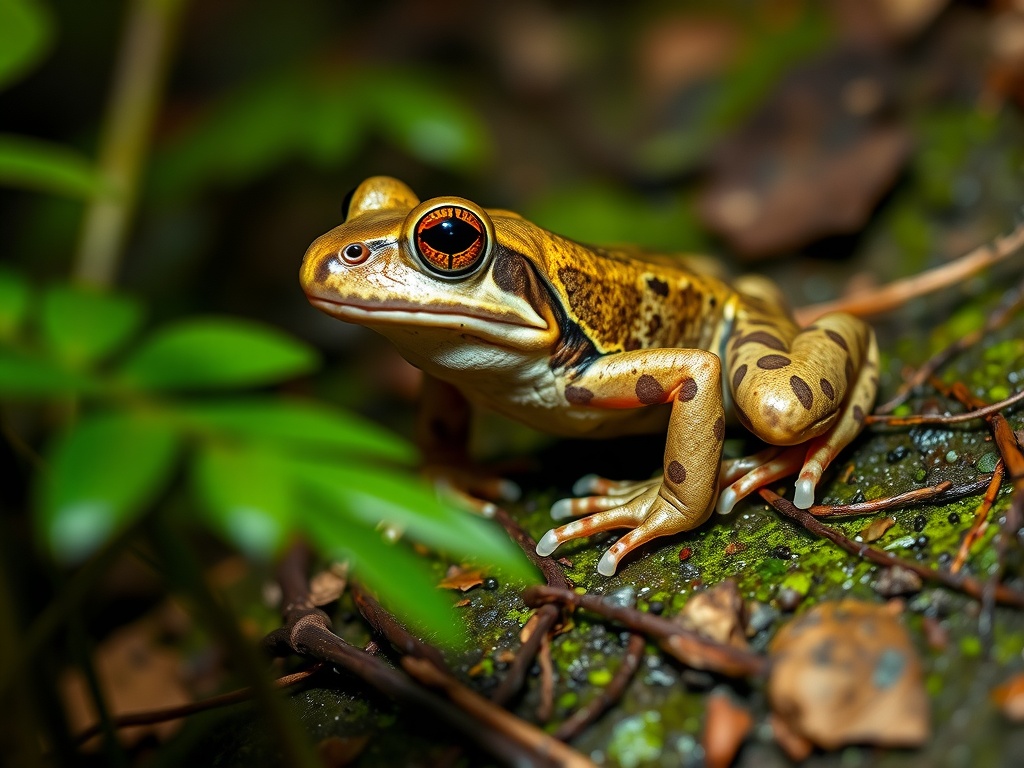
About the Mountain Chicken Frog
The Mountain Chicken Frog, despite its name, is actually a large frog native to the Caribbean islands of Dominica and Montserrat. It is one of the largest frogs in the world, reaching lengths of up to 21 cm (8.3 in). This terrestrial amphibian inhabits moist forests and valleys, where it hunts at night for a variety of prey. The Mountain Chicken Frog is critically endangered, primarily due to the spread of chytridiomycosis, habitat destruction, and overhunting for its meat, which is considered a delicacy locally. Its population has declined drastically in recent years, making it one of the rarest amphibians globally.
Fascinating facts
Name Origin
The frog is called 'Mountain Chicken' because its meat tastes similar to chicken and is eaten as a delicacy.
Giant Among Frogs
It is one of the largest frog species in the world, capable of growing up to 21 centimeters long.
Unique Parental Care
Female Mountain Chicken Frogs feed their young with unfertilized eggs, providing essential nutrition for the developing tadpoles.
Detailed description
The Mountain Chicken Frog (Leptodactylus fallax) is a robust, terrestrial amphibian notable for its impressive size, with adult females typically larger than males, reaching up to 21 cm in snout-vent length and weighing as much as 1 kg. Its skin is generally mottled brown or gray, providing effective camouflage among leaf litter and forest debris. The species has powerful hind limbs adapted for leaping and digging, and its toes are unwebbed, reflecting its primarily terrestrial lifestyle. The frog’s head is broad with prominent eyes and a strong jaw, suited for subduing large prey. Mountain Chicken Frogs are nocturnal ambush predators, relying on stealth and sudden bursts of speed to capture a wide range of invertebrates and small vertebrates. Socially, they are largely solitary outside of the breeding season, occupying overlapping home ranges in suitable habitat. Their vocalizations are loud and distinctive, serving both territorial and reproductive functions. The species exhibits unique reproductive behavior, including foam-nesting and direct parental care, which is rare among amphibians. These frogs are highly sensitive to environmental changes and are considered ecological indicators of forest health.
Did you know?
The Mountain Chicken Frog was once so common it was Dominica's national dish, but now fewer than 100 individuals are estimated to survive in the wild.
Research & sources
Behaviour & social structure
Mountain Chicken Frogs are primarily nocturnal, emerging at dusk to hunt and remaining active throughout the night. They employ a sit-and-wait hunting strategy, remaining motionless until prey approaches, then lunging with remarkable speed. Their diet includes insects, crustaceans, small mammals, reptiles, and even other amphibians, making them apex terrestrial predators within their ecosystem. During the day, they seek refuge in self-dug burrows or natural crevices to avoid desiccation and predation. Social interactions are minimal outside of the breeding season, with individuals maintaining loose territories. Males are highly vocal during the rainy season, producing a deep, booming call to attract females and deter rivals. Aggressive encounters between males can occur, involving wrestling and physical displays. The species exhibits seasonal activity patterns, with increased movement and calling during periods of high humidity.
Reproduction & life cycle
Breeding in Leptodactylus fallax is closely tied to the onset of the rainy season, typically from May to July. Males establish calling sites near suitable nesting locations and attract females with their distinctive calls. Once a female selects a mate, the pair engages in amplexus, after which the female excavates a burrow in moist soil. The female lays 20–40 large eggs in a foam nest, which she creates by whipping up secretions with her hind legs. Both parents may guard the nest, but the female provides the most direct care. Remarkably, after hatching, the female feeds the developing tadpoles with unfertilized eggs, a form of maternal provisioning known as oophagy. The tadpoles develop entirely within the nest, bypassing the aquatic larval stage, and metamorphose into froglets after 45–60 days. This reproductive strategy reduces predation risk and dependence on standing water.
Adaptations & survival
The Mountain Chicken Frog exhibits several adaptations for terrestrial life, including unwebbed toes for efficient movement on land and strong forelimbs for digging burrows. Its cryptic coloration helps it avoid detection by predators and prey alike. The foam-nesting reproductive strategy and direct development of young are significant evolutionary adaptations, allowing the species to exploit environments with limited standing water. The provision of unfertilized eggs to tadpoles is a rare example of parental investment among amphibians. Physiologically, the species is adapted to humid environments, with permeable skin that facilitates cutaneous respiration but also makes it vulnerable to desiccation and pathogens. Its large size enables it to prey on a wide range of animals, occupying a unique ecological niche.
Cultural significance
The Mountain Chicken Frog holds significant cultural value in Dominica and Montserrat, where it has long been regarded as a traditional food source. Its meat, said to resemble chicken, is considered a delicacy and was once a staple in local cuisine, giving rise to its common name. The frog is featured in local folklore and is an emblematic species for conservation in the region. In recent years, its plight has raised awareness about amphibian declines and the importance of biodiversity, leading to its adoption as a flagship species for environmental education and ecotourism initiatives.
Recent research
Recent research has focused on disease ecology, particularly the impact of chytridiomycosis and potential mitigation strategies, such as antifungal treatments and captive breeding. Genetic studies have revealed low genetic diversity within surviving populations, raising concerns about inbreeding depression and long-term viability. Conservation programs, including the Mountain Chicken Recovery Programme, have established ex situ populations in European zoos, with some success in captive breeding and reintroduction trials. Ongoing studies are investigating habitat requirements, reproductive biology, and the effectiveness of habitat restoration. Advances in environmental DNA (eDNA) monitoring are aiding in the detection of remnant wild populations.
Sources
Leptodactylus fallax (Mountain Chicken): Natural History, Reproductive Biology, and Conservation
Daltry, J.C., Gray, G., and Ottenwalder, J.A. (2016)
scientificLeptodactylus fallax: The IUCN Red List of Threatened Species 2021
IUCN SSC Amphibian Specialist Group
conservationVideos
Habitat
Tropical rainforest and moist lowland forests
 Tropical Regions
Rainforest
Dense, wet forests with the highest biodiversity on Earth, containing more than half of the world's plant and animal species.
 Global
Forest
Wooded areas with significant tree cover and diverse plant and animal communities.
 Global
Freshwater
Lakes, rivers, and wetlands with diverse aquatic ecosystems.
Conservation
The Mountain Chicken Frog is currently classified as Critically Endangered on the IUCN Red List.
Threats & challenges
Leptodactylus fallax faces multiple, severe threats. The most devastating is chytridiomycosis, a fungal disease caused by Batrachochytrium dendrobatidis, which has decimated populations on both Dominica and Montserrat since the early 2000s. Habitat loss due to agriculture, deforestation, and development further restricts suitable living space. Overhunting for its meat, considered a delicacy, historically contributed to population declines. Invasive predators such as rats, mongoose, and feral cats also pose risks, particularly to eggs and juveniles. The species is now restricted to a few isolated populations, with fewer than 100 mature individuals estimated in the wild as of 2023. Conservation efforts are hampered by the difficulty of managing disease in wild populations and the limited geographic range of the species.
Taxonomy
Scientific name
Leptodactylus fallax
- Kingdom
- Animalia
- Phylum
- Chordata
- Class
- Amphibia
- Order
- Anura
- Family
- Leptodactylidae
- Genus
- Leptodactylus
- Species
- fallax
Community notes
Share your observations about the Mountain Chicken Frog.
No community notes yet. Be the first!
Discover more wildlife
More fascinating animals from the encyclopedia.