
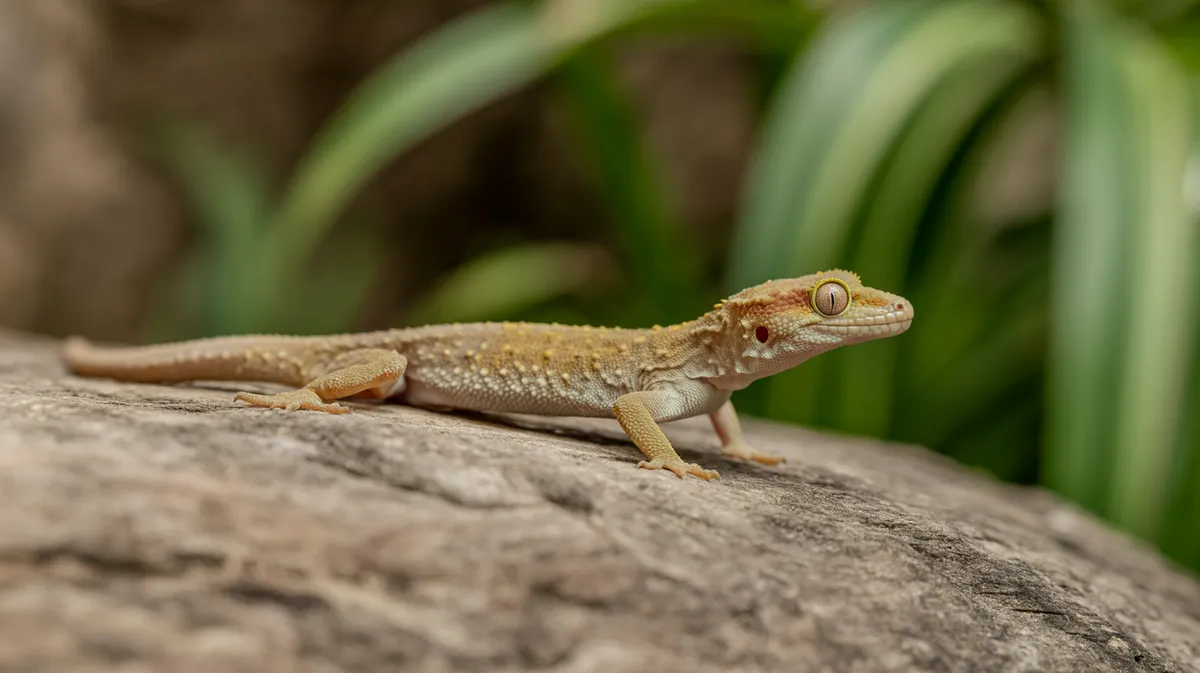
About the Mourning Gecko
The Mourning Gecko is a small, nocturnal lizard native to coastal regions and islands of the Indo-Pacific. It is renowned for its parthenogenetic reproduction, with most individuals being female and capable of laying fertile eggs without mating. Mourning Geckos have a brown or grayish coloration with subtle patterning, aiding their camouflage among rocks and vegetation. Highly adaptable, they thrive in diverse environments, often living in human dwellings and gardens as well as natural forests. Their ease of care and fascinating reproductive biology have made them popular in the pet trade and scientific research.
Fascinating facts
All-Female Species
Nearly all Mourning Geckos are female and can reproduce without males through a process called parthenogenesis.
Widespread Distribution
Their ability to thrive in various habitats and stow away in cargo has allowed Mourning Geckos to colonize many tropical islands worldwide.
Egg-Laying Experts
Each gecko lays pairs of eggs, often sticking them to hidden surfaces like crevices or inside plant leaf axils for protection.
Detailed description
The Mourning Gecko (Lepidodactylus lugubris) is a small, slender-bodied gecko, typically reaching 8.5–10.5 cm in total length, with a snout-to-vent length (SVL) of 4–5 cm. Its dorsal coloration ranges from light brown to grayish with darker mottling or reticulated patterns, providing effective camouflage against bark, rocks, and leaf litter. The ventral side is pale cream or yellowish. The skin is smooth and delicate, with minute granular scales. Mourning Geckos possess adhesive toe pads with microscopic setae, enabling them to climb vertical and even inverted surfaces, including glass. Their large, lidless eyes have vertical pupils, adapted for nocturnal activity and low-light vision. This species is primarily nocturnal, emerging at dusk to forage and socialize. Socially, they are gregarious and often form loose colonies, sharing communal nesting sites and exhibiting complex dominance hierarchies. Uniquely, almost all individuals are female and reproduce via obligate parthenogenesis, producing clonal offspring without fertilization. Eggs are typically laid in concealed locations, often in communal clusters. Their adaptability, small size, and cryptic coloration allow them to exploit a wide range of habitats, from pristine coastal forests to urban environments.
Did you know?
Mourning Geckos have spread across vast regions of the world, often hitching rides on ships and cargo, making them one of the most widespread gecko species.
Research & sources
Wikipedia summary
Lepidodactylus lugubris, known as the mourning gecko or common smooth-scaled gecko, is a species of lizard, a gecko of the family Gekkonidae.
Behaviour & social structure
Mourning Geckos are primarily nocturnal, emerging at dusk to forage for food and interact socially. They are opportunistic omnivores, feeding on small insects (such as ants, termites, and fruit flies), spiders, and other arthropods, as well as plant matter like nectar, pollen, and soft fruits. In captivity, they readily consume fruit-based gecko diets. Foraging is typically solitary, but individuals often aggregate at abundant food sources. Social interactions are frequent, with established dominance hierarchies among colony members; dominant individuals may display threat postures or tail waving to subordinate geckos. Communal nesting is common, with multiple females depositing eggs in shared, secure microhabitats. Mourning Geckos communicate through tactile and chemical cues, and may emit soft chirps or squeaks when threatened or during social encounters. During the day, they hide in crevices, under bark, or within human structures to avoid predators and desiccation.
Reproduction & life cycle
Lepidodactylus lugubris is renowned for its obligate parthenogenetic reproduction; nearly all individuals are female, and populations are maintained without males. Rare males have been reported but are typically sterile. Females lay eggs in pairs every 4–6 weeks, with clutch frequency influenced by temperature and food availability. Eggs are adhered to substrates in concealed locations, often in communal clusters. Incubation lasts 60–90 days at 24–28°C (75–82°F), with hatchlings emerging fully independent and measuring about 30–35 mm in total length. There is no parental care post-oviposition. Breeding occurs year-round in stable tropical climates, allowing for rapid population growth in suitable habitats.
Adaptations & survival
Key adaptations include parthenogenesis, allowing rapid colonization of new habitats from a single individual, and adhesive toe pads for climbing smooth surfaces. Their cryptic coloration and nocturnal habits reduce predation risk. Communal nesting enhances egg survival through predator dilution and microclimate stability. Mourning Geckos can autotomize (shed) their tails to escape predators, with subsequent regeneration. Their omnivorous diet and tolerance of a wide range of microhabitats, including anthropogenic environments, contribute to their ecological success. Physiologically, they exhibit high desiccation tolerance and can exploit both humid and relatively dry environments.
Cultural significance
While not prominent in traditional folklore, Mourning Geckos are valued in the pet trade for their ease of care, small size, and fascinating reproductive biology. They are frequently used in bioactive terrarium setups and as feeder species for small reptiles and amphibians. In scientific research, they serve as a model for studies on parthenogenesis, invasive species dynamics, and reproductive ecology. Their presence in human dwellings is generally tolerated or unnoticed, and they are sometimes considered beneficial for controlling insect pests.
Recent research
Recent genetic studies have revealed that Mourning Geckos are a complex of multiple clonal lineages, with hybrid origins involving several closely related Lepidodactylus species. Ongoing research investigates the mechanisms and evolutionary consequences of parthenogenesis, including genetic diversity and adaptability. Studies have also examined their role as invasive species and their ecological interactions with native geckos. Mourning Geckos have been used to study the effects of environmental change on reproductive strategies and colonization success. Notably, their ability to persist and thrive in urban environments is a focus of urban ecology research.
Sources
The Evolution and Ecology of Parthenogenesis in Lepidodactylus lugubris
Moritz, C., Brown, W.M., Densmore, L.D., et al. (1993)
scientificGenetic Diversity and Clonal Structure in the Parthenogenetic Gecko Lepidodactylus lugubris
Radtkey, R.R., Donnellan, S., Fisher, R.N., et al. (1995)
scientificVideos
Habitat
Coastal forests and human dwellings


Conservation
The Mourning Gecko is currently classified as Least Concern on the IUCN Red List.
Threats & challenges
Currently, Mourning Geckos face few significant threats and are classified as Least Concern by the IUCN. Their adaptability to human-modified environments and parthenogenetic reproduction have facilitated their spread across the Indo-Pacific and beyond, including accidental introductions to the Americas and Indian Ocean islands. Localized threats may include habitat destruction, competition with invasive gecko species, and predation by introduced mammals (e.g., rats, cats). However, their populations remain stable or expanding in most regions. No major conservation actions are currently required, but monitoring is recommended in areas where they may impact native fauna.
Taxonomy
Scientific name
Lepidodactylus lugubris
- Kingdom
- Animalia
- Phylum
- Chordata
- Class
- Reptilia
- Order
- Squamata
- Family
- Gekkonidae
- Genus
- Lepidodactylus
- Species
- lugubris
Community notes
Share your observations about the Mourning Gecko.
No community notes yet. Be the first!
Discover more wildlife
More fascinating animals from the encyclopedia.