
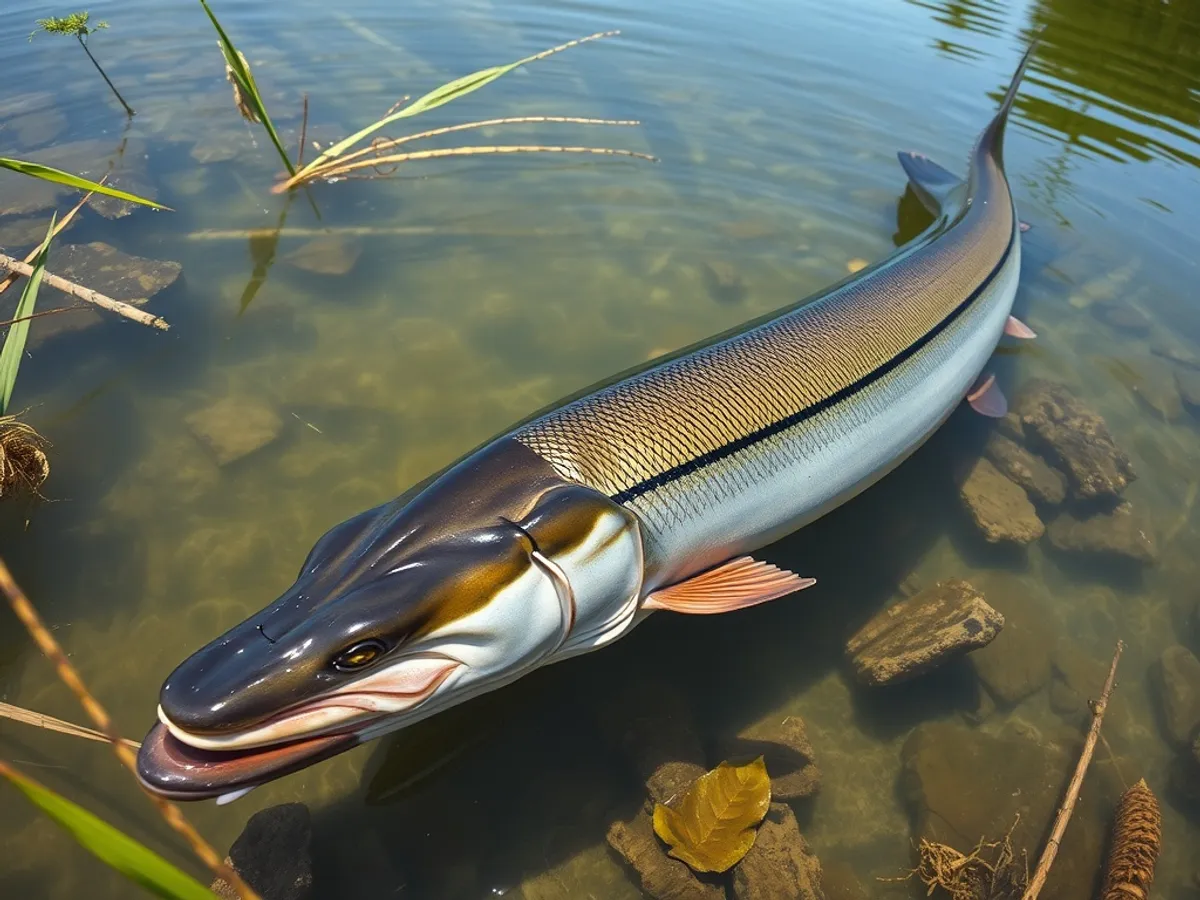
About the Muskellunge
The Muskellunge, often called 'muskie,' is the largest member of the pike family and is renowned for its elongated body, pointed snout, and sharp teeth. It is a top predator in its freshwater habitats, hunting fish, frogs, and even small mammals or birds. Muskellunge are elusive and prized among anglers for their size and fighting spirit, often reaching impressive lengths. They have cryptic color patterns that help them blend into aquatic vegetation, making them stealthy ambush hunters.
Fascinating facts
Prized Sport Fish
Muskellunge are highly sought after by anglers due to their size and strength, often requiring specialized gear and techniques to catch.
Ferocious Predator
Their mouths are filled with sharp teeth and powerful jaws, enabling them to ambush and consume prey almost half their own size.
Habitat Camouflage
Their mottled coloration and vertical bars allow them to blend seamlessly into weedy and vegetated waters, making them expert ambush hunters.
Detailed description
The muskellunge (Esox masquinongy) is a large, elongated predatory fish distinguished by its torpedo-shaped body, flattened head, and long, pointed snout lined with numerous sharp, canine-like teeth. Adults typically range from 71 to 122 cm (28–48 in) in length, but exceptional individuals can exceed 150 cm (59 in) and weigh over 30 kg (66 lbs), making them the largest member of the Esocidae family. Their coloration is highly variable, often featuring light silver, green, or brown backgrounds with dark vertical bars or spots, providing effective camouflage among aquatic vegetation. The dorsal and anal fins are set far back on the body, enabling rapid acceleration and sudden lunges at prey. Muskellunge possess a lateral line system highly sensitive to vibrations, aiding in the detection of prey in murky waters. They are solitary apex predators, typically occupying clear, vegetated lakes and slow-moving rivers across the northern United States and Canada. Their cryptic coloration and ambush tactics allow them to remain motionless for extended periods before striking with explosive speed. Lifespans can reach 15–20 years in the wild, with some individuals living over 30 years in optimal conditions. The species exhibits sexual dimorphism, with females generally attaining larger sizes than males.
Did you know?
Unlike many other fish, muskellunge can live in relatively low-oxygen waters, allowing them to thrive in environments where other predators might struggle.
Research & sources
Wikipedia summary
The muskellunge, often shortened to muskie, musky, ski, or lunge, is a species of large freshwater predatory fish native to North America. It is the largest member of the pike family, Esocidae.
Behaviour & social structure
Muskellunge are primarily solitary and territorial, occupying defined home ranges that they defend from conspecifics, especially during the summer months. They are crepuscular, with peak hunting activity occurring during dawn and dusk, although feeding can occur throughout the day under suitable conditions. Their hunting strategy is characterized by ambush predation: muskellunge remain motionless among submerged vegetation or structure, then rapidly accelerate to capture prey with a sideways lunge. Their diet is opportunistic and shifts with age and size; juveniles consume zooplankton and small fish, while adults prey on fish (such as suckers, perch, and smaller pike), amphibians, waterfowl, and occasionally small mammals. Muskellunge exhibit low social interaction outside of the breeding season and rarely form groups. They are known for their wariness and sensitivity to disturbances, which contributes to their reputation as elusive game fish.
Reproduction & life cycle
Spawning occurs in early spring, typically when water temperatures reach 9–15°C (48–59°F), often shortly after ice-out. Muskellunge are broadcast spawners: females release eggs over shallow, vegetated areas or gravelly substrates, while multiple males fertilize them externally. There is no nest-building or parental care; eggs are left to develop unguarded. Fecundity is high, with large females producing up to 250,000 eggs per season, though survival rates are low due to predation and environmental factors. Incubation lasts 8–14 days, depending on temperature, after which larvae are planktonic before settling into vegetated nursery habitats. Sexual maturity is reached at 3–5 years for males and 4–7 years for females, with growth rates influenced by water temperature, prey availability, and population density.
Adaptations & survival
Muskellunge possess several adaptations for predation and survival. Their elongated, streamlined bodies and posteriorly positioned fins enable rapid bursts of speed and agile maneuvering during ambush attacks. The large, tooth-filled jaws are capable of grasping and subduing sizable, slippery prey. Their cryptic coloration and patterning provide camouflage among aquatic vegetation, reducing detection by both prey and potential predators. The lateral line system is highly developed, allowing muskellunge to detect subtle water movements and vibrations, even in low-visibility conditions. Physiologically, they tolerate a range of water temperatures but prefer cool, well-oxygenated environments. Behaviorally, their solitary and territorial nature reduces competition for resources and minimizes intraspecific conflict.
Cultural significance
Muskellunge hold iconic status among North American anglers, revered for their size, power, and challenging pursuit—often referred to as 'the fish of ten thousand casts.' They are central to the sport fishing culture of the Great Lakes and Upper Midwest, with numerous tournaments and clubs dedicated to their pursuit. In Indigenous cultures, muskellunge have been featured in traditional stories and as a food source, though their role is less prominent than other fish species. The fish also appears in regional folklore and is the state fish of Wisconsin. Conservation and catch-and-release ethics are strongly promoted within the angling community to ensure sustainable populations.
Recent research
Recent research has focused on muskellunge genetics, population structure, and the effectiveness of stocking programs. Studies using telemetry have revealed detailed movement patterns, habitat preferences, and seasonal migrations, informing management strategies. Genetic analyses have clarified the relationships between muskellunge, northern pike, and their hybrids, aiding in the identification of distinct population segments. Ongoing research investigates the impacts of climate change on muskellunge distribution and reproductive success, as well as the ecological consequences of introducing muskellunge into non-native waters. Advances in hatchery techniques and selective breeding are being explored to enhance survival rates and maintain genetic diversity in stocked populations.
Videos
Habitat
Freshwater lakes and rivers with clear water and abundant vegetation


Conservation
The Muskellunge is currently classified as Least Concern on the IUCN Red List.
Threats & challenges
While the muskellunge is currently classified as Least Concern, populations face several localized threats. Habitat loss and degradation from shoreline development, water pollution, and dam construction can reduce spawning and nursery habitats. Overfishing, particularly by anglers targeting trophy specimens, can impact local population structure, as large, mature females are disproportionately removed. Muskellunge are sensitive to changes in water quality and temperature, making them vulnerable to climate change and eutrophication. Stocking programs and habitat restoration have been implemented in some regions to support declining populations. Hybridization with northern pike (producing 'tiger muskies') can also occur, though it is typically limited to areas where both species overlap.
Taxonomy
Scientific name
Esox masquinongy
- Kingdom
- Animalia
- Phylum
- Chordata
- Class
- Actinopterygii
- Order
- Esociformes
- Family
- Esocidae
- Genus
- Esox
- Species
- masquinongy
Community notes
Share your observations about the Muskellunge.
No community notes yet. Be the first!
Discover more wildlife
More fascinating animals from the encyclopedia.