
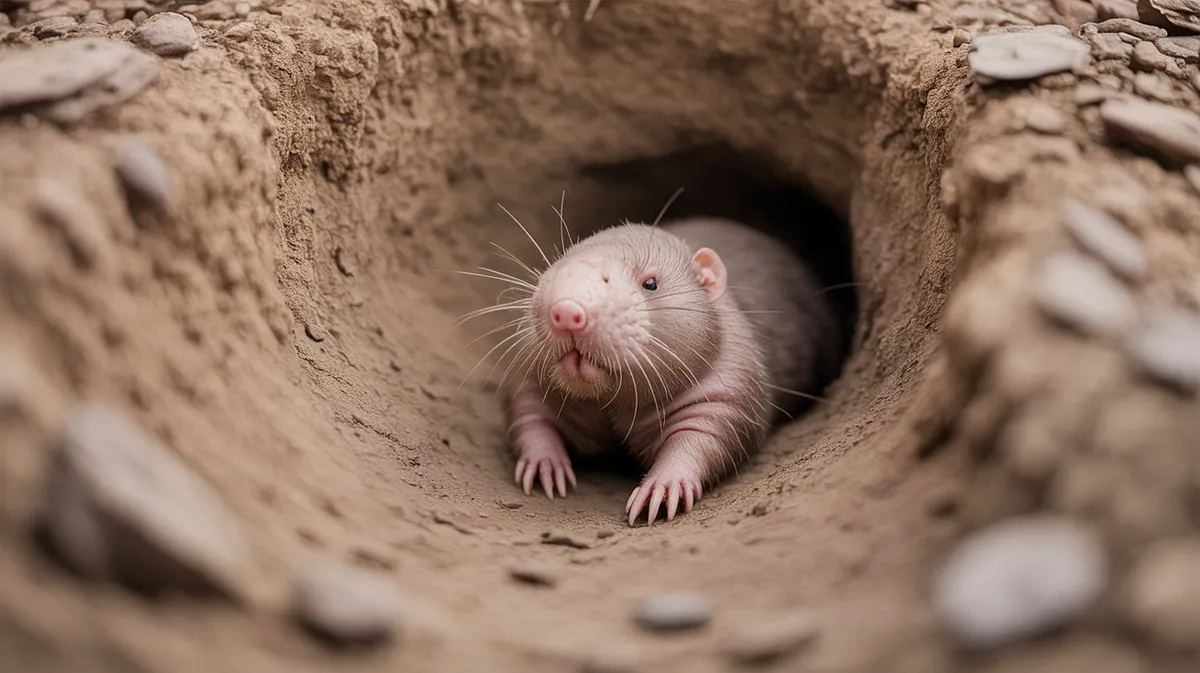
About the Naked Mole Rat
The naked mole rat breaks so many mammalian rules that it is studied less as a rodent than as a biological anomaly. It is eusocial — one of the only mammals to live like ants or bees, in colonies where a single breeding queen chemically suppresses reproduction in everyone else while non-breeding workers dig, forage and defend. It is effectively cold-blooded, unable to hold a stable body temperature, and instead shuttles between warmer and cooler chambers of its burrow and huddles for heat. It is strikingly resistant to cancer, its cells refusing to overcrowd, and it barely ages: mortality risk does not climb with time the way it does in other mammals, and individuals live around thirty years — roughly ten times a mouse. It cannot feel pain from acid, an adaptation to sealed burrows where carbon dioxide builds to levels that would be agonising to other mammals. Deprived of oxygen entirely, it switches to metabolising fructose — a trick otherwise seen in plants — and survives for many minutes where a mouse would be dead in one.
Fascinating facts
Colony Queen
Each naked mole rat colony has a single breeding queen, while other females are sterile workers.
Burrowing Masters
They use their large incisors to dig complex tunnel systems stretching for several kilometers.
Cancer Resistance
Naked mole rats have a unique biology that makes them almost entirely resistant to cancer.
Detailed description
The naked mole rat (Heterocephalus glaber) is a small, fossorial rodent measuring 8–10 cm in length and weighing 30–50 grams, with queens reaching up to 80 grams. Its most distinctive feature is its nearly hairless, wrinkled, pinkish or yellowish skin, which lacks insulating fur and is highly sensitive to touch and vibration. The species has tiny, degenerate eyes and poor vision, relying instead on tactile and olfactory cues. Its prominent, ever-growing incisors protrude externally and are used for digging through hard, compact soils. Naked mole rats are renowned for their eusocial organization, living in colonies that can exceed 300 individuals, with a strict division of labor among castes: a single breeding queen, a few breeding males, and numerous sterile workers and soldiers. Colonies construct extensive underground tunnel systems, sometimes stretching over 3–5 kilometers, with specialized chambers for nesting, food storage, and waste. Their metabolism is extremely low, and they can survive in hypoxic (low oxygen) and hypercapnic (high carbon dioxide) environments that would be lethal to most mammals. Naked mole rats exhibit remarkable longevity for rodents, with lifespans exceeding 30 years, and show negligible signs of aging or age-related decline. They are also highly resistant to cancer, pain, and certain types of tissue injury, making them a model organism in biomedical research.
Did you know?
Naked mole rats can survive up to 18 minutes without oxygen, far longer than most mammals.
Research & sources
Wikipedia summary
The naked mole-rat, also known as the sand puppy, is a burrowing rodent native to the Horn of Africa and parts of Kenya, notably in Somali regions. It is closely related to the blesmols and is the only species in the genus Heterocephalus.
Behaviour & social structure
Naked mole rats are strictly subterranean and almost never emerge above ground. They are active throughout the day and night, with activity patterns governed more by colony needs than by circadian rhythms. Workers are responsible for foraging, tunnel excavation, and maintenance, using their teeth to dig and their lips to seal their mouths from soil. Soldiers defend the colony from predators such as snakes and rival colonies, displaying aggressive postures and biting. Communication is complex, involving over 18 distinct vocalizations, as well as tactile and chemical signals. Foraging involves harvesting underground tubers and roots, which are gnawed from the outside, allowing regrowth and sustainable food supply. Cooperative behaviors include food sharing, allogrooming, and coordinated care of the queen and pups. Waste is deposited in dedicated latrine chambers, minimizing disease risk. Colony members recognize each other by scent, and intruders are fiercely repelled.
Reproduction & life cycle
Only the queen and 1–3 selected males reproduce in a colony, while all other members are reproductively suppressed through behavioral and pheromonal mechanisms. The queen is larger than other females, having undergone morphological changes after becoming dominant. She breeds year-round, producing litters of 1–28 pups (average 12) after a gestation period of about 70 days. Pups are born altricial (helpless and naked) and are cared for by workers, who feed them fecal pellets and later solid food. Weaning occurs at three to four weeks. Queens can produce up to five litters per year, and colony stability depends on her continued dominance; if she dies or is removed, intense competition among females may ensue to establish a new queen.
Adaptations & survival
Naked mole rats possess numerous adaptations for their subterranean lifestyle. Their skin is rich in sensory nerve endings, aiding navigation in darkness. They lack pain sensitivity to acid and capsaicin, likely an adaptation to high carbon dioxide levels in burrows. Their hemoglobin has an unusually high affinity for oxygen, and they can switch to anaerobic metabolism, using fructose instead of glucose, to survive periods of anoxia. Their low metabolic rate reduces oxygen demand. The external position of their incisors allows them to dig without ingesting soil. Socially, eusociality maximizes survival in harsh, resource-scarce environments by promoting cooperation and division of labor. Their resistance to cancer is linked to high-molecular-mass hyaluronan in their tissues, and they show exceptional DNA repair and protein stability mechanisms.
Cultural significance
Naked mole rats have limited traditional significance in local cultures but have become prominent in global popular culture and science. They are featured in educational programs, documentaries, and as the character 'Rufus' in the animated series 'Kim Possible.' Their unique biology has made them symbols of longevity, resilience, and scientific curiosity. In biomedical research, they are valued for insights into aging, cancer resistance, and pain physiology.
Recent research
Recent studies have revealed the naked mole rat's ability to survive up to 18 minutes without oxygen by switching to fructose-driven anaerobic metabolism, a trait unique among mammals. Their social structure is a rare example of mammalian eusociality, providing parallels to insect societies and insights into the evolution of cooperation. Ongoing research focuses on their cancer resistance, longevity, and pain insensitivity, with potential applications for human medicine. Genomic studies have identified unique genes related to DNA repair, protein stability, and metabolic adaptation. Behavioral research continues to explore their complex communication and social dynamics.
Videos
Habitat
Underground burrows in arid and semi-arid grasslands


Conservation
The Naked Mole Rat is currently classified as Least Concern on the IUCN Red List.
Threats & challenges
Currently, naked mole rats face few natural predators due to their subterranean habits, with snakes being the primary threat. Human impact is minimal, though habitat loss from agriculture and development could pose future risks. Their IUCN status is 'Least Concern,' with stable populations across their range. However, their specialized habitat requirements make them vulnerable to environmental changes, such as prolonged drought or soil compaction. Research collection for biomedical studies is carefully regulated to avoid population impacts.
Taxonomy
Scientific name
Heterocephalus glaber
- Kingdom
- Animalia
- Phylum
- Chordata
- Class
- Mammalia
- Order
- Rodentia
- Family
- Heterocephalidae
- Genus
- Heterocephalus
- Species
- glaber
Where to see a naked mole rat
9 zoos and aquariums in 2 countries are recorded as keeping this species.
 San Diego Zoo🇺🇸 San Diego, United States
 Zoo Dresden🇩🇪 Dresden, Germany
 Houston Zoo🇺🇸 Houston, United States
 National Zoological Park🇺🇸 Washington, United States
- 🦁Little Rock Zoo🇺🇸 Little Rock, United States
Community notes
Share your observations about the Naked Mole Rat.
No community notes yet. Be the first!
Discover more wildlife
More fascinating animals from the encyclopedia.