
About the Neon Tetra
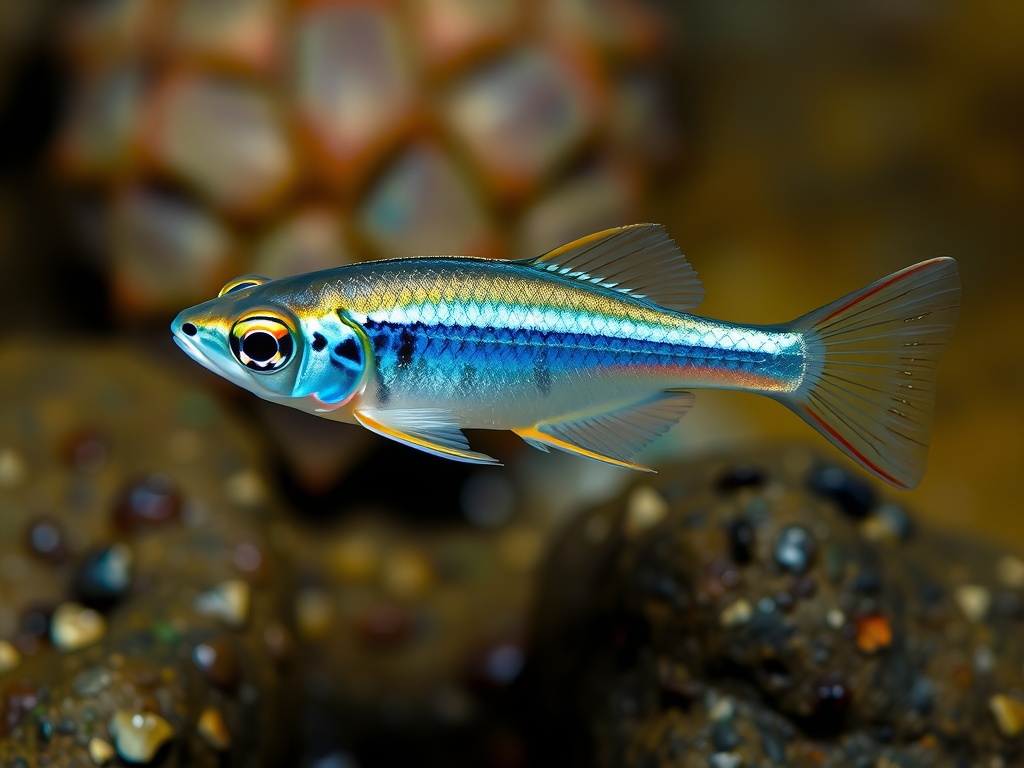
The neon tetra is a small, vibrantly colored freshwater fish native to the blackwater and clearwater streams of the Amazon Basin in South America. It is renowned for its iridescent blue lateral stripe and bright red tail, making it one of the most popular aquarium fish worldwide. Neon tetras are peaceful, schooling fish that thrive in groups and are best kept in well-planted tanks that mimic their natural habitat. These fish are sensitive to water conditions but are otherwise hardy when kept in stable, clean environments.
Fascinating facts
Tiny Size
Neon tetras rarely grow longer than 4 centimeters (1.5 inches), making them one of the smallest aquarium fish.
Bright Colors
Their brilliant blue and red stripes are used for communication and camouflage in the shifting light of Amazonian streams.
Schooling Behavior
Neon tetras are highly social and feel most secure when kept in groups of six or more, mimicking their natural schooling behavior.
Detailed description
The neon tetra (Paracheirodon innesi) is a diminutive freshwater fish, typically reaching an adult length of 3.5–4 cm (1.4–1.6 in) and weighing less than 1 g. Its most distinctive features are the iridescent blue stripe running laterally from the nose to the adipose fin and a vivid red stripe extending from the middle of the body to the base of the caudal fin. The body is slender, laterally compressed, and semi-transparent, with a silvery-white abdomen. Neon tetras possess a single dorsal fin, a small adipose fin, and a deeply forked caudal fin, which aid in agile schooling maneuvers. Their large eyes enhance vision in dimly lit blackwater habitats. In the wild, neon tetras inhabit slow-moving tributaries and flooded forest areas of the Amazon basin, where water is soft, acidic (pH 5.0–7.0), and temperatures range from 20–26°C (68–79°F). They are highly social, forming schools of several dozen to hundreds of individuals, which provides protection from predators and improves foraging efficiency. Neon tetras are omnivorous, feeding on small invertebrates, zooplankton, algae, and detritus. Their coloration is thought to play a role in intraspecific communication and mate selection, as well as camouflage among dappled sunlight and tannin-stained waters. In captivity, they are prized for their peaceful nature, adaptability to community tanks, and striking appearance.
Did you know?
Neon tetras are bioluminescent, meaning their colors appear to glow under certain lighting conditions, which is a form of camouflage in their native habitat.
Research & sources
Wikipedia summary
The neon tetra is a freshwater fish of the characin family of order Characiformes. The type species of its genus, it is native to blackwater and clearwater streams in the Amazon basin of South America. Its bright colouring makes the fish visible to conspecifics in the dark blackwater streams, and is also the main reason for its popularity among freshwater fish hobbyists, with neon tetras being one of the most widely kept tropical fish in the world.
Behaviour & social structure
Neon tetras are diurnal, becoming most active during daylight hours when they engage in schooling and foraging. Schooling behavior is tightly coordinated, with individuals synchronizing their movements to evade predators and reduce individual predation risk. When threatened, the school may rapidly disperse or change direction. Feeding occurs throughout the day, with tetras picking at microcrustaceans, insect larvae, and plant matter in the water column and on submerged surfaces. Social hierarchies are subtle but present, with dominant individuals often occupying central positions within the school. Neon tetras communicate visually, using body postures and coloration changes, and may exhibit mild territoriality during breeding. At night, they seek shelter among dense vegetation or submerged roots, reducing activity to conserve energy and avoid nocturnal predators.
Reproduction & life cycle
Neon tetras are egg scatterers with no parental care. Breeding typically coincides with the onset of the rainy season in the Amazon, when water levels rise and temperatures increase. Spawning is preceded by courtship displays, where males intensify their coloration and perform zigzag swimming patterns to attract females. Females release 60–130 adhesive eggs, which are fertilized externally as they fall among fine-leaved plants or detritus. Incubation lasts 24–36 hours at optimal temperatures (24–26°C), after which transparent larvae emerge. Fry are photophobic for the first few days, hiding in substrate and feeding on infusoria until they are large enough to consume microplankton. Sexual maturity is reached at 6–9 months. In captivity, successful breeding requires soft, acidic water and subdued lighting to mimic natural conditions.
Adaptations & survival
Neon tetras exhibit several adaptations for survival in blackwater environments. Their iridescent blue and red stripes enhance visibility to conspecifics in low-light, tannin-rich waters, facilitating schooling and mate recognition. The semi-transparent body reduces visibility to predators from below. Large eyes improve vision in dim conditions. Physiologically, neon tetras are adapted to soft, acidic water with low mineral content, and their gills are efficient at extracting oxygen from warm, low-oxygen habitats. Behaviorally, tight schooling reduces predation risk and increases foraging success. Their omnivorous diet allows flexibility in resource-limited environments.
Cultural significance
Neon tetras have become iconic in the aquarium hobby since their introduction to the West in the 1930s, symbolizing the allure of Amazonian biodiversity. They are among the most popular ornamental fish worldwide, valued for their beauty, peaceful temperament, and compatibility with other species. While they hold no significant role in indigenous mythology or traditional uses, their economic importance in the global aquarium trade is substantial, supporting livelihoods in both source and breeding countries. The species is often used in educational settings to teach about aquatic ecosystems and responsible pet ownership.
Recent research
Recent research has focused on the genetic diversity of wild and captive populations, revealing subtle differences that may impact long-term viability and coloration. Studies on stress physiology have shown that neon tetras are sensitive to water quality fluctuations, making them useful bioindicators of environmental health. Investigations into their schooling behavior have provided insights into collective animal movement and predator avoidance strategies. Ongoing research explores the impacts of selective breeding on health and coloration, as well as the ecological consequences of aquarium trade collection in native habitats.
Videos
Habitat
Freshwater streams and rivers


Conservation
The Neon Tetra is currently classified as Least Concern on the IUCN Red List.
Threats & challenges
In the wild, neon tetras face predation from larger fish, birds, and aquatic invertebrates. Habitat degradation due to deforestation, water pollution, and hydroelectric development poses localized threats, particularly in the upper Amazon basin. However, their wide distribution and adaptability contribute to a stable population, and the species is currently classified as Least Concern by the IUCN. Overharvesting for the aquarium trade was once a concern, but most neon tetras sold today are captive-bred, reducing pressure on wild populations. Climate change and ongoing habitat loss remain potential long-term threats.
Taxonomy
Scientific name
Paracheirodon innesi
- Kingdom
- Animalia
- Phylum
- Chordata
- Class
- Actinopterygii
- Order
- Characiformes
- Family
- Characidae
- Genus
- Paracheirodon
- Species
- innesi
Where to see a neon tetra
2 zoos and aquariums in 1 country are recorded as keeping this species.

Community notes
Share your observations about the Neon Tetra.
No community notes yet. Be the first!
Discover more wildlife
More fascinating animals from the encyclopedia.