
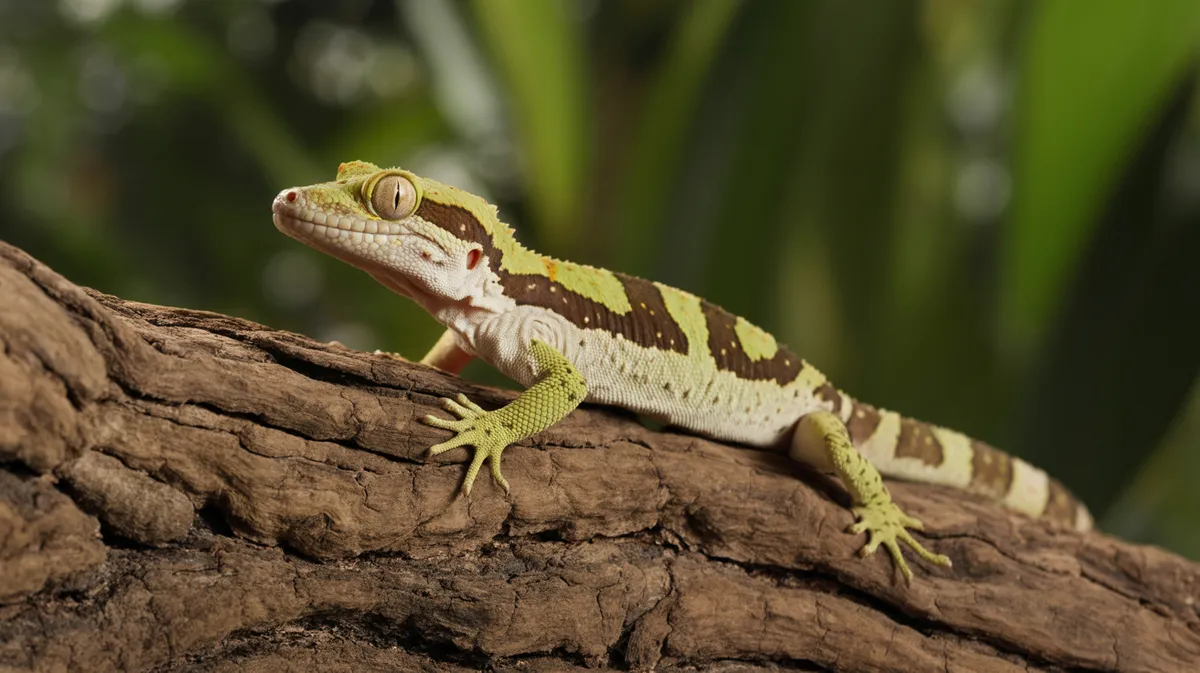
About the New Caledonian Giant Gecko
Rhacodactylus leachianus is the largest living gecko in the world, reaching about 36 cm in total length and over 250 g — heavy enough that it moves with a deliberate, sloth-like slowness quite unlike a typical darting gecko. It is endemic to New Caledonia and its offshore islets, and the island populations differ so much in size and pattern that keepers refer to distinct locality types by island name. It lives high in forest trees, sheltering by day in hollow trunks, and it is nocturnal, taking insects, fruit and nectar — and, according to some accounts, birds and other geckos. Its most memorable feature is its voice: it growls, and it produces a loud, guttural, dog-like bark and a rasping scream when disturbed, giving rise to the local name "devil in the trees." It also has skin that is loose, baggy and mossy in appearance, and a very short, stubby tail. Like other diplodactylids it has adhesive toe pads that work by van der Waals forces, with millions of setae splitting into nanoscale spatulae, and unusually the tail tip is also adhesive. The species is long-lived, with captives exceeding 20 years, and it lays only two eggs at a time, several times a year.
Fascinating facts
Largest Gecko
The New Caledonian Giant Gecko holds the record as the world's largest extant gecko species by length and mass.
Arboreal Lifestyle
This species spends nearly its entire life in the upper canopy of tropical forests, rarely descending to the ground.
Vocal Communicator
It communicates with conspecifics using a complex array of sounds, including barks, growls, and clicks.
Detailed description
The New Caledonian Giant Gecko (Rhacodactylus leachianus) is the largest extant gecko species, with adults typically reaching 25–36 cm (10–14 in) in total length and weighing up to 400 grams, though some insular forms are smaller. Its robust, muscular body is covered in loose, velvety skin, often colored in mottled shades of green, gray, brown, or olive, providing effective camouflage against tree bark and moss. The head is broad and triangular, with large lidless eyes adapted for nocturnal vision and vertical pupils for enhanced light sensitivity. Notably, the species possesses a prehensile tail, aiding in arboreal locomotion, and expanded toe pads with lamellae that allow for remarkable climbing ability on smooth surfaces. R. leachianus is primarily nocturnal and spends daylight hours concealed in tree hollows or crevices. It is renowned for its deep, barking vocalizations, which serve both territorial and communicative functions. The species exhibits a degree of territoriality, with individuals often defending tree hollows or sections of canopy. Sexual dimorphism is subtle, with males typically displaying slightly larger heads and more pronounced femoral pores. Lifespans in the wild are estimated at 15–20 years, with some individuals in captivity surpassing 25 years. Their diet is omnivorous, consisting of fruits, nectar, insects, and occasionally small vertebrates, reflecting their ecological role as both predator and seed disperser in New Caledonian forests.
Did you know?
This gecko can grow up to 36 centimeters (over 14 inches) in total length, making it the largest living gecko species on Earth.
Research & sources
Wikipedia summary
Rhacodactylus leachianus, commonly known as the New Caledonian giant gecko, Leach's giant gecko, leachianus gecko, or Leachie, is the largest living species of gecko and a member of the family Diplodactylidae. It is native to most of New Caledonia.
Behaviour & social structure
Rhacodactylus leachianus is primarily arboreal and nocturnal, emerging at dusk to forage and patrol its territory. Individuals are solitary outside of the breeding season, with both sexes exhibiting aggressive territorial displays, including vocalizations, body inflation, and open-mouthed posturing. They are opportunistic feeders, using their acute sense of smell and vision to locate ripe fruit, nectar, and invertebrate prey such as beetles, moths, and spiders. Feeding is often slow and deliberate, with geckos using their tongue to lap up soft foods or seize prey. During the day, they remain motionless in tree hollows, relying on cryptic coloration for protection. Social interactions are generally limited to mating encounters or territorial disputes, which can be intense and sometimes result in injury. Vocal communication is highly developed, with a repertoire of barks, growls, and squeaks used for mate attraction, deterrence of rivals, and alarm.
Reproduction & life cycle
Breeding in R. leachianus typically occurs during the warmer, wetter months (October to March in New Caledonia). Courtship involves vocalizations and tactile displays, with males often grasping females by the neck during copulation. Females lay clutches of 1–2 large, leathery eggs, usually deposited in moist, protected sites within tree hollows or under bark. Incubation is temperature-dependent and ranges from 60 to 90 days. Hatchlings are precocial, measuring 8–10 cm at birth, and are independent from the moment of hatching. Parental care is absent post-oviposition. In captivity, females may lay multiple clutches per season, but in the wild, clutch frequency is lower due to environmental constraints. Sexual maturity is reached at 2–3 years of age.
Adaptations & survival
R. leachianus exhibits several key adaptations for arboreal life, including a prehensile tail for balance and grip, and large, adhesive toe pads with microscopic setae for climbing vertical and even inverted surfaces. Its cryptic coloration and loose, baggy skin help break up its outline, providing camouflage against predators. The species' vocal abilities are unusual among geckos and serve as both a deterrent to rivals and a means of communication over long distances in dense forest. Its omnivorous diet allows it to exploit a wide range of food resources, while its robust jaws enable it to consume hard-shelled insects and tough fruits. The ability to autotomize (shed) the tail as a predator escape mechanism is present but less pronounced than in some smaller gecko species.
Cultural significance
While not a major figure in local Kanak mythology, the New Caledonian Giant Gecko is sometimes regarded as a symbol of the unique biodiversity of New Caledonia. Its impressive size and striking appearance have made it an animal of interest to naturalists and collectors since the 19th century. In recent years, it has become an ambassador species for New Caledonian conservation, featured in educational materials and ecotourism initiatives. There are no known traditional uses of the species in medicine or folklore, but its presence is often cited as evidence of the ancient origins and isolation of New Caledonia's fauna.
Recent research
Recent molecular studies have revealed significant genetic divergence among populations of R. leachianus, supporting the recognition of several subspecies or distinct evolutionary lineages, particularly between mainland (Grande Terre) and island (e.g., Isle of Pines) forms. Research into their vocalizations has highlighted the complexity and individual specificity of calls, suggesting advanced social communication. Ongoing ecological studies focus on habitat requirements, population densities, and the impact of invasive species. Captive breeding programs have provided insights into reproductive biology and growth rates, aiding both conservation and the responsible management of the pet trade. The species is also of interest in studies of gecko adhesion and biomechanics due to its large size.
Videos
Habitat
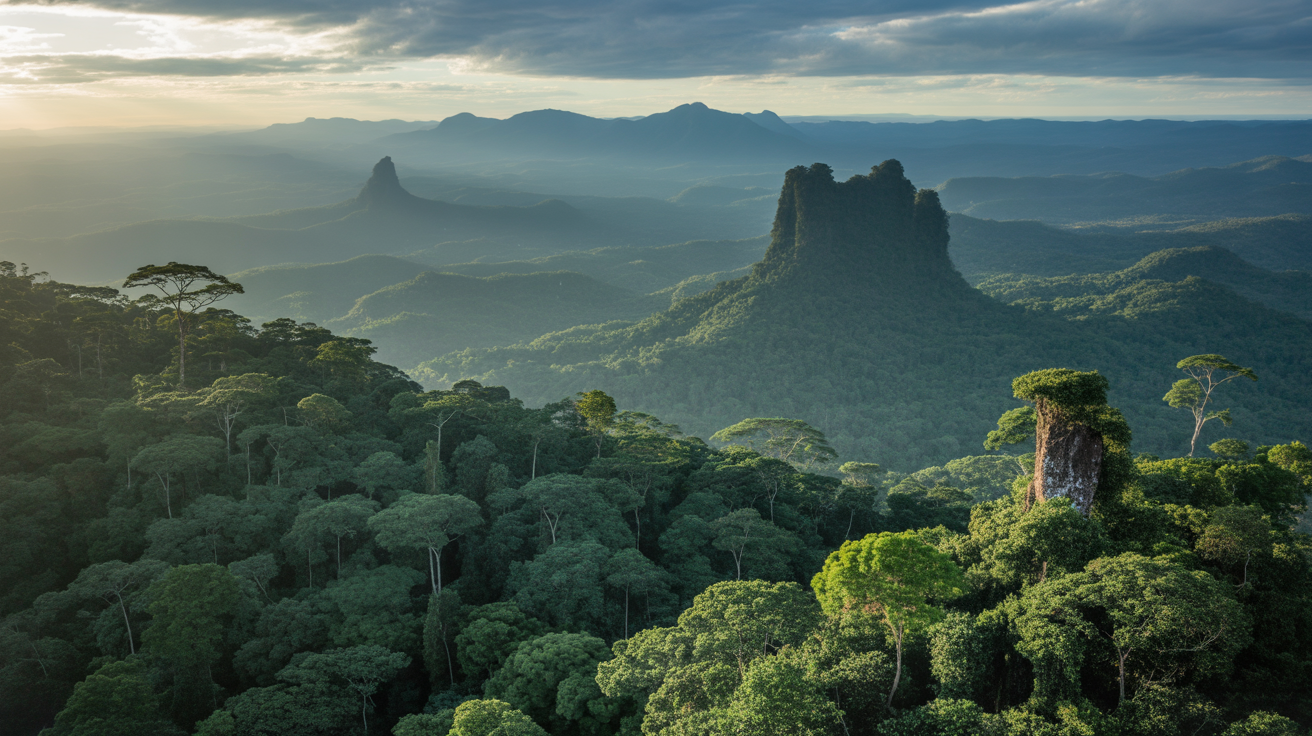
Tropical forest (primarily humid lowland and montane forests)
 Elevated Terrain
Mountain
High-altitude environments with varying climates and specialized wildlife adapted to rugged terrain and thin air.
 Tropical Regions
Rainforest
Dense, wet forests with the highest biodiversity on Earth, containing more than half of the world's plant and animal species.
 Global
Forest
Wooded areas with significant tree cover and diverse plant and animal communities.
Conservation
The New Caledonian Giant Gecko is currently classified as Near Threatened on the IUCN Red List.
Threats & challenges
The primary threats to R. leachianus include habitat loss due to logging, agriculture, and urban development, as well as predation by introduced species such as rats and cats. Illegal collection for the international pet trade also poses a significant risk, particularly to isolated populations. Fragmentation of forest habitats restricts gene flow and increases vulnerability to stochastic events. Climate change, with its associated shifts in temperature and humidity, may further impact reproductive success and food availability. While the species is still locally common in some areas, population declines have been observed, especially on smaller islands. Conservation efforts are hampered by limited ecological data and the species' secretive habits.
Taxonomy
Scientific name
Rhacodactylus leachianus
- Kingdom
- Animalia
- Phylum
- Chordata
- Class
- Reptilia
- Order
- Squamata
- Family
- Diplodactylidae
- Genus
- Rhacodactylus
- Species
- leachianus
Where to see a new caledonian giant gecko
1 zoo and aquarium in 1 country are recorded as keeping this species.

Community notes
Share your observations about the New Caledonian Giant Gecko.
No community notes yet. Be the first!
Discover more wildlife
More fascinating animals from the encyclopedia.