
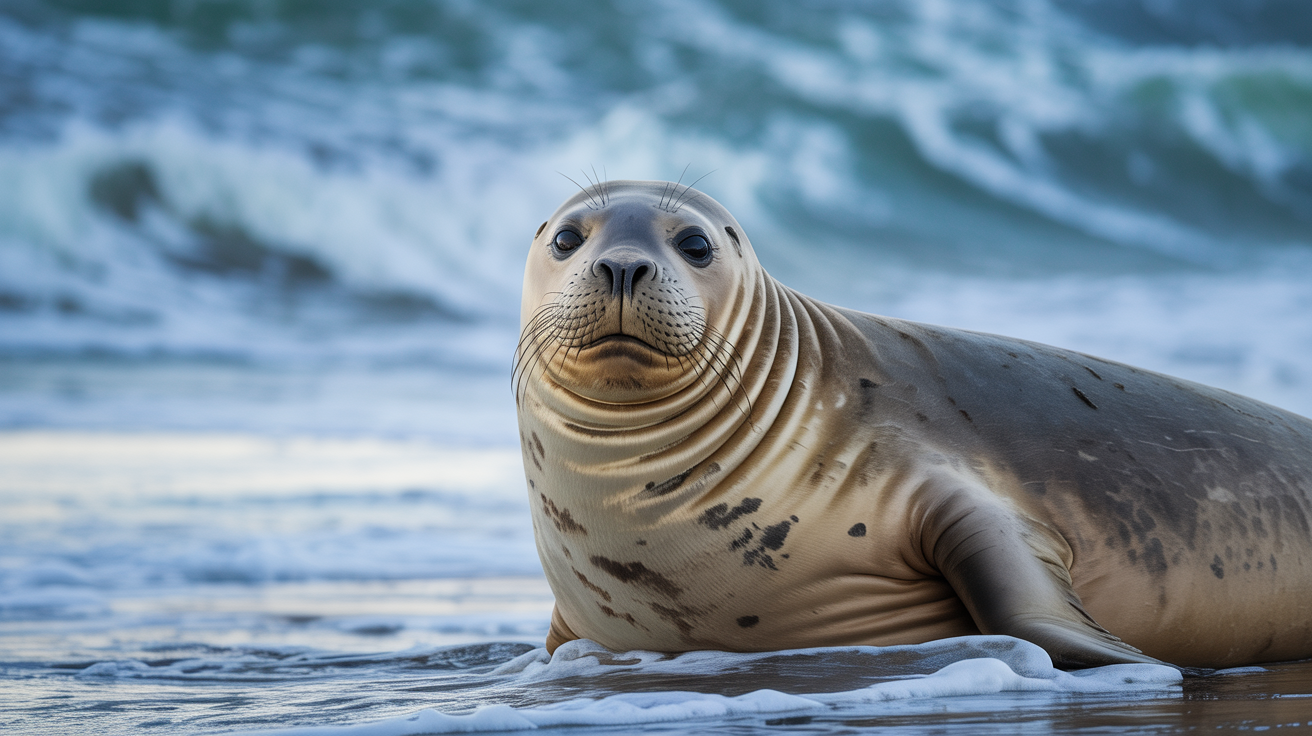
About the Northern Elephant Seal
Mirounga angustirostris is one of the deepest-diving air-breathing animals in the world, routinely working at 300 to 800 m and recorded past 1,700 m, and it spends roughly 90 percent of its life at sea and about 80 percent of that submerged — surfacing for only two or three minutes between dives of 20 minutes or more. It manages this by collapsing its lungs on descent to avoid nitrogen loading, slowing its heart to a few beats per minute, and carrying an enormous oxygen store in blood and muscle rather than in air. Females forage across the open North Pacific for months, following the deep scattering layer; males instead grind along the continental shelf up to the Aleutians. The species is a striking case of a genetic bottleneck: hunted for its blubber oil down to perhaps 20 to 100 animals on Isla de Guadalupe by the 1890s, it has rebounded to well over 200,000 but shows almost no genetic diversity, which is a long-term risk. Bulls reach 2,000 kg and four times a female's mass and fight bloodily on the beach for harems of dozens of females; the inflatable proboscis acts as a resonating chamber for the low, drumming threat call, and each bull's call has an individually recognisable rhythm that rivals learn.
Fascinating facts
Record-Breaking Dives
Northern Elephant Seals are among the deepest diving mammals, regularly reaching depths of over 1,500 meters in search of prey.
Impressive Size Difference
Adult males can weigh up to 2,300 kg and grow over 4 meters long, while females are much smaller, usually weighing less than 600 kg.
Ocean Wanderers
They spend most of their lives at sea, only coming ashore for breeding and molting, sometimes traveling more than 21,000 km per year.
Detailed description
The Northern Elephant Seal (Mirounga angustirostris) is a massive pinniped, with adult males (bulls) reaching lengths of up to 4–5 meters (13–16 ft) and weighing as much as 2,300 kg (5,000 lbs), while females (cows) are significantly smaller, typically 2.5–3.6 meters (8–12 ft) long and weighing 400–900 kg (880–2,000 lbs). Males are distinguished by their large, inflatable proboscis, which amplifies their vocalizations during the breeding season and is a key feature in male-male competition. Their bodies are streamlined for efficient swimming, with strong foreflippers and a thick layer of blubber for insulation and energy storage. The pelage is generally grayish or brown, with pups born black and molting to a silvery gray. Northern Elephant Seals spend about 80–90% of their lives at sea, often far from land, and are among the deepest and longest-duration divers of all mammals. They are solitary at sea but highly gregarious during breeding and molting, forming dense colonies on remote beaches. Their eyes are large and adapted for low-light vision, aiding in deep-water foraging. The species exhibits pronounced sexual dimorphism not only in size but also in behavior and life history strategies. Their annual cycle is marked by two haul-outs: one for breeding (December–March) and one for molting (April–August), with individuals fasting for weeks during these periods.
Did you know?
Despite their massive size, Northern Elephant Seals can travel thousands of kilometers in a single migration between feeding and breeding grounds.
Research & sources
Wikipedia summary
The northern elephant seal is one of two species of elephant seal. It is a member of the family Phocidae. Elephant seals derive their name from their great size and from the male's large proboscis, which is used in making extraordinarily loud roaring noises, especially during the mating competition. Sexual dimorphism in size is great. Correspondingly, the mating system is highly polygynous; a successful male is able to impregnate up to 50 females in one season.
Behaviour & social structure
Northern Elephant Seals are primarily solitary and pelagic outside of the breeding and molting seasons. At sea, they exhibit a bimodal diving pattern: females typically dive deeper and for longer durations (average 400–600 meters, up to 1,500 meters, with dives lasting 20–30 minutes), while males tend to forage along the continental shelf at shallower depths. Their diet consists mainly of squid, fish (such as Pacific hake and lanternfish), and occasionally small sharks and rays. Foraging trips can last several months and cover thousands of kilometers, with individuals displaying remarkable navigational abilities. On land, social interactions are dominated by a strict hierarchy among males, established through vocalizations, displays, and physical confrontations. Females form loosely organized groups, and mother-pup pairs are highly bonded during the nursing period. Daily routines on land are largely inactive, with individuals conserving energy by resting and minimizing movement.
Reproduction & life cycle
Northern Elephant Seals have a highly polygynous mating system, with dominant alpha males controlling access to large harems of up to 50 females. The breeding season occurs from December to March, primarily on sandy beaches of offshore islands and remote mainland sites from Baja California to central California. Females give birth to a single pup after an 11-month gestation, which includes a delayed implantation period of about 3–4 months. Pups are nursed for approximately 24–28 days, during which mothers fast and rely on stored blubber. Weaned pups, known as 'weaners,' remain on the beach for several weeks, learning to swim and fast before heading to sea. Males reach sexual maturity at 5–6 years but rarely achieve breeding success until 8–10 years, while females begin breeding at 3–5 years. Parental care is provided exclusively by the mother; males do not participate in pup rearing.
Adaptations & survival
Northern Elephant Seals possess several remarkable adaptations for deep diving and long-distance oceanic travel. Their blood has a high concentration of hemoglobin and myoglobin, allowing efficient oxygen storage, and they can shunt blood away from non-essential organs to conserve oxygen during dives. Their large eyes enhance vision in the dim light of deep waters, and their whiskers (vibrissae) are sensitive to water movements, aiding in prey detection. The thick blubber layer provides insulation in cold waters and serves as an energy reserve during prolonged fasting. Behavioral adaptations include synchronized haul-outs to minimize predation risk and energy expenditure, and a highly developed sense of spatial memory for navigation. Their proboscis in males is an evolutionary specialization for acoustic signaling and social dominance.
Cultural significance
Northern Elephant Seals have featured in the cultural narratives of indigenous peoples along the Pacific coast, though they were not as heavily hunted for subsistence as other marine mammals. In the 19th century, they were extensively hunted for their blubber, which was rendered into oil for lamps and industrial uses. Today, they are a focus of ecotourism and scientific study, particularly at accessible colonies such as Año Nuevo State Park and Piedras Blancas in California. Their dramatic life history and recovery from near-extinction have made them symbols of marine conservation success.
Recent research
Recent research on Northern Elephant Seals has focused on their extraordinary diving physiology, including studies using biologging devices to record heart rate, blood oxygen levels, and movement patterns during deep dives. Genetic studies have revealed extremely low genetic diversity, yet the species has persisted and expanded, offering insights into population recovery and resilience. Ongoing research is examining the impacts of climate change on foraging ecology and the potential for disease outbreaks in dense colonies. Satellite telemetry has greatly expanded knowledge of their migratory routes and foraging hotspots, informing conservation strategies. Notably, studies of their sleep patterns at sea have revealed that they can sleep during short, drifting dives, a unique adaptation among mammals.
Videos
Habitat
Coastal beaches and islands along the Pacific coast of North America

Conservation
The Northern Elephant Seal is currently classified as Least Concern on the IUCN Red List.
Threats & challenges
Although the Northern Elephant Seal has rebounded from near-extinction in the late 19th century (when fewer than 100 individuals survived), the species remains vulnerable to several threats. These include entanglement in fishing gear, disturbance from human activities at breeding sites, oil spills, and disease outbreaks. Climate change poses a growing challenge by altering prey availability and oceanographic conditions. Their limited genetic diversity, a legacy of the population bottleneck, may reduce resilience to disease and environmental change. Despite these challenges, current population trends are stable or increasing, with an estimated 200,000 individuals, but ongoing monitoring and habitat protection are crucial.
Taxonomy
Scientific name
Mirounga angustirostris
- Kingdom
- Animalia
- Phylum
- Chordata
- Class
- Mammalia
- Order
- Carnivora
- Family
- Phocidae
- Genus
- Mirounga
- Species
- angustirostris
Community notes
Share your observations about the Northern Elephant Seal.
No community notes yet. Be the first!
Discover more wildlife
More fascinating animals from the encyclopedia.