
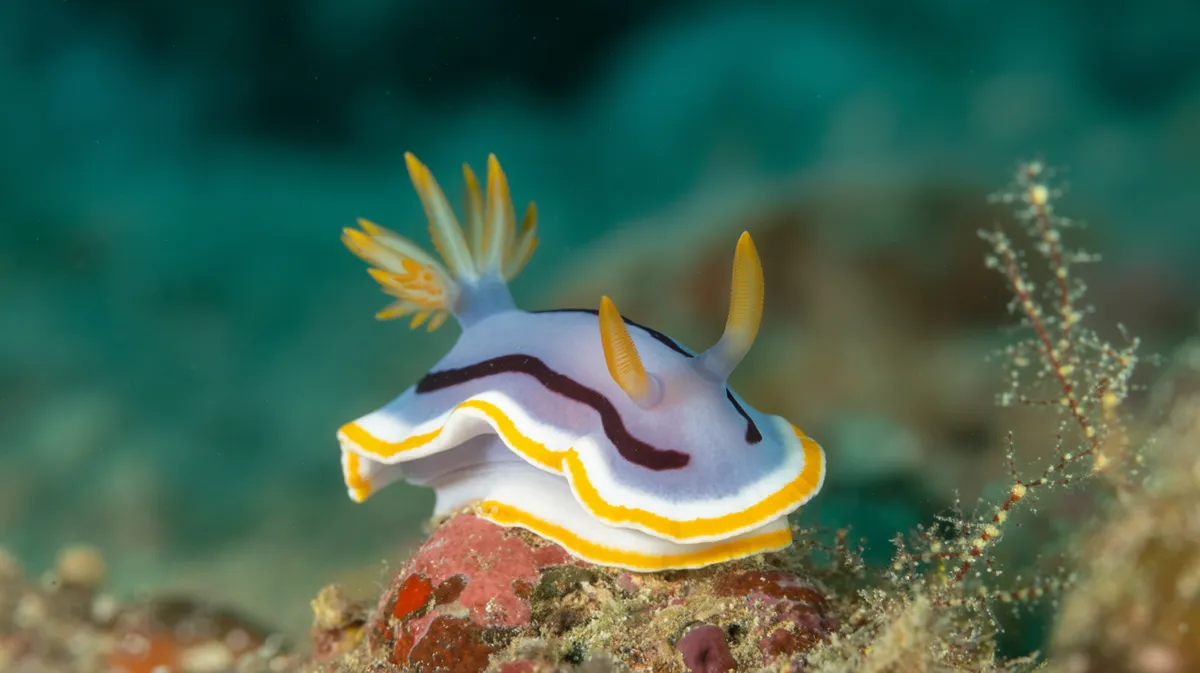
About the Nudibranch
Nudibranchs are sea slugs that have thrown away their shell and replaced it with chemistry. There are around 3,000 described species, and the group's defining trick is the theft of other organisms' weapons: aeolid nudibranchs eat hydroids, anemones and even Portuguese man o' war, pass the undischarged stinging cells intact through their gut, and store them in the tips of their dorsal cerata, where they are used for the slug's own defence — kleptocnidae, one of the strangest cases of weapon appropriation in nature. Dorid nudibranchs instead sequester or synthesise toxins from the sponges they eat, and their brilliant colours are aposematic advertising of the fact. Some, like Elysia and the related sacoglossans, go further and steal chloroplasts, though true nudibranchs generally do not. The name means "naked gill," a reference to the exposed rosette of gills on a dorid's back; the pair of tentacles on the head, the rhinophores, are chemosensory and can detect prey trails in water. All nudibranchs are simultaneous hermaphrodites, and because their genital openings are on the right side of the body, two mating slugs must align head to tail, right side to right side. Almost all are carnivores.
Fascinating facts
Brilliant Colors
Nudibranchs are famous for their vibrant coloration, which can serve as camouflage or as a warning to predators about their toxicity.
Chemical Defenses
Many nudibranchs can sequester toxins or stinging cells from their prey, such as jellyfish or sponges, and use them for their own defense.
Solar Power
Certain species can photosynthesize by incorporating chloroplasts or symbiotic algae into their tissues, a process known as kleptoplasty.
Detailed description
Nudibranchs are a diverse order of marine gastropod mollusks, distinguished by their lack of a protective shell in the adult stage and their often vivid coloration and intricate body forms. Adult nudibranchs typically range in size from a few millimeters up to 60 centimeters, though most species are between 2 and 6 centimeters long. Their soft, elongated bodies are divided into a head, a central visceral mass, and a foot, with the head bearing sensory tentacles called rhinophores that detect chemical cues in the water. Many species also display elaborate cerata or gill structures on their dorsal surface, which function in respiration and, in some species, defense. Nudibranchs are exclusively carnivorous, preying on a wide variety of sessile or slow-moving invertebrates such as sponges, hydroids, bryozoans, anemones, and even other nudibranchs. They are solitary animals, generally active during the day, and rely on chemosensory and tactile cues to locate food and mates. Nudibranchs are simultaneous hermaphrodites, possessing both male and female reproductive organs, and engage in reciprocal mating. Their eggs are laid in distinctive gelatinous ribbons or spirals attached to substrates. Many nudibranchs have evolved remarkable chemical defenses, often sequestering toxins or stinging cells from their prey and incorporating them into their own tissues, which, along with their aposematic coloration, deters predators. These adaptations, along with a high degree of ecological specialization, have contributed to the extraordinary diversity and evolutionary success of the group.
Did you know?
Some nudibranchs can photosynthesize by storing algae or chloroplasts from their food within their own tissues, allowing them to derive energy from sunlight.
Research & sources
Wikipedia summary
Nudibranchs are a group of soft-bodied marine gastropod molluscs, belonging to the order Nudibranchia, that shed their shells after their larval stage. They are noted for their often extraordinary colours and striking forms, and they have been given colourful nicknames to match, such as "clown", "marigold", "splendid", "dancer", "dragon", and "sea rabbit". About 3,000 species of nudibranchs are known.
Behaviour & social structure
Nudibranchs are primarily benthic and slow-moving, gliding along the substrate using muscular contractions of their broad, flat foot. They exhibit active foraging behavior, often using their rhinophores to 'taste' the water for chemical signals emitted by prey. Some species display complex hunting strategies, such as the aeolid nudibranchs, which can track down and consume cnidarians, carefully avoiding stinging tentacles. Social interactions are limited, as nudibranchs are generally solitary except during mating encounters. They do not form social groups or hierarchies. Daily activity patterns are influenced by light and prey availability, with some species more active during daylight hours, while others may be nocturnal. Defensive behaviors include rapid withdrawal of exposed appendages, secretion of distasteful or toxic compounds, and, in some cases, the display of bright warning colors to deter predators.
Reproduction & life cycle
Nudibranchs are simultaneous hermaphrodites, meaning each individual possesses both male and female reproductive organs. During mating, two individuals align head-to-tail and exchange sperm through a specialized genital pore. Fertilization is internal, and both partners can lay eggs after copulation. The eggs are deposited in elaborate, often species-specific gelatinous ribbons or coils on hard substrates, such as rocks, algae, or sponges. Embryonic development is typically direct, with planktonic veliger larvae hatching and undergoing a brief free-swimming stage before settling and metamorphosing into juvenile nudibranchs. There is no parental care after egg-laying. Breeding can occur year-round in tropical regions, while temperate species may have defined breeding seasons linked to water temperature and food availability.
Adaptations & survival
Nudibranchs exhibit a suite of remarkable adaptations for survival in diverse marine environments. Their bright coloration serves as aposematic (warning) signaling, advertising their toxicity or unpalatability to potential predators. Many species sequester chemical defenses from their prey, such as toxic metabolites from sponges or nematocysts (stinging cells) from cnidarians, which are stored in specialized tissues or cerata. Some nudibranchs, like those in the genus Elysia, can incorporate chloroplasts from algae into their own cells, enabling limited photosynthesis (kleptoplasty). The loss of the shell in the adult stage has allowed for greater flexibility and access to narrow crevices, while the development of rhinophores and oral tentacles enhances their ability to detect food and mates. Their reproductive strategy as simultaneous hermaphrodites maximizes reproductive success in low-density populations.
Cultural significance
Nudibranchs have become icons of marine biodiversity and are popular subjects in underwater photography and ecotourism, celebrated for their beauty and diversity. In some cultures, their striking appearance has inspired art, jewelry, and folklore, though they are not traditionally used for food or medicine due to their toxicity. Nudibranchs are also important in scientific research, serving as model organisms for studies on chemical ecology, neurobiology, and evolutionary biology.
Recent research
Recent research has focused on the chemical compounds produced or sequestered by nudibranchs, many of which have potential pharmaceutical applications, including anticancer and antimicrobial agents. Molecular phylogenetic studies have reshaped the understanding of nudibranch evolutionary relationships, revealing cryptic species and clarifying classification. Studies on kleptoplasty in sacoglossan relatives have provided insights into symbiosis and horizontal gene transfer. Ongoing research is also examining the impacts of climate change on nudibranch distribution, phenology, and population dynamics. Citizen science initiatives, such as global nudibranch surveys, are contributing valuable data on species diversity and distribution.
Videos
Habitat
Ocean

Conservation
The Nudibranch is currently classified as Least Concern on the IUCN Red List.
Threats & challenges
While most nudibranch species are currently classified as Least Concern, they face a range of threats from human activities and environmental changes. Habitat destruction, particularly of coral reefs and coastal ecosystems, poses a significant risk. Pollution, including oil spills and chemical contaminants, can directly harm nudibranchs or disrupt their food sources. Climate change and ocean acidification are altering marine habitats and may impact the distribution and abundance of both nudibranchs and their prey. Overcollection for the aquarium trade and scientific study has affected some localized populations. Despite these challenges, many species display resilience due to their wide distribution and adaptability, though specialized or endemic species may be more vulnerable.
Taxonomy
Scientific name
Chromodoris willani (example)
- Kingdom
- Animalia
- Phylum
- Mollusca
- Class
- Gastropoda
- Order
- Nudibranchia
- Family
- various (e.g., Chromodorididae, Glaucidae, etc.)
- Genus
- various (e.g., Chromodoris)
- Species
- willani (example)
Community notes
Share your observations about the Nudibranch.
No community notes yet. Be the first!
Discover more wildlife
More fascinating animals from the encyclopedia.