
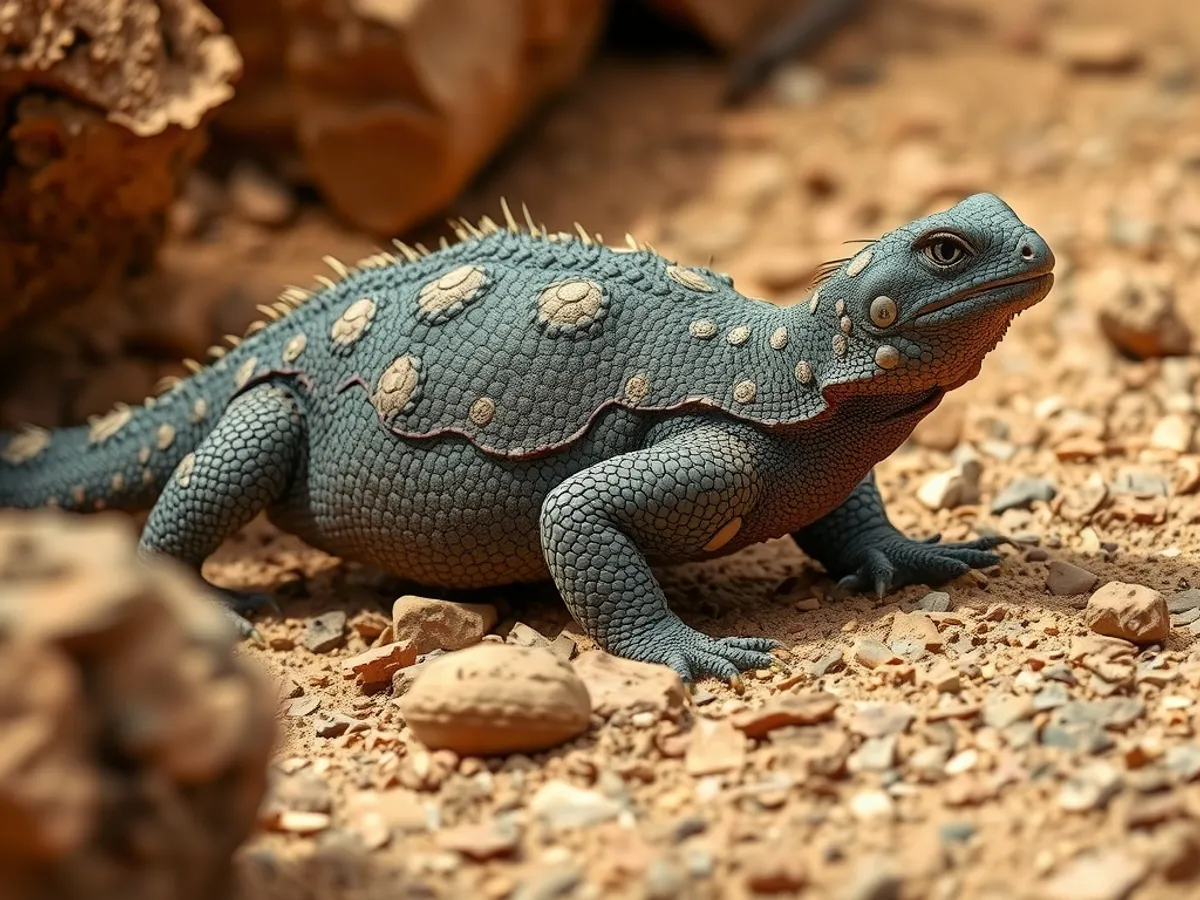
About the Ocellated Uromastyx
The Ocellated Uromastyx is a medium-sized, robust lizard notable for its vibrant blue coloration marked with yellow and white spots, or 'ocelli', giving it a striking appearance. Native to arid and semi-arid regions of northeastern Africa, this diurnal reptile is highly adapted to hot, rocky deserts where it finds shelter in burrows. It primarily feeds on a herbivorous diet, consuming leaves, flowers, and seeds, and is well-known for its spiny, club-like tail used in defense. The species is popular in the exotic pet trade due to its dazzling colors and relatively docile temperament.
Fascinating facts
Desert Specialist
The Ocellated Uromastyx has adapted to extreme desert heat by seeking shelter in deep burrows during the hottest parts of the day.
Colorful Patterns
Their bright blue bodies with yellow-spotted 'ocelli' make them one of the most visually stunning uromastyx species.
Plant Eater
Despite the harsh desert environment, this lizard thrives on a diet of tough, fibrous desert plants and seeds.
Detailed description
The Ocellated Uromastyx (Uromastyx ocellata) is a medium-sized agamid lizard, typically reaching a total length of 30–35 cm, with robust, muscular limbs and a broad, flattened body. Its most distinctive feature is its vivid blue dorsal coloration, adorned with numerous yellow to white ocelli (eye-like spots), which serve as both camouflage and a warning display. The head is short and blunt, with strong jaws adapted for crushing tough plant material. The tail is thick, spiny, and club-like, comprising 20–23 whorls of sharply keeled scales, used defensively against predators. The ventral surface is generally lighter, often pale cream or yellowish. U. ocellata is diurnal and highly heliothermic, basking for extended periods to regulate its body temperature, often exceeding 40°C. It is predominantly terrestrial, inhabiting rocky outcrops and burrow systems that provide refuge from extreme desert temperatures and predators. The species exhibits marked sexual dimorphism, with males displaying more intense coloration and larger femoral pores. Its herbivorous diet is supplemented opportunistically with insects, especially during juvenile stages. The Ocellated Uromastyx displays complex social behaviors, including territoriality and visual signaling, and is well-adapted to arid environments through physiological and behavioral specializations.
Did you know?
Unlike many lizards, the Ocellated Uromastyx gets almost all its required water from the plants it eats and rarely drinks standing water.
Research & sources
Behaviour & social structure
Ocellated Uromastyx are primarily solitary, with individuals maintaining and defending territories, especially during the breeding season. They are active during the hottest parts of the day, emerging from burrows to bask and forage. Their feeding behavior is highly selective, favoring nutrient-rich leaves, flowers, and seeds of desert plants, but juveniles may consume insects for additional protein. They use visual cues, such as head-bobbing and tail-waving, to communicate with conspecifics, particularly during territorial disputes or courtship. When threatened, they retreat rapidly into burrows or crevices, using their spiny tails to block entrances and deter predators. U. ocellata is known for its ability to tolerate high body temperatures and can remain active when surface temperatures exceed 45°C. They exhibit seasonal activity patterns, with reduced activity or aestivation during the coolest or driest months.
Reproduction & life cycle
Breeding in Uromastyx ocellata typically occurs at the onset of the hot, dry season (March–June), triggered by increasing temperatures and day length. Males engage in courtship displays involving head-bobbing, body inflation, and vibrant coloration to attract females. After successful copulation, females lay a clutch of 8–20 eggs in deep, humid burrows, which they excavate specifically for nesting. Incubation lasts approximately 8–10 weeks, depending on ambient temperatures (usually 28–32°C). There is no parental care post-oviposition; hatchlings are independent from birth and must fend for themselves. Sexual maturity is reached at 2–3 years of age, with growth rates influenced by food availability and environmental conditions. Reproductive output may vary annually based on rainfall and plant productivity.
Adaptations & survival
Uromastyx ocellata exhibits several key adaptations for desert survival. Its spiny tail serves as both a defensive weapon and a deterrent, making it difficult for predators to extract the lizard from burrows. The species is capable of rapid burrowing, using strong forelimbs to excavate shelters that buffer against extreme temperatures and dehydration. Physiologically, it has a low metabolic rate and can conserve water by producing highly concentrated uric acid instead of liquid urine. The digestive system is specialized for cellulose breakdown, with an enlarged colon and symbiotic gut flora. Behavioral thermoregulation, such as basking and retreating to burrows, allows precise control of body temperature. Its cryptic coloration and ocelli provide camouflage among rocks and sand, while sexual dimorphism enhances reproductive success.
Cultural significance
In its native range, Uromastyx ocellata has limited direct cultural significance but is sometimes referenced in local folklore as a symbol of resilience and adaptation to harsh environments. In some North African and Middle Eastern cultures, related Uromastyx species have been used in traditional medicine or as a food source, though this is less common for U. ocellata due to its smaller range and striking appearance. Its popularity in the global pet trade has increased awareness of desert reptiles and their ecological roles.
Recent research
Recent studies have focused on the thermoregulatory behavior and physiological adaptations of U. ocellata, revealing remarkable tolerance to high temperatures and dehydration. Genetic research has clarified its phylogenetic relationships within the Uromastyx genus, supporting its distinction from closely related species. Ongoing fieldwork in northeastern Africa is investigating population genetics, habitat use, and the impacts of climate variability. Captive breeding programs have provided insights into reproductive biology and juvenile development, informing both conservation and husbandry practices. Notably, research on gut microbiota has highlighted the importance of symbiotic bacteria in digesting fibrous desert plants.
Sources
The Agamidae (Reptilia: Sauria) of Africa: Systematics, Distribution, and Ecology
Wilms, T.M., Böhme, W. (2007)
scientificUromastyx ocellata: The IUCN Red List of Threatened Species 2021
Wilms, T., Wagner, P., Niagate, B.
conservationVideos
Habitat
Arid rocky deserts and semi-desert regions


Conservation
The Ocellated Uromastyx is currently classified as Least Concern on the IUCN Red List.
Threats & challenges
Although currently listed as Least Concern by the IUCN, U. ocellata faces localized threats from habitat degradation due to agricultural expansion, overgrazing, and infrastructure development. Collection for the international pet trade, while regulated, can impact wild populations if not managed sustainably. Climate change poses a long-term threat by altering precipitation patterns and plant availability in its arid habitats. Predation by feral animals and increased human encroachment also present challenges. Population trends are believed to be stable overall, but regional declines have been reported where pressures are intense. Conservation efforts focus on habitat protection, trade regulation, and public education.
Taxonomy
Scientific name
Uromastyx ocellata
- Kingdom
- Animalia
- Phylum
- Chordata
- Class
- Reptilia
- Order
- Squamata
- Family
- Agamidae
- Genus
- Uromastyx
- Species
- ocellata
Where to see an ocellated uromastyx
1 zoo and aquarium in 1 country are recorded as keeping this species.

Community notes
Share your observations about the Ocellated Uromastyx.
No community notes yet. Be the first!
Discover more wildlife
More fascinating animals from the encyclopedia.