
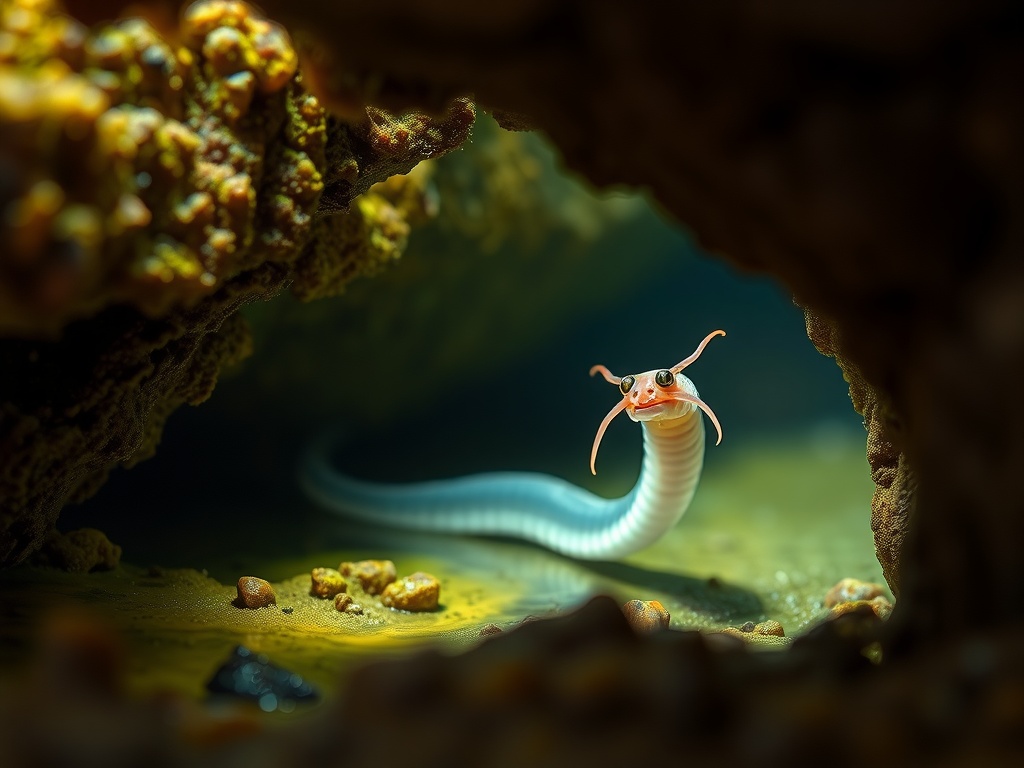
About the Olm
Proteus anguinus lives its entire life underwater in the flooded karst caves of the Dinaric Alps, in Slovenia, Croatia, Bosnia and Herzegovina, and it may be the longest-lived amphibian on Earth: demographic work on a Vieux Chateau population in France estimates a lifespan of around 100 years, with sexual maturity at 15. It is neotenic — it never metamorphoses, keeping its external feathery red gills and larval body plan for life while becoming sexually mature, the same trick the axolotl uses. Its eyes are present but degenerate and buried under skin, and the animal is functionally blind, navigating instead by an acute sense of smell, by lateral-line pressure detection, and by sensitivity to weak electric fields and the Earth's magnetic field. The pale pink skin, which gives it the folk name human fish, lacks melanin, though an olm kept in light will slowly darken. Its metabolism is astonishingly slow: it can survive years without food, living off stored lipids and glycogen and even reabsorbing its own tissues. A tracking study in a Bosnian cave found individual olms that had not moved more than a few metres in seven years, and one that stayed put for 2,569 days. Medieval locals who found them washed out of springs after floods took them for baby dragons.
Fascinating facts
Blind but Aware
The olm's eyes are covered by skin and are non-functional, but it compensates with heightened senses of hearing and smell.
Eternal Youth
Olms display neoteny, meaning they retain larval features like external gills throughout their entire lives.
Longevity Champions
These amphibians can live for over a century, making them some of the longest-lived amphibians in the world.
Detailed description
The olm (Proteus anguinus) is a highly specialized, troglobitic salamander uniquely adapted to life in the permanent darkness of subterranean karst aquifers. Adults typically measure 20–30 cm in length, with a slender, elongated, eel-like body, reduced limbs, and a flattened head. The skin is unpigmented and translucent, often appearing pinkish due to underlying blood vessels, and is capable of limited photosensitivity. The olm’s eyes are vestigial and covered by skin, rendering it functionally blind, but it compensates with an array of heightened non-visual senses, including chemoreception, mechanoreception, and electroreception. External feathery gills, along with rudimentary lungs, allow for aquatic respiration, and the olm can survive in hypoxic conditions. It is a slow-growing, long-lived species, with sexual maturity reached at 12–15 years and lifespans documented to exceed 70 years, with some estimates over 100 years. The olm is a sit-and-wait predator, feeding on small aquatic invertebrates, and can endure prolonged periods—up to a decade—without food by drastically reducing its metabolic rate. Socially, olms are largely solitary, occupying individual territories within cave systems. Their reproductive cycle is slow, with females laying clutches of eggs attached to submerged rocks, and there is no parental care post-oviposition. The species is highly sensitive to environmental changes, making it an important bioindicator for subterranean water quality.
Did you know?
Despite being completely blind, olms can detect electrical fields and minute chemical changes in the water to locate prey.
Research & sources
Wikipedia summary
The olm or proteus is an aquatic salamander which is the only species in the genus Proteus of the family Proteidae and the only exclusively cave-dwelling chordate species found in Europe; the family's other extant genus is Necturus. In contrast to most amphibians, it is entirely aquatic, eating, sleeping, and breeding underwater. Living in caves found in the Dinaric Alps, it is endemic to the waters that flow underground through the extensive limestone bedrock of the karst of Central and Southeastern Europe in the basin of the Soča River near Trieste, Italy, southern Slovenia, southwestern Croatia, and Bosnia and Herzegovina. Introduced populations are found near Vicenza, Italy, and Kranj, Slovenia. It was first mentioned in 1689 by the local naturalist Valvasor in his Glory of the Duchy of Carniola, who reported that, after heavy rains, the olms were washed up from the underground waters and were believed by local people to be a cave dragon's offspring.
Behaviour & social structure
Olms are predominantly sedentary, spending much of their lives motionless or moving slowly along the cave substrate. They exhibit nocturnal-like activity patterns, despite the absence of light, relying on circadian rhythms. Hunting is accomplished through chemoreception and mechanoreception, detecting prey such as crustaceans, insect larvae, snails, and worms. Feeding events are infrequent due to the low productivity of cave ecosystems. Olms are solitary and territorial, with individuals maintaining distance from one another except during the breeding season. Aggressive interactions are rare, but spatial avoidance is observed. They display minimal vocalization or visual signaling, instead relying on chemical cues for communication. Rest periods are interspersed with short bursts of activity, and olms can remain motionless for extended durations to conserve energy.
Reproduction & life cycle
Olms exhibit a prolonged and infrequent reproductive cycle. Sexual maturity is reached at 12–15 years, with breeding occurring every 6–12 years under optimal conditions. Mating typically takes place in late winter or early spring, triggered by water temperature and quality. Courtship involves tactile and chemical cues, with males depositing spermatophores on the substrate, which females then pick up with their cloaca. Females lay 35–70 eggs, attaching them individually to submerged rocks or crevices. Incubation lasts 2–6 months, depending on water temperature (optimal range: 8–11°C). There is no parental care; larvae are fully aquatic and resemble miniature adults, retaining external gills. In rare cases, neoteny is observed, with individuals retaining larval characteristics throughout life.
Adaptations & survival
The olm’s adaptations to cave life are among the most extreme of any vertebrate. Morphologically, it exhibits troglomorphism: loss of pigmentation, eye regression, and elongation of body and limbs. Its skin contains photoreceptive cells, allowing detection of light intensity, which triggers avoidance behavior. The lateral line system is highly developed, enabling detection of minute water vibrations. Olms possess acute chemosensory and mechanosensory abilities, facilitating prey detection and navigation in total darkness. Metabolic rates are exceptionally low, supporting survival in nutrient-poor environments and enabling extended fasting. The external gills are efficient at extracting oxygen from hypoxic water. Physiologically, olms can tolerate a wide range of water chemistries and temperatures, and their immune systems are adapted to low-pathogen environments.
Cultural significance
The olm holds a prominent place in the folklore of the Dinaric Karst region, historically regarded as the offspring of cave dragons due to its serpentine appearance and emergence from subterranean waters after floods. It is a symbol of Slovenia’s natural heritage and features in local myths, literature, and art. The olm is also an emblematic species for cave conservation and environmental awareness in the region. In modern times, it serves as a flagship species for subterranean biodiversity and is featured in educational and ecotourism initiatives, particularly in Slovenia’s Postojna Cave.
Recent research
Recent research has focused on the olm’s exceptional longevity and resistance to aging, with studies revealing low rates of cellular senescence and remarkable regenerative abilities, including limb and organ regeneration. Genomic analyses have uncovered unique adaptations related to DNA repair, metabolic regulation, and sensory systems. Ongoing projects are investigating the olm’s microbiome and its role in health and disease resistance. Conservation genetics studies have identified significant genetic differentiation among isolated populations, underscoring the need for site-specific management. The black olm (Proteus anguinus parkelj), a rare, pigmented subspecies, has been the subject of comparative studies to understand the genetic basis of troglomorphic traits. The olm’s sensitivity to pollutants has led to its use as a sentinel species for groundwater quality assessment.
Videos
Habitat
Subterranean freshwater caves

Conservation
The Olm is currently classified as Vulnerable on the IUCN Red List.
Threats & challenges
The primary threats to the olm are habitat degradation, groundwater pollution (from agricultural runoff, industrial waste, and urbanization), water extraction, and cave tourism. The species’ highly restricted and fragmented range, coupled with its low reproductive rate and specialized habitat requirements, make populations vulnerable to stochastic events and environmental changes. Climate change poses additional risks by altering hydrological regimes and increasing the frequency of droughts. Illegal collection for the pet trade and scientific research, while less common today, has historically impacted some populations. Conservation efforts focus on habitat protection, water quality monitoring, and legal protection at national and international levels. Population trends are difficult to assess due to the species’ cryptic lifestyle, but declines have been documented in several localities.
Taxonomy
Scientific name
Proteus anguinus
- Kingdom
- Animalia
- Phylum
- Chordata
- Class
- Amphibia
- Order
- Caudata
- Family
- Proteidae
- Genus
- Proteus
- Species
- anguinus
Community notes
Share your observations about the Olm.
No community notes yet. Be the first!
Discover more wildlife
More fascinating animals from the encyclopedia.