
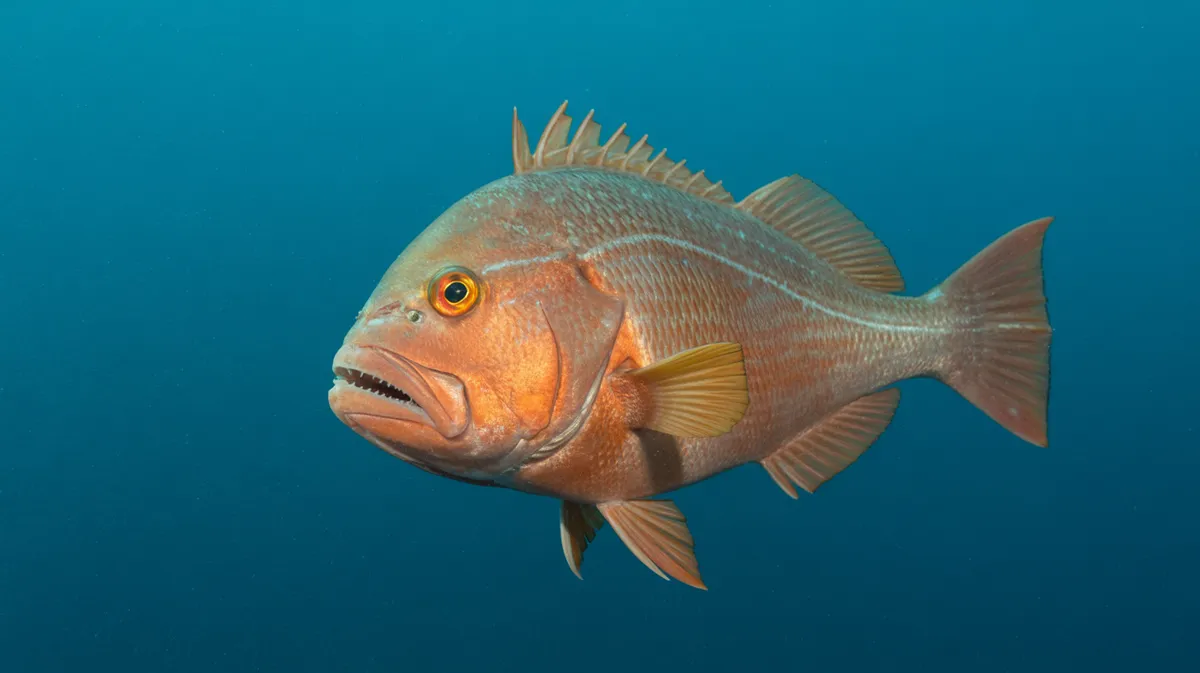
About the Orange roughy
Hoplostethus atlanticus is a cautionary tale about fishing an animal you do not understand. Marketed from the late 1970s as a mild white fish — it was renamed from "slimehead," which was accurate but unsellable — it was trawled off New Zealand and Australia in enormous volumes before anyone had aged one. When otoliths were finally dated by radiometric methods, orange roughy turned out to live to about 150 years and not to breed until roughly 20 to 30. Populations that looked like a limitless resource were actually accumulations of a century of slow growth, and several fisheries collapsed by more than 80 percent within a decade. The fish lives at 700 to 1,800 m on seamounts and deep slopes, aggregating in dense spawning shoals over pinnacles — which is exactly what makes it catchable and exactly what makes bottom trawling for it so destructive, since the gear flattens the cold-water coral that builds the seamount habitat. Its body is a deep-sea design: bright vermilion in life (it looks orange because red light does not reach that depth, so the fish is effectively black down there), a large head riddled with mucus-filled sensory canals, and low-density wax esters in the flesh for neutral buoyancy.
Fascinating facts
Deep-sea Dweller
Orange roughy inhabit depths of up to 1,800 meters, far below where sunlight penetrates the ocean.
Extreme Longevity
Some individuals have been aged at more than 150 years, making them one of the longest-lived fish species.
Vulnerable to Overfishing
Due to slow growth and late maturity, orange roughy populations recover very slowly after being depleted by fisheries.
Detailed description
The orange roughy (Hoplostethus atlanticus) is a deep-sea, bathypelagic fish notable for its robust, laterally compressed body reaching up to 75 cm in length and weighing as much as 7 kg, though most individuals encountered are smaller. Its skin is covered with rough, ctenoid scales and prominent bony ridges on the head, giving rise to the common name 'slimehead.' The species exhibits a striking brick-red coloration in life, which fades to a yellowish-orange post-mortem. Adapted to life at depths of 600–1,800 meters, it possesses large eyes optimized for low-light vision and a swim bladder suited for withstanding immense hydrostatic pressures. Orange roughy are slow-growing and among the longest-lived vertebrates, with verified ages exceeding 200 years, as determined by otolith (ear bone) analysis. Their metabolism is extremely slow, a trait linked to both their longevity and the cold, nutrient-poor environments they inhabit. Morphologically, they have a large mouth with villiform teeth, adapted for capturing small prey in the dark. The lateral line is well-developed, aiding in the detection of subtle water movements. Orange roughy form dense aggregations, particularly during spawning, and are known for their low reproductive output, with females producing relatively few, large eggs. These characteristics, combined with late sexual maturity (typically at 20–30 years), make the species highly susceptible to overexploitation.
Did you know?
Orange roughy do not begin to reproduce until they are 20-30 years old, making population recovery from overfishing extremely slow.
Research & sources
Wikipedia summary
The orange roughy, also known as the red roughy, slimehead and deep sea perch, is a relatively large deep-sea fish belonging to the slimehead family (Trachichthyidae). It is bathypelagic, found in cold, deep waters of the Western Pacific Ocean, eastern Atlantic Ocean, Indo-Pacific, and in the eastern Pacific off Chile. The orange roughy is notable for its extraordinary lifespan, attaining over 200 years. The fish has a bright, brick red color, fading to a yellowish-orange after death.
Behaviour & social structure
Orange roughy are primarily nocturnal, exhibiting limited daily vertical migration within the water column. They are opportunistic carnivores, feeding mainly on mesopelagic and benthopelagic organisms such as crustaceans (shrimps, mysids, amphipods), fish (notably lanternfish and other small teleosts), and squid. Prey is detected using a combination of acute vision and mechanosensory input from the lateral line. Orange roughy are generally solitary outside of spawning periods but aggregate in large numbers (sometimes tens of thousands) around seamounts and underwater ridges, especially during breeding. These aggregations are thought to be driven by both reproductive and feeding opportunities, as seamounts concentrate prey. The species is relatively sedentary, with individuals exhibiting high site fidelity and limited long-distance movement. Their slow metabolism and low activity levels are typical of deep-sea fishes, allowing survival in environments with scarce food resources.
Reproduction & life cycle
Orange roughy are oviparous, with external fertilization. Spawning typically occurs once per year, with timing varying by region (e.g., June–August in New Zealand, July–September in the North Atlantic). Sexual maturity is reached at an exceptionally late age—females at 23–32 years and males slightly earlier. During spawning, females release buoyant eggs into the water column, which are fertilized by males. Fecundity is low, with females producing between 20,000 and 90,000 eggs per season, a small number relative to body size. There is no parental care; eggs and larvae are planktonic, drifting with ocean currents. Larval survival is poorly understood but believed to be low, contributing to the species' slow population recovery rates. Recruitment events (successful addition of juveniles to the population) are sporadic and unpredictable.
Adaptations & survival
Orange roughy exhibit numerous adaptations to deep-sea life: their large eyes maximize light capture in near-total darkness, while a specialized swim bladder and robust skeletal structure allow them to withstand pressures exceeding 180 atmospheres. Their red coloration, which appears black at depth, provides camouflage from both predators and prey. The slow metabolic rate reduces energy requirements, an advantage in nutrient-poor environments. The lateral line system is highly developed, enabling detection of minute vibrations and aiding in prey localization. Their reproductive strategy—few, large, energy-rich eggs—maximizes the chance of larval survival in the vast, food-scarce ocean. Longevity and slow growth are evolutionary responses to low predation pressure and infrequent recruitment opportunities in the deep sea.
Cultural significance
Orange roughy entered global markets in the late 1970s and 1980s, rapidly gaining popularity for its palatable flesh. The species became a symbol of the deep-sea fishery boom and subsequent collapse, serving as a cautionary example in fisheries management literature. It is featured in sustainability campaigns and seafood advisories, often cited as a species to avoid due to overfishing. There is little evidence of traditional use or significant role in indigenous cultures, as its deep-sea habitat made it inaccessible to pre-industrial fisheries. The orange roughy's plight has contributed to broader public awareness of deep-sea conservation issues.
Recent research
Recent research has focused on refining age estimation techniques using radiometric dating of otoliths, confirming extreme longevity and slow growth rates. Genetic studies have revealed low population structure across ocean basins, suggesting high larval dispersal but also highlighting the risk of widespread depletion. Acoustic and tagging studies have improved understanding of aggregation dynamics and site fidelity. Ongoing work examines the impacts of deep-sea trawling on seamount ecosystems and the species' role in deep-sea food webs. Advances in non-lethal monitoring and population modeling are informing more sustainable management practices. The orange roughy remains a focal species in discussions of deep-sea fisheries sustainability and the ecological consequences of exploiting long-lived marine organisms.
Sources
Age validation and growth of orange roughy (Hoplostethus atlanticus): A review and evaluation of radiometric age estimation
Fenton, G.E., Short, S.A., Ritz, D.A. (1991)
scientificVideos
Habitat
Deep-sea ocean

Conservation
The Orange roughy is currently classified as Vulnerable on the IUCN Red List.
Threats & challenges
The primary threat to orange roughy is overfishing, driven by high commercial demand for their mild, firm flesh. Their aggregative spawning behavior and slow life history traits make populations extremely vulnerable to rapid depletion. Bottom trawling, the main fishing method, also damages seamount habitats critical for spawning and feeding. Bycatch and habitat destruction further exacerbate population declines. Recovery is hindered by low reproductive rates and sporadic recruitment, with some stocks showing little sign of rebound decades after heavy exploitation. Climate change may pose additional risks by altering deep-sea currents, oxygen levels, and prey availability. The IUCN lists orange roughy as 'Vulnerable' in Europe, with similar concerns globally. Effective management is challenged by the species' deep-water habitat, slow response to conservation measures, and economic pressures from fisheries.
Taxonomy
Scientific name
Hoplostethus atlanticus
- Kingdom
- Animalia
- Phylum
- Chordata
- Class
- Actinopterygii
- Order
- Trachichthyiformes
- Family
- Trachichthyidae
- Genus
- Hoplostethus
- Species
- atlanticus
Community notes
Share your observations about the Orange roughy.
No community notes yet. Be the first!
Discover more wildlife
More fascinating animals from the encyclopedia.