
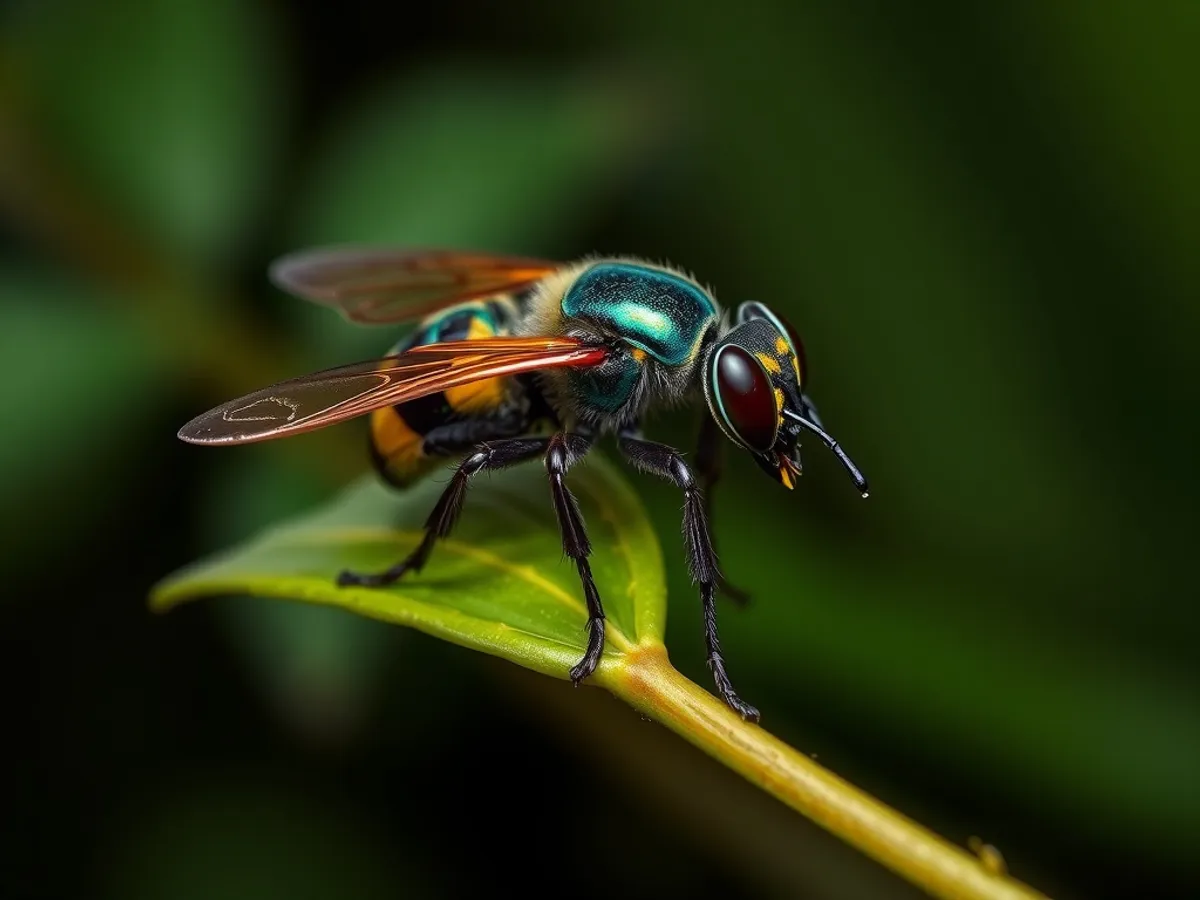
About the Orchid bee
The orchid bee is a vibrant, metallic-colored bee native to Central and South America, renowned for its striking iridescent green, blue, or gold hues. Males are famous for their unique behavior of collecting aromatic compounds from orchids and other sources, which they store in specialized leg pouches to attract mates. These bees play a crucial role in the pollination of many tropical plants, especially orchids, with which they share a unique mutualistic relationship. Orchid bees are solitary and do not form large colonies like honeybees, and they are recognized for their rapid, darting flight patterns.
Fascinating facts
Fragrance Collectors
Male orchid bees are known for gathering and blending a wide array of scents from orchids and other sources to use in mating displays.
Metallic Brilliance
Their stunning metallic green, blue, or gold coloration is due to microscopic structural features that reflect light, rather than pigments.
Pollination Partners
Orchid bees are essential pollinators for many tropical plants, especially orchids that have evolved specifically to attract these bees.
Detailed description
Euglossa dilemma, commonly known as the orchid bee, is a medium-sized bee measuring approximately 10–13 mm in length, with a robust, metallic exoskeleton that shimmers in shades of green, blue, or gold due to microscopic surface structures that refract light. The species exhibits pronounced sexual dimorphism: males possess enlarged hind tibiae modified into pouches for collecting and storing volatile aromatic compounds, while females lack these adaptations and have more robust mandibles for nest construction. Unlike eusocial bees, E. dilemma is primarily solitary, with each female constructing and provisioning her own nest, typically in pre-existing cavities or rotting wood. The bee's tongue is exceptionally long—often exceeding its body length—enabling access to deep floral nectaries, especially in orchids. Males are renowned for their unique behavior of collecting and blending complex fragrances from a variety of floral and non-floral sources, which they display during elaborate courtship rituals to attract females. Activity is diurnal, with peak foraging in the early morning. The species is a vital pollinator in neotropical ecosystems, facilitating the reproduction of over 700 orchid species and numerous other plants. Flight is rapid and agile, with the ability to hover and maneuver precisely, a necessity for accessing intricate flowers. The bee's life cycle is closely tied to the phenology of local flora, and its mutualistic relationship with orchids is a classic example of coevolution.
Did you know?
Orchid bees are the only group of corbiculate bees whose members are primarily solitary rather than eusocial.
Research & sources
Wikipedia summary
The tribe Euglossini, in the subfamily Apinae, commonly known as orchid bees or euglossine bees, are the only group of corbiculate bees whose non-parasitic members do not all possess eusocial behavior.
Behaviour & social structure
Orchid bees are primarily solitary, with females independently constructing nests and provisioning brood cells with pollen and nectar. Males are highly mobile and spend much of their time searching for and collecting aromatic compounds from orchids and other sources such as tree resins, fungi, and even decaying wood or fruit. These fragrances are stored in specialized hind leg pouches and are believed to serve as a chemical display to attract mates. Males establish display territories, often on exposed branches or leaves, where they perform ritualized flight patterns and release their collected scents. Foraging behavior is highly specialized; both sexes exhibit flower constancy and are capable of learning and remembering floral scents and locations. Females are responsible for all aspects of nest construction, provisioning, and brood care, while males do not participate in parental care. Daily activity is influenced by temperature and humidity, with foraging and scent collection peaking during the cooler, more humid hours of the morning.
Reproduction & life cycle
Mating in Euglossa dilemma is preceded by complex male courtship displays involving the release of collected fragrances at display sites. Females are attracted to these chemical bouquets, and successful males mate with receptive females at these territories. After mating, females independently construct nests in natural cavities, such as hollow stems, rotting logs, or abandoned insect nests. Each nest contains several brood cells, which the female provisions with a mixture of pollen and nectar before laying a single egg in each cell. The development from egg to adult typically takes 6–8 weeks, depending on environmental conditions. There is no true social structure or division of labor; each female is solely responsible for her offspring. Breeding occurs year-round in tropical climates, but may be synchronized with the flowering periods of key nectar and pollen sources.
Adaptations & survival
Euglossa dilemma exhibits several remarkable adaptations. The males' hind legs are uniquely modified for collecting and storing volatile compounds, a rare trait among bees. Their exceptionally long proboscis allows access to deep, tubular flowers, particularly orchids that few other pollinators can reach. The metallic exoskeleton not only provides camouflage among glossy leaves but may also play a role in thermoregulation. Their acute olfactory system enables the detection and discrimination of a vast array of chemical compounds, critical for both foraging and mate attraction. The ability to hover and maneuver with precision is facilitated by specialized wing musculature and a high wingbeat frequency. Females' strong mandibles are adapted for excavating nesting sites in tough substrates.
Cultural significance
Orchid bees have fascinated naturalists and scientists for centuries due to their brilliant coloration and unique ecological role. They are often featured in educational materials and ecotourism programs highlighting tropical biodiversity and pollination ecology. In some indigenous cultures, the bees' association with orchids—plants often revered for their beauty and rarity—has led to symbolic connections with fertility and renewal. Their mutualism with orchids is frequently cited in scientific literature as a classic example of coevolution and has influenced the study of plant-pollinator interactions worldwide.
Recent research
Recent studies have focused on the genomics of Euglossa dilemma, revealing genes associated with olfactory receptor expansion and fragrance metabolism. Research published in 2021 identified the molecular pathways involved in fragrance collection and storage, shedding light on the evolution of this unique behavior. Ongoing ecological studies are examining the impacts of habitat fragmentation on gene flow and population structure. Additionally, E. dilemma has become a model organism for studying the effects of neonicotinoid pesticides on solitary bee cognition and behavior. The species' recent range expansion into southern Florida has provided opportunities to study adaptation and invasion biology in real time.
Videos
Habitat
Tropical rainforest


Conservation
The Orchid bee is currently classified as Least Concern on the IUCN Red List.
Threats & challenges
While currently listed as Least Concern, Euglossa dilemma faces several threats, primarily habitat loss due to deforestation and agricultural expansion in Central and South America. The decline of native orchid populations, often caused by logging and land conversion, directly impacts male fragrance collection and thus reproductive success. Pesticide use, particularly neonicotinoids, poses risks to foraging bees and can disrupt their olfactory-based behaviors. Climate change may alter the phenology of both bees and their host plants, potentially leading to mismatches in timing. Invasive species and habitat fragmentation further threaten local populations by reducing genetic diversity and available nesting sites.
Taxonomy
Scientific name
Euglossa dilemma
- Kingdom
- Animalia
- Phylum
- Arthropoda
- Class
- Insecta
- Order
- Hymenoptera
- Family
- Apidae
- Genus
- Euglossa
- Species
- dilemma
Community notes
Share your observations about the Orchid bee.
No community notes yet. Be the first!
Discover more wildlife
More fascinating animals from the encyclopedia.