
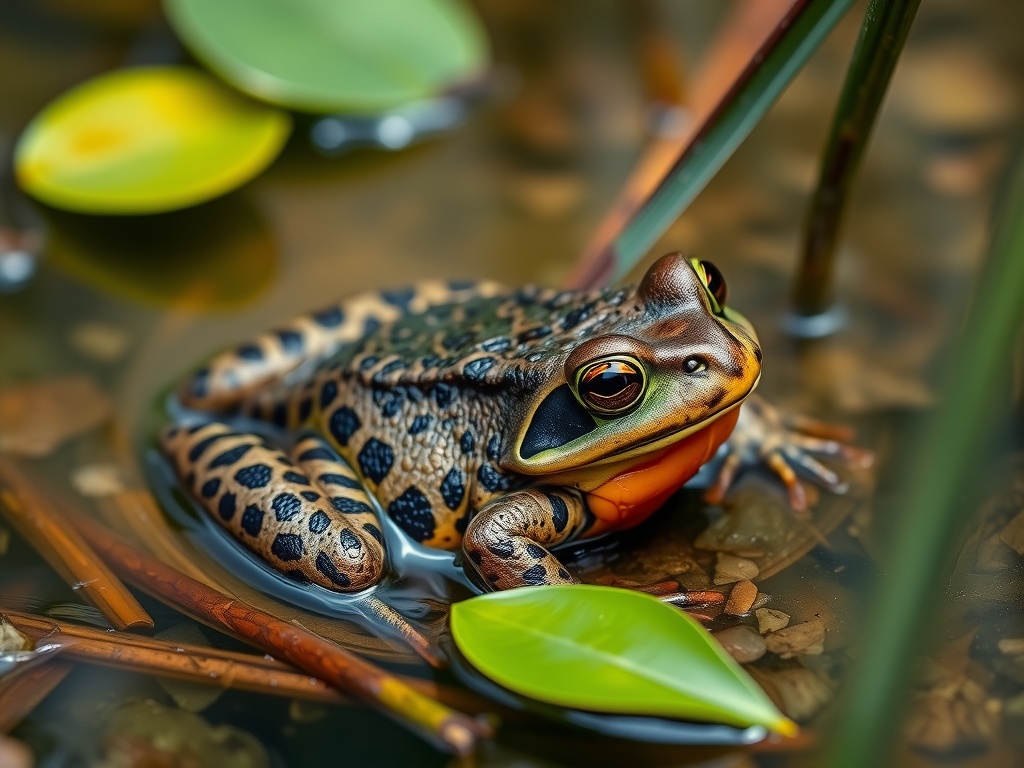
About the Oriental Fire-bellied Toad
The Oriental Fire-bellied Toad is a small, brightly colored amphibian known for its vivid green and black dorsal pattern and striking orange-red belly. Native to Northeast Asia, this toad is semi-aquatic and often found in shallow ponds, marshes, and slow-moving streams. Its distinctive coloration serves as a warning to predators about its mild toxicity. The Oriental Fire-bellied Toad is popular in the pet trade due to its hardy nature and active behavior. In the wild, it plays an important ecological role as both predator and prey in freshwater habitats.
Fascinating facts
Bright Warning Colors
Their vivid red or orange belly warns predators of their skin toxins, a defense mechanism known as aposematism.
Semi-Aquatic Lifestyle
Oriental Fire-bellied Toads spend much of their lives in or near water, thriving in ponds and marshes.
Insect Eaters
They primarily feed on small invertebrates, such as insects, worms, and crustaceans.
Detailed description
The Oriental Fire-bellied Toad (Bombina orientalis) is a small, robust amphibian, typically measuring 3.8–5.1 cm (1.5–2 inches) in length, with females generally larger than males. Its dorsal surface is bright green with irregular black mottling, while the ventral side is a vivid orange-red with black spots—a striking example of aposematic coloration warning predators of its toxicity. The skin is granular and covered in small tubercles, giving it a warty texture. Eyes are prominent, set high on the head, and pupils are heart-shaped, a characteristic of the Bombina genus. Limbs are relatively short but strong, with partially webbed toes adapted for an aquatic lifestyle. This species is semi-aquatic, spending significant time both in water and on land, favoring shallow, slow-moving bodies of water with abundant vegetation. Its call is a soft, melodic 'barking' or 'chirping' sound, produced by males during the breeding season, and is unique among frogs as it is created without an external vocal sac. The Oriental Fire-bellied Toad is diurnal, often basking during the day and actively foraging for invertebrates. Its skin secretes mild toxins (bombesins and bombinins) as a defense mechanism, which, while not dangerous to humans, can deter many natural predators. In the wild, it plays a key role in controlling insect populations and serves as prey for birds, snakes, and larger amphibians.
Did you know?
The Oriental Fire-bellied Toad's skin toxins can cause mild irritation in humans, so it's important to wash hands after handling them.
Research & sources
Wikipedia summary
The Oriental fire-bellied toad is a small semiaquatic frog species found in northeastern Asia, where they primarily dwell in slow-moving bodies of water and temperate forests. Quite common throughout much of their range, these frogs have mild toxins that can be excreted through their skin, with their vibrant underbellies serving as a warning of this. While not a true toad, their green and black skin is covered in small tubercles, giving them a toadlike appearance. Their sounds, mainly produced by males during the mating season, are very unlike those of other frogs. While their population is in decline, their numbers are still high overall, with the International Union for Conservation of Nature (IUCN) rating them as a least-concern species. They are commonly kept as pets in land and water vivaria, as a relatively easy-to-care for species. They are also frequently used in scientific research, with their behavior, vocalizations, and learning skills all moderately studied.
Behaviour & social structure
Oriental Fire-bellied Toads are generally solitary outside of the breeding season but may be found in loose aggregations in suitable habitats. They are active during the day (diurnal), often seen basking on rocks or floating vegetation. Their hunting strategy is primarily 'sit-and-wait,' ambushing small invertebrates such as insects, worms, and crustaceans. Prey is captured with a rapid flick of the sticky tongue. When threatened, they exhibit the 'unken reflex,' arching their back and limbs to display the bright ventral coloration as a warning. Social interactions are limited, but males may engage in mild territorial disputes during breeding, using vocalizations and physical posturing. They are known for their relatively high tolerance to conspecifics, which contributes to their popularity in group vivarium settings. Daily routines include alternating periods of aquatic activity, terrestrial foraging, and basking.
Reproduction & life cycle
Breeding occurs in late spring to early summer, triggered by rising temperatures and increased rainfall. Males congregate in shallow water and emit distinctive, melodic calls to attract females. Courtship involves amplexus, where the male clasps the female around the waist. Females lay 40–100 eggs per clutch, attaching them singly or in small groups to submerged vegetation. Embryonic development is rapid; eggs hatch within 3–10 days depending on temperature. Larvae (tadpoles) are fully aquatic, feeding on algae and detritus, and undergo metamorphosis into juvenile toads after approximately 6–8 weeks. There is no parental care post-oviposition. Sexual maturity is typically reached within 1–2 years.
Adaptations & survival
Bombina orientalis exhibits several adaptations for a semi-aquatic lifestyle, including partially webbed feet for efficient swimming and a flattened body for ease of movement in water. The bright ventral coloration serves as an aposematic signal, enhanced by the unken reflex display. Skin glands produce antimicrobial peptides and mild toxins, providing defense against pathogens and predators. The species can tolerate a wide range of temperatures (from near freezing to over 25°C) and can survive brief periods of drought by burrowing into moist substrate. Their heart-shaped pupils enhance peripheral vision, aiding in predator detection. Vocalizations are adapted for underwater transmission, allowing males to communicate effectively in their aquatic environment.
Cultural significance
The Oriental Fire-bellied Toad holds modest cultural significance in East Asia, sometimes appearing in local folklore as a symbol of good luck or transformation, likely due to its striking appearance and metamorphic life cycle. In modern times, it is widely kept as a pet and used in educational settings to teach about amphibian biology and environmental health. The species has also contributed to biomedical research, particularly in studies of amphibian skin peptides and neurobiology.
Recent research
Recent studies have focused on the chemical composition of Bombina skin secretions, revealing novel antimicrobial peptides with potential pharmaceutical applications. Behavioral research has examined their learning abilities, demonstrating simple associative learning and spatial memory. Vocalization studies have elucidated the unique mechanisms of underwater sound production. Conservation genetics work is ongoing to assess population structure and gene flow across their range. The species is also used as a model organism in studies of amphibian development and environmental toxicology.
Videos
Habitat
Freshwater wetlands, ponds, and slow-moving streams
 Various Continental Regions
Grassland
Open areas dominated by grasses rather than trees, supporting numerous herbivores and their predators.
 Global
Forest
Wooded areas with significant tree cover and diverse plant and animal communities.
 Global
Freshwater
Lakes, rivers, and wetlands with diverse aquatic ecosystems.
Conservation
The Oriental Fire-bellied Toad is currently classified as Least Concern on the IUCN Red List.
Threats & challenges
While Bombina orientalis remains common and is classified as Least Concern by the IUCN, populations face localized threats. Habitat loss due to urbanization, agriculture, and pollution of wetlands is a primary concern. Collection for the pet trade, although regulated, can impact wild populations in some regions. Introduced predators and diseases, such as chytridiomycosis, pose emerging threats. Climate change may alter breeding habitats and timing. Despite these challenges, the species' adaptability and broad range have helped maintain stable overall numbers, but continued monitoring is recommended.
Taxonomy
Scientific name
Bombina orientalis
- Kingdom
- Animalia
- Phylum
- Chordata
- Class
- Amphibia
- Order
- Anura
- Family
- Bombinatoridae
- Genus
- Bombina
- Species
- orientalis
Where to see an oriental fire-bellied toad
1 zoo and aquarium in 1 country are recorded as keeping this species.

Community notes
Share your observations about the Oriental Fire-bellied Toad.
No community notes yet. Be the first!
Discover more wildlife
More fascinating animals from the encyclopedia.