
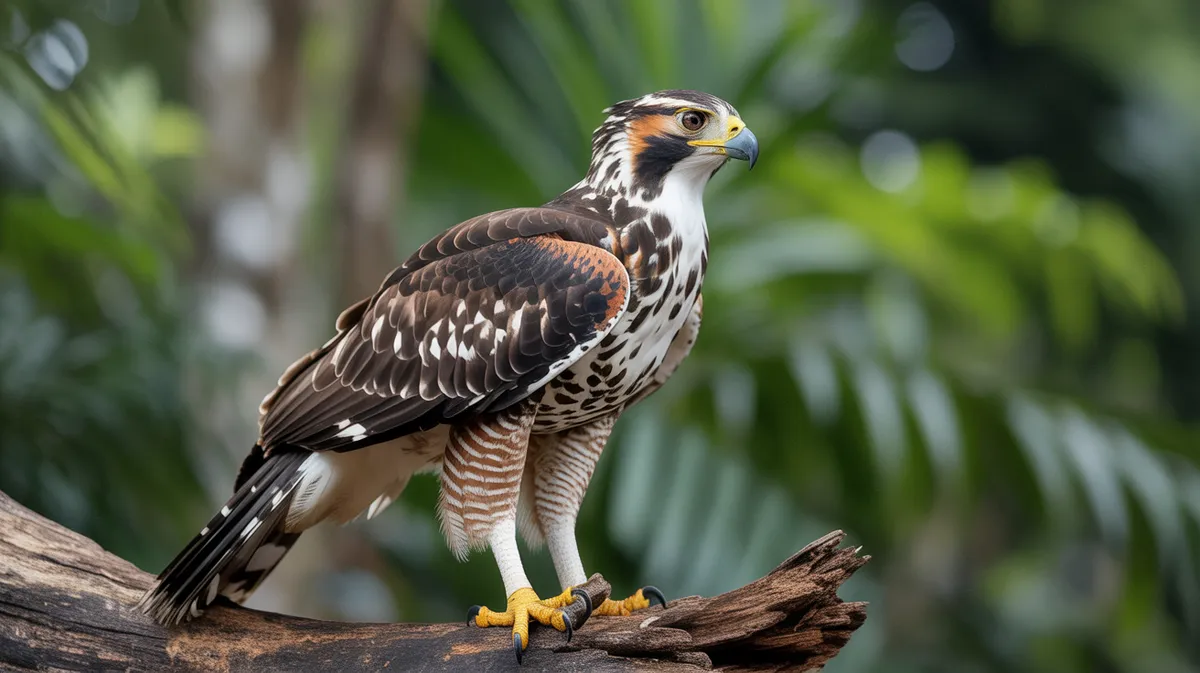
About the Ornate Hawk-Eagle
The Ornate Hawk-Eagle is a striking raptor native to the tropical forests of Central and South America. It is renowned for its bold plumage, featuring a black crest, rufous neck, and striking barred underparts. This medium-sized eagle is an agile and powerful hunter, preying on birds, mammals, and reptiles within dense forest canopies. Its piercing call and dramatic appearance make it a sought-after sight among birdwatchers. Despite its beauty, the species faces threats from habitat loss due to deforestation.
Fascinating facts
Spectacular Crest
The Ornate Hawk-Eagle sports a prominent black crest that can be raised when excited or threatened, adding to its imposing appearance.
Forest Hunter
This eagle is an apex predator of the rainforest, expertly navigating dense foliage to ambush birds and small mammals.
Monogamous Pairing
Ornate Hawk-Eagles form monogamous pairs and are known to fiercely defend their nesting territory from intruders.
Detailed description
The Ornate Hawk-Eagle (Spizaetus ornatus) is a medium-to-large raptor, measuring 58–67 cm (23–26 in) in length with a wingspan of 105–120 cm (41–47 in) and weighing between 900–1,600 grams (2–3.5 lbs), with females typically larger than males. Adults are instantly recognizable by their striking plumage: a bold black crest, rufous (reddish-brown) nape and neck, white throat with a dark central stripe, and heavily barred black-and-white underparts. The upperparts are mostly dark brown to black, contrasting with the lighter, patterned underparts. Juveniles are much paler, with predominantly white underparts and less distinct barring, gradually acquiring adult coloration over several years. The tarsi (lower legs) are fully feathered, a trait of booted eagles, providing protection when capturing prey. The species has powerful talons and a robust, hooked beak adapted for seizing and dismembering prey. Its eyes are large and yellow, providing acute vision for hunting in dim forest light. The Ornate Hawk-Eagle is highly agile in flight, capable of rapid maneuvers through dense forest canopies. It is generally solitary or seen in pairs, occupying large territories in primary and mature secondary forests. Its vocalizations are loud, piercing whistles, often given in flight or from a perch, and are used for communication between mates or territorial advertisement. This eagle is a top predator in its ecosystem, exerting significant influence on prey populations and forest dynamics.
Did you know?
Despite their powerful build, Ornate Hawk-Eagles are rarely seen in flight above the canopy, preferring to move stealthily within the trees.
Research & sources
Wikipedia summary
The ornate hawk-eagle is a fairly large bird of prey from the tropical Americas. Formerly, some authorities referred to this species as the crested hawk-eagle, a name that may cause some confusion as it is more commonly used for an Asian eagle species. Like all eagles, it is in the family Accipitridae. This species has a feathered tarsus that marks it as a member of the Aquilinae or booted eagle subfamily. This species is notable for the vivid colors and bold markings of adults, which differ considerably from the far more whitish plumage of the juvenile bird. The ornate hawk-eagle ranges from central Mexico south through much of Central America and in a somewhat spotty but broad overall range into South America, including in the west apart from the Andes and broadly on the Atlantic side especially Brazil down to as far as Southeast Brazil and northern Argentina. This species is found largely in primary forests with tall trees, although can be found in many forest types.
Behaviour & social structure
Ornate Hawk-Eagles are diurnal and primarily solitary, except during the breeding season when pairs may be observed together. They hunt from concealed perches within the forest, using a sit-and-wait strategy before launching swift, surprise attacks on prey. Their diet is diverse, consisting mainly of medium-sized birds (such as guans, pigeons, and toucans), mammals (including squirrels, monkeys, and opossums), and occasionally large reptiles like iguanas. They are known for their agility, often weaving through dense foliage in pursuit of prey, and may even snatch birds in mid-flight. Territorial and secretive, they defend large home ranges (estimated at 10–30 km²) and rarely tolerate other raptors nearby. Daily routines include periods of inactivity interspersed with hunting bouts, preening, and calling. Social interactions are mostly limited to courtship and parental care, with little evidence of cooperative hunting or group living.
Reproduction & life cycle
Breeding occurs once per year, with timing varying geographically but generally coinciding with the late dry or early wet season (e.g., February–May in Central America). Courtship involves aerial displays, including soaring, mutual calling, and talon-grappling. The species is monogamous, forming long-term pair bonds. Nests are large platforms of sticks, lined with green leaves, and built high (20–40 m) in the main fork of tall emergent trees. The female typically lays a single egg per clutch, which she incubates for 44–48 days while the male provides food. After hatching, the chick is brooded and fed by both parents, with fledging occurring at 9–11 weeks. Juveniles remain dependent on adults for several months post-fledging, gradually learning to hunt before dispersing. Reproductive success is low, with only one chick per year and high sensitivity to disturbance.
Adaptations & survival
The Ornate Hawk-Eagle exhibits several adaptations for life as a forest-dwelling apex predator. Its short, broad wings and long tail enable exceptional maneuverability in dense woodland, allowing it to pursue agile prey through complex vegetation. The fully feathered tarsi protect its legs from bites and scratches during predation. Its cryptic plumage, with disruptive barring and bold colors, provides camouflage among dappled forest light. Acute binocular vision aids in detecting movement in the dim understory. Behavioral adaptations include silent, stealthy hunting and the use of high vantage points for ambush. Its powerful feet and curved talons are specialized for grasping and subduing struggling prey. The species' vocalizations are adapted for long-distance communication in dense forests.
Cultural significance
While not as prominent in folklore as some larger eagles, the Ornate Hawk-Eagle is occasionally featured in indigenous myths and local symbolism, often representing power, agility, or the spirit of the forest. In some regions, its striking appearance and piercing calls have inspired stories about forest guardians or omens. It is a sought-after species for birdwatchers and ecotourism, contributing to local economies and raising awareness of forest conservation. There are no known widespread traditional uses, but it is sometimes displayed in local art or ceremonial contexts.
Recent research
Recent research has focused on the species' ecology, home range size, and the impact of forest fragmentation on its populations. Satellite telemetry studies have revealed the eagle's need for large, contiguous forest territories and its avoidance of heavily disturbed areas. Genetic studies indicate low genetic diversity in some isolated populations, raising concerns about long-term viability. Ongoing research includes monitoring nest success, prey selection, and the effectiveness of protected areas. Notably, a 2021 study in Brazil documented the eagle's role in controlling populations of medium-sized arboreal mammals, highlighting its ecological importance. Conservationists are also investigating the potential for habitat corridors to connect fragmented populations.
Videos
Habitat
Tropical rainforest
 Elevated Terrain
Mountain
High-altitude environments with varying climates and specialized wildlife adapted to rugged terrain and thin air.
 Tropical Regions
Rainforest
Dense, wet forests with the highest biodiversity on Earth, containing more than half of the world's plant and animal species.
 Global
Forest
Wooded areas with significant tree cover and diverse plant and animal communities.
Conservation
The Ornate Hawk-Eagle is currently classified as Near Threatened on the IUCN Red List.
Threats & challenges
The primary threat to the Ornate Hawk-Eagle is habitat loss and fragmentation due to deforestation, agricultural expansion, and logging, particularly in lowland tropical forests. As a species dependent on large tracts of mature forest, it is highly sensitive to habitat disturbance and edge effects. Secondary threats include direct persecution (hunting or trapping), especially where it is mistakenly blamed for livestock predation, and illegal wildlife trade. Population declines have been documented across much of its range, with local extirpations in areas of severe forest loss. Current IUCN estimates suggest a decreasing population trend, with the species classified as Near Threatened. Conservation challenges include enforcing protected areas, promoting sustainable forestry, and mitigating human-wildlife conflict.
Taxonomy
Scientific name
Spizaetus ornatus
- Kingdom
- Animalia
- Phylum
- Chordata
- Class
- Aves
- Order
- Accipitriformes
- Family
- Accipitridae
- Genus
- Spizaetus
- Species
- ornatus
Where to see an ornate hawk-eagle
1 zoo and aquarium in 1 country are recorded as keeping this species.

Community notes
Share your observations about the Ornate Hawk-Eagle.
No community notes yet. Be the first!
Discover more wildlife
More fascinating animals from the encyclopedia.