
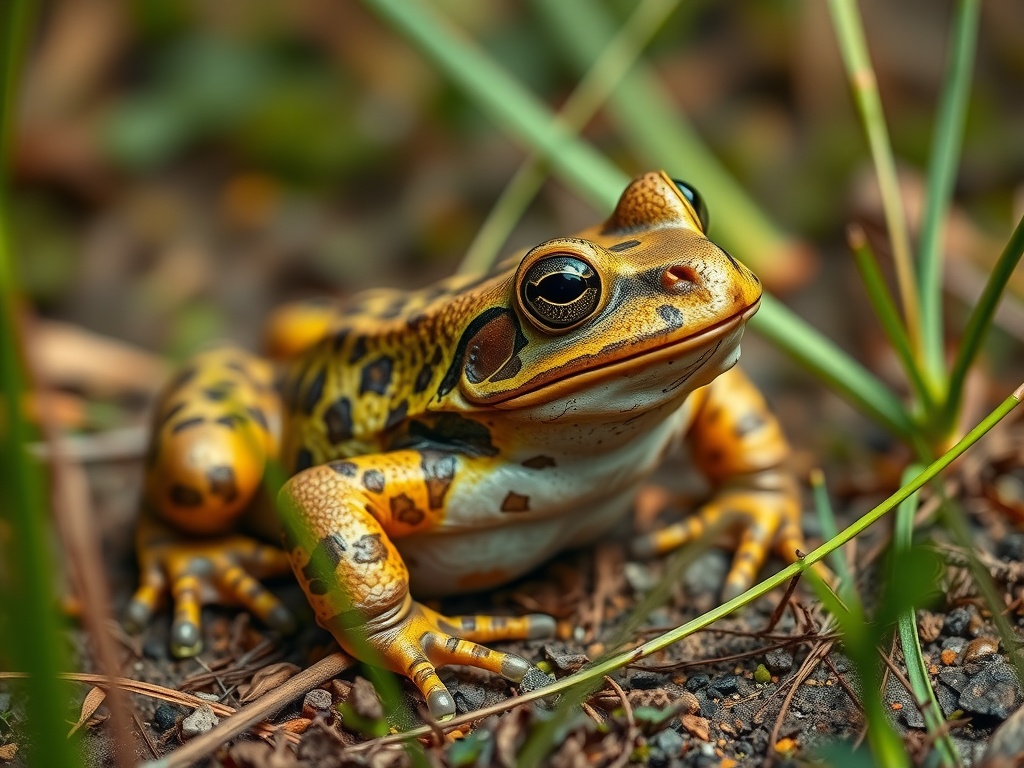
About the Ornate Horned Frog
The Ornate Horned Frog, also known as the Argentine Horned Frog or 'Pacman Frog', is a large, robust amphibian native to the grasslands of South America. It is easily recognized by its wide mouth, horn-like projections above the eyes, and vivid coloration featuring green and brown patterns with striking yellow, orange, or red accents. This ambush predator spends much of its time partially buried, waiting to lunge at prey with its powerful jaws. Despite its charming appearance, it is known for its voracious appetite and can consume prey nearly as large as itself, including insects, small mammals, and even other frogs.
Fascinating facts
Powerful Bite
The Ornate Horned Frog possesses tooth-like projections called odontoids, allowing it to deliver a surprisingly strong bite for an amphibian.
Prolific Breeder
Females can lay up to 1,000 to 2,000 eggs at a time in temporary pools formed during heavy rains.
Colorful Camouflage
Their vibrant colors help them blend into leaf litter and grass, providing both camouflage from predators and an advantage when ambushing prey.
Detailed description
The Ornate Horned Frog (Ceratophrys ornata) is a robust, terrestrial amphibian distinguished by its disproportionately large head and mouth, which can account for nearly half its body length. Adults typically measure 10–15 cm (4–6 inches) in snout-vent length, with females generally larger than males. Its skin is thick and warty, displaying a striking mosaic of green, brown, yellow, and sometimes red or orange, providing effective camouflage among leaf litter and grasses. Above each eye are fleshy, horn-like projections—extensions of the upper eyelids—that contribute to its common name. The body is squat and rounded, with short, powerful limbs adapted for sudden lunges rather than sustained movement. The frog’s jaw muscles are exceptionally strong, enabling it to subdue large and struggling prey. Ceratophrys ornata is primarily nocturnal and spends much of its life partially buried in moist substrate, relying on ambush predation. It possesses a sticky tongue for capturing prey, but larger individuals may simply lunge and engulf prey directly. The species is solitary outside of the breeding season and exhibits little social interaction. Its unique adaptations and voracious appetite have made it a popular subject in herpetoculture and scientific study.
Did you know?
Ornate Horned Frogs can bite with surprising force and will sometimes attempt to eat objects much larger than themselves.
Research & sources
Behaviour & social structure
Ornate Horned Frogs are classic sit-and-wait predators, remaining motionless and partially buried for extended periods until prey approaches. They are highly opportunistic, consuming a wide range of animals, including insects, spiders, small rodents, lizards, and other amphibians—even conspecifics, displaying notable cannibalistic tendencies. Their feeding response is triggered by movement, and they may attempt to consume prey nearly as large as themselves. They are generally inactive during the day, emerging at dusk and during rainy periods to hunt. Aggression is common, especially among males during the breeding season, and they may bite if threatened or handled. Outside of mating, individuals are strictly solitary and territorial. When threatened, they may inflate their bodies, emit a loud distress call, or bite in defense.
Reproduction & life cycle
Breeding in Ceratophrys ornata is closely tied to the onset of the rainy season, typically from late spring to summer (October–March in the southern hemisphere). Males congregate in temporary pools and produce a loud, guttural call to attract females. Amplexus is axillary (male grasps the female behind her forelimbs), and females lay large clutches of 1,000–2,000 eggs in shallow water. Eggs hatch within 2–4 days, depending on temperature, and tadpoles are highly carnivorous, often preying on each other. Metamorphosis occurs rapidly, usually within 2–3 weeks, as the ephemeral pools may dry quickly. There is no parental care after egg-laying. Sexual maturity is reached at 1–2 years of age in optimal conditions.
Adaptations & survival
Ceratophrys ornata is highly adapted for a fossorial and ambush-predator lifestyle. Its cryptic coloration and warty skin provide camouflage among leaf litter and grasses, reducing predation risk. The large mouth and powerful jaws allow it to tackle large prey, while its expandable stomach accommodates substantial meals. The horn-like eyelid projections may help break up the frog’s outline or protect the eyes. During dry periods, it can enter a state of estivation, secreting a cocoon of shed skin to reduce water loss and burrowing underground until favorable conditions return. Its aggressive feeding response and cannibalistic tendencies are evolutionary strategies to maximize resource intake in unpredictable environments.
Cultural significance
The Ornate Horned Frog is well-known in the pet trade, often called the 'Pacman Frog' due to its resemblance to the video game character. In South American folklore, frogs are sometimes associated with rain and fertility, though Ceratophrys ornata itself holds no prominent mythological role. Its striking appearance and voracious appetite have made it a subject of fascination in popular culture and educational programs. In some regions, it is used in traditional medicine, though such practices are not widespread.
Recent research
Recent research has focused on the biomechanics of the Ornate Horned Frog’s bite, revealing it has one of the strongest bite forces relative to body size among amphibians. Studies on its feeding ecology have provided insights into cannibalism and resource competition among tadpoles. Genetic analyses are refining our understanding of Ceratophrys systematics and population structure. Conservation research is ongoing, particularly regarding the impact of agricultural chemicals on larval development and the effects of climate change on breeding phenology. The species is also used as a model organism in studies of amphibian immune responses and skin toxin composition.
Sources
Ceratophrys ornata (Amphibia: Anura: Ceratophryidae): Natural History and Conservation
I. J. De la Riva et al. (2012)
scientificCeratophrys ornata: The IUCN Red List of Threatened Species 2020
IUCN SSC Amphibian Specialist Group
conservationVideos
Habitat
Moist grasslands and flooded savannas
 Africa
Savanna
Grasslands with scattered trees, characterized by seasonal rainfall and home to diverse grazing animals and predators.
 Various Continental Regions
Grassland
Open areas dominated by grasses rather than trees, supporting numerous herbivores and their predators.
 Global
Forest
Wooded areas with significant tree cover and diverse plant and animal communities.
 Global
Freshwater
Lakes, rivers, and wetlands with diverse aquatic ecosystems.
Conservation
The Ornate Horned Frog is currently classified as Least Concern on the IUCN Red List.
Threats & challenges
While currently listed as Least Concern by the IUCN, Ceratophrys ornata faces localized threats from habitat destruction due to agriculture, urbanization, and wetland drainage in its native range (Argentina, Uruguay, Brazil). Pesticide and fertilizer runoff can contaminate breeding sites, impacting larval survival. Collection for the pet trade, though regulated, has led to some population declines in accessible areas. Climate change poses a long-term threat by altering rainfall patterns and reducing the availability of ephemeral breeding pools. Despite these challenges, the species remains relatively widespread and adaptable, but ongoing habitat loss and environmental changes warrant continued monitoring.
Taxonomy
Scientific name
Ceratophrys ornata
- Kingdom
- Animalia
- Phylum
- Chordata
- Class
- Amphibia
- Order
- Anura
- Family
- Ceratophryidae
- Genus
- Ceratophrys
- Species
- ornata
Where to see an ornate horned frog
4 zoos and aquariums in 2 countries are recorded as keeping this species.
 Dudley Zoo & Castle🇬🇧 Dudley, United Kingdom
 Honolulu Zoo🇺🇸 Honolulu, United States
 Memphis Zoo🇺🇸 Memphis, United States
 Louisville Zoo🇺🇸 United States
Community notes
Share your observations about the Ornate Horned Frog.
No community notes yet. Be the first!
Discover more wildlife
More fascinating animals from the encyclopedia.