
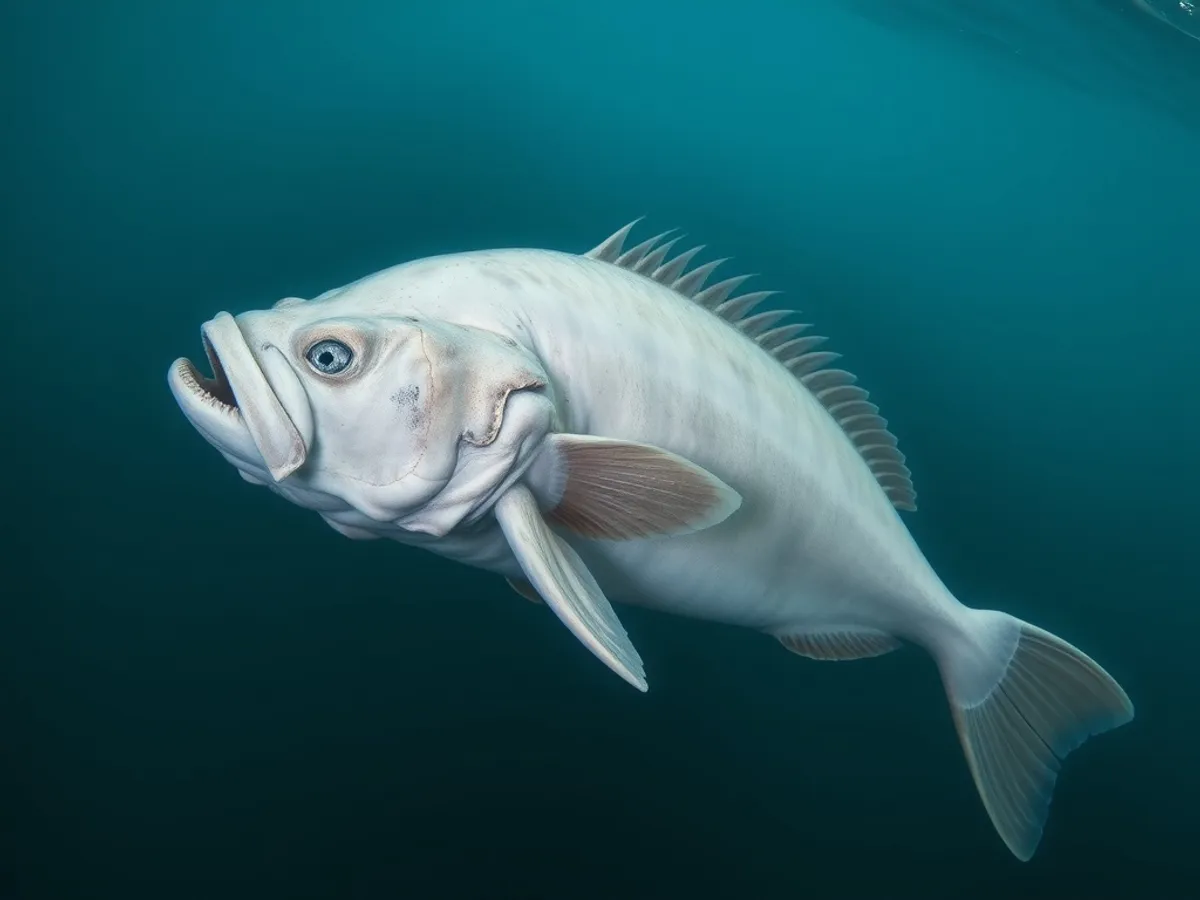
About the Pacific halibut
The Pacific halibut is a large, flat-bodied fish native to the North Pacific Ocean, recognized for its diamond-shaped body and both eyes located on its right side. It is one of the largest flatfish species, with mature females often reaching impressive sizes. Pacific halibut inhabit deep, cold waters and are prized both commercially and recreationally for their firm, mild-flavored flesh. Their populations are managed carefully to ensure sustainability due to their importance in fisheries. These fish are highly migratory, traveling great distances between spawning and feeding grounds.
Fascinating facts
Record Size
The largest Pacific halibut ever recorded weighed 245 kg (540 lbs), caught off Alaska.
Eye Migration
During development, the left eye of the Pacific halibut migrates to the right side, so both eyes end up on the upward-facing side.
Seasonal Migrations
Pacific halibut migrate long distances annually, moving to deeper waters for spawning in winter and returning to shallower feeding grounds in summer.
Detailed description
The Pacific halibut (Hippoglossus stenolepis) is one of the largest species of flatfish, with females commonly reaching lengths of 1.5 to 2.4 meters (5–8 feet) and weights exceeding 200 kg (440 lbs), while males are typically smaller. Its body is diamond-shaped, strongly compressed, and adapted for a benthic lifestyle, with both eyes located on the right side due to a remarkable metamorphosis during development. The upper (eyed) side is a mottled dark brown to olive, providing camouflage against the ocean floor, while the underside is pale. Pacific halibut possess a large mouth with sharp, conical teeth, well-suited for grasping prey. Their lateral line is highly sensitive, aiding in prey detection. They are long-lived, with individuals commonly reaching 25–30 years and some documented over 50 years old. The species exhibits sexual dimorphism, with females growing much larger and living longer than males. Pacific halibut are highly migratory, capable of traveling hundreds of kilometers between feeding and spawning grounds. Their physiology is adapted for cold, oxygen-rich waters, and they can inhabit depths from 20 to over 1,200 meters (65–3,900 feet), though most are found between 90 and 900 meters.
Did you know?
Pacific halibut can live for more than 50 years, with some individuals documented at over 70 years old.
Research & sources
Wikipedia summary
Hippoglossus stenolepis, the Pacific halibut, is a species of righteye flounder. This very large species of flatfish is native to the North Pacific and is fished by commercial fisheries, sport fishers, and subsistence fishers.
Behaviour & social structure
Pacific halibut are primarily solitary, though they may aggregate in areas of abundant food or during spawning migrations. They are ambush predators, often lying motionless and partially buried in sediment to surprise prey. Their diet is varied and includes fish (such as cod, pollock, and herring), cephalopods, crustaceans, and occasionally benthic invertebrates. Juveniles feed mainly on small crustaceans and other invertebrates. Halibut are crepuscular feeders, with peak activity at dawn and dusk, though feeding can occur throughout the day. They use their excellent vision and lateral line system to detect prey movements. While generally non-territorial, adults may exhibit site fidelity to productive feeding grounds. Seasonal migrations are pronounced, with individuals moving to shallower waters in summer for feeding and deeper waters in winter for spawning.
Reproduction & life cycle
Pacific halibut are batch spawners, with reproduction occurring annually from November to March, peaking in December and January. Spawning takes place in deep waters (300–600 meters) along the continental slope. Females release between 0.5 and 4 million eggs per season, depending on size and age. Fertilization is external, with males releasing sperm into the water column. Eggs are pelagic and hatch after approximately 15–20 days, depending on temperature. Larvae are initially symmetrical and pelagic, drifting with ocean currents. During metamorphosis, the left eye migrates to the right side, and juveniles settle to the benthos at 6–7 months of age. There is no parental care; survival rates are low, with high mortality in early life stages. Sexual maturity is reached at 8–12 years for females and 7–8 years for males.
Adaptations & survival
Pacific halibut exhibit several adaptations for benthic predation and survival in cold, deep waters. Their flattened, asymmetrical body allows them to lie flush against the seafloor, reducing visibility to predators and prey. The migration of both eyes to the right side enhances binocular vision for detecting prey above. Their coloration provides effective camouflage. A robust musculature and large pectoral fins enable short bursts of speed for ambush attacks and long-distance migrations. The lateral line system is highly developed, detecting vibrations and movements in the substrate. Physiologically, they possess adaptations for low-temperature environments, including antifreeze proteins in their blood and efficient oxygen utilization. Their slow growth and longevity are evolutionary responses to the stable but resource-limited deep-sea environment.
Cultural significance
Pacific halibut holds significant economic, cultural, and nutritional value for Indigenous peoples and coastal communities throughout the North Pacific. It is a staple in traditional diets and features prominently in the subsistence and ceremonial practices of Alaska Native and First Nations peoples. Commercially, it supports a lucrative fishery, with the flesh prized for its mild flavor and firm texture. The species is also a popular target for recreational anglers, contributing to local tourism economies. In art and folklore, the halibut is sometimes depicted as a symbol of abundance and sustenance. Its management is often cited as a model of successful international fisheries cooperation.
Recent research
Recent research on Pacific halibut has focused on population genetics, migration patterns, and responses to climate change. Genetic studies have revealed limited population structure across their range, supporting the management of the species as a single stock. Satellite tagging and electronic tracking have provided insights into seasonal migrations, depth preferences, and habitat use. Studies on otolith microchemistry are being used to reconstruct life histories and migration routes. Ongoing research is assessing the impacts of ocean warming and acidification on growth rates, reproductive success, and prey availability. Advances in stock assessment models and ecosystem-based management are helping refine harvest strategies and ensure sustainability.
Videos
Habitat
Cold, deep ocean waters along the continental shelf

Conservation
The Pacific halibut is currently classified as Least Concern on the IUCN Red List.
Threats & challenges
The primary threats to Pacific halibut are overfishing, bycatch in other fisheries, and habitat degradation. Historically, intense commercial exploitation in the early 20th century led to significant population declines, prompting the establishment of international management through the International Pacific Halibut Commission (IPHC). Current populations are considered stable and well-managed, with quotas, size limits, and seasonal closures in place. Climate change poses emerging risks, including shifts in distribution, changes in prey availability, and potential impacts on spawning success. Bycatch in trawl and longline fisheries remains a concern, as does illegal, unreported, and unregulated (IUU) fishing. Ongoing monitoring and adaptive management are essential to ensure long-term sustainability.
Taxonomy
Scientific name
Hippoglossus stenolepis
- Kingdom
- Animalia
- Phylum
- Chordata
- Class
- Actinopterygii
- Order
- Pleuronectiformes
- Family
- Pleuronectidae
- Genus
- Hippoglossus
- Species
- stenolepis
Community notes
Share your observations about the Pacific halibut.
No community notes yet. Be the first!
Discover more wildlife
More fascinating animals from the encyclopedia.