
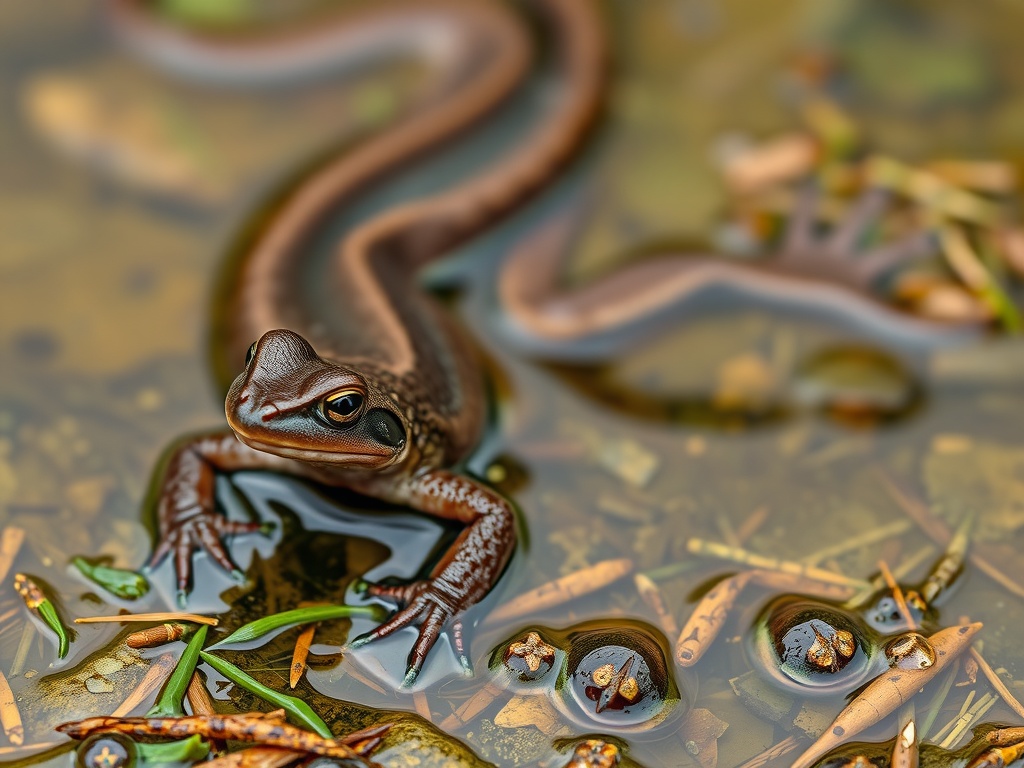
About the Palmate Newt
The Palmate Newt is a small, slender amphibian native to Western Europe, recognized for its smooth skin and subtle coloration. Males display a distinct filament at the tip of their tails and black webbing on their hind feet during the breeding season, while females are generally more subdued in appearance. These newts are semi-aquatic, spending part of the year in ponds and other freshwater bodies for breeding, and the rest on land in damp, sheltered habitats. Palmate Newts are adaptable and can thrive in a variety of environments, including gardens, woodlands, and heathlands. Their secretive nature makes them less often seen compared to other newt species.
Fascinating facts
Breeding Display
During courtship, males perform elaborate underwater dances and display their tail filament and webbed feet to attract females.
Habitat Flexibility
Palmate Newts can live in a range of habitats, from acidic heathland pools to garden ponds, making them one of the most adaptable European newts.
Tail Regeneration
If threatened by a predator, the Palmate Newt can shed its tail, which will then regrow—a remarkable survival adaptation.
Detailed description
The Palmate Newt (Lissotriton helveticus) is a small, slender amphibian, typically measuring 5–9.5 cm in length, with females generally larger than males. Its dorsal coloration ranges from olive-green to brown, often with scattered dark spots, while the ventral side is pale yellow to orange, and the throat is characteristically unspotted—a key distinction from the similar Smooth Newt (Lissotriton vulgaris). A dark, well-defined stripe runs from the snout, through the eye, and along the side of the head. During the breeding season, males develop a low, smooth dorsal crest, strongly webbed hind feet, and a distinctive filament at the tip of the tail, which can be up to 1 cm long. The skin is smooth and moist, aiding in cutaneous respiration, and the limbs are relatively short but well-adapted for both swimming and terrestrial movement. Palmate Newts possess a tail that is laterally compressed, enhancing aquatic locomotion. Their eyes are prominent, with a horizontal pupil, and their sense of smell is highly developed, assisting in prey detection and mate location. Outside the breeding season, both sexes adopt a more cryptic, terrestrial coloration and behavior, often hiding under logs, stones, or leaf litter.
Did you know?
Palmate Newts can shed their tails to escape predators, and the tail will gradually regenerate over time.
Research & sources
Wikipedia summary
The palmate newt is a species of newt found in Western Europe, from Great Britain to the northern Iberian Peninsula. It is 5–9.5 cm (2.0–3.7 in) long and olive or brown with some dark spots. The underside is yellow to orange, and the throat, unlike in the similar smooth newt, always unspotted. A dark stripe runs along the head and through the eyes. Breeding males develop a distinct filament on the end of their tail, strongly webbed hind feet, and a low, smooth crest on their back.
Behaviour & social structure
Palmate Newts are primarily nocturnal, emerging at dusk to forage and mate. Their diet consists mainly of small invertebrates, including insect larvae, crustaceans, worms, and aquatic snails. In aquatic environments, they use stealth and rapid tongue projection to capture prey, while on land they rely on slow, deliberate movements to ambush terrestrial invertebrates. Social interactions are generally limited outside the breeding season, with individuals leading solitary lives. During the breeding period, males become territorial and perform elaborate courtship displays, including tail fanning and undulating movements to attract females. They are capable swimmers, using lateral undulations of the tail for propulsion. When threatened, Palmate Newts may exhibit thanatosis (playing dead) or secrete mild toxins from their skin as a deterrent to predators.
Reproduction & life cycle
Breeding occurs from March to June, triggered by rising temperatures and increased rainfall. Males arrive first at breeding ponds and establish small territories. Courtship involves the male performing a display in front of the female, waving his tail filament and releasing pheromones to entice her. If receptive, the female follows the male, who deposits a spermatophore (sperm packet) on the substrate, which she then picks up with her cloaca. Females lay 100–300 eggs singly, carefully wrapping each egg in aquatic plant leaves to protect them from predation and desiccation. Embryonic development lasts 10–21 days, depending on temperature. Larvae are fully aquatic, with external gills, and metamorphose into juveniles (efts) after 6–12 weeks. There is no parental care after egg-laying. Sexual maturity is typically reached at 2–3 years of age.
Adaptations & survival
Palmate Newts exhibit several adaptations for a semi-aquatic lifestyle. Their smooth, permeable skin facilitates cutaneous respiration and moisture retention. The webbed hind feet and tail filament in breeding males enhance swimming efficiency and courtship success. Their ability to absorb oxygen through the skin allows survival in low-oxygen aquatic environments. Behavioral plasticity enables them to exploit a wide range of habitats, from acidic heathland pools to garden ponds. During terrestrial phases, they reduce activity and seek moist microhabitats to prevent desiccation. Their cryptic coloration and secretive habits reduce predation risk, while mild skin toxins provide chemical defense.
Cultural significance
Palmate Newts have limited direct cultural significance but are sometimes featured in European folklore as symbols of transformation and adaptability. In some regions, newts have been associated with witchcraft or used in traditional remedies, though the Palmate Newt is not a primary species for such uses. More recently, they have become indicators of healthy pond ecosystems and are valued in citizen science and environmental education programs.
Recent research
Recent research has focused on the genetic differentiation between Palmate Newt populations across their range, revealing subtle phylogeographic structure and evidence of postglacial recolonization. Studies on their response to environmental pollutants, such as pesticides and endocrine disruptors, have highlighted their sensitivity and utility as bioindicators. Ongoing research is examining the impact of habitat fragmentation and climate change on breeding phenology and larval development. There is also interest in their skin microbiome and its role in disease resistance, particularly in light of emerging amphibian pathogens like Batrachochytrium dendrobatidis.
Videos
Habitat
Freshwater ponds and adjacent terrestrial habitats such as woodland and heathland
 Various Continental Regions
Grassland
Open areas dominated by grasses rather than trees, supporting numerous herbivores and their predators.
 Global
Forest
Wooded areas with significant tree cover and diverse plant and animal communities.
 Global
Freshwater
Lakes, rivers, and wetlands with diverse aquatic ecosystems.
Conservation
The Palmate Newt is currently classified as Least Concern on the IUCN Red List.
Threats & challenges
Although currently classified as Least Concern by the IUCN, Palmate Newts face localized threats from habitat loss, pond drainage, pollution, and the introduction of predatory fish. Agricultural intensification and urbanization can fragment populations and reduce breeding site availability. Climate change poses additional risks by altering hydrological regimes and breeding phenology. Road mortality during seasonal migrations and competition with invasive species, such as the North American crayfish, are emerging concerns. Despite these challenges, the species remains widespread and adaptable, with stable populations in many areas.
Taxonomy
Scientific name
Lissotriton helveticus
- Kingdom
- Animalia
- Phylum
- Chordata
- Class
- Amphibia
- Order
- Urodela
- Family
- Salamandridae
- Genus
- Lissotriton
- Species
- helveticus
Community notes
Share your observations about the Palmate Newt.
No community notes yet. Be the first!
Discover more wildlife
More fascinating animals from the encyclopedia.