
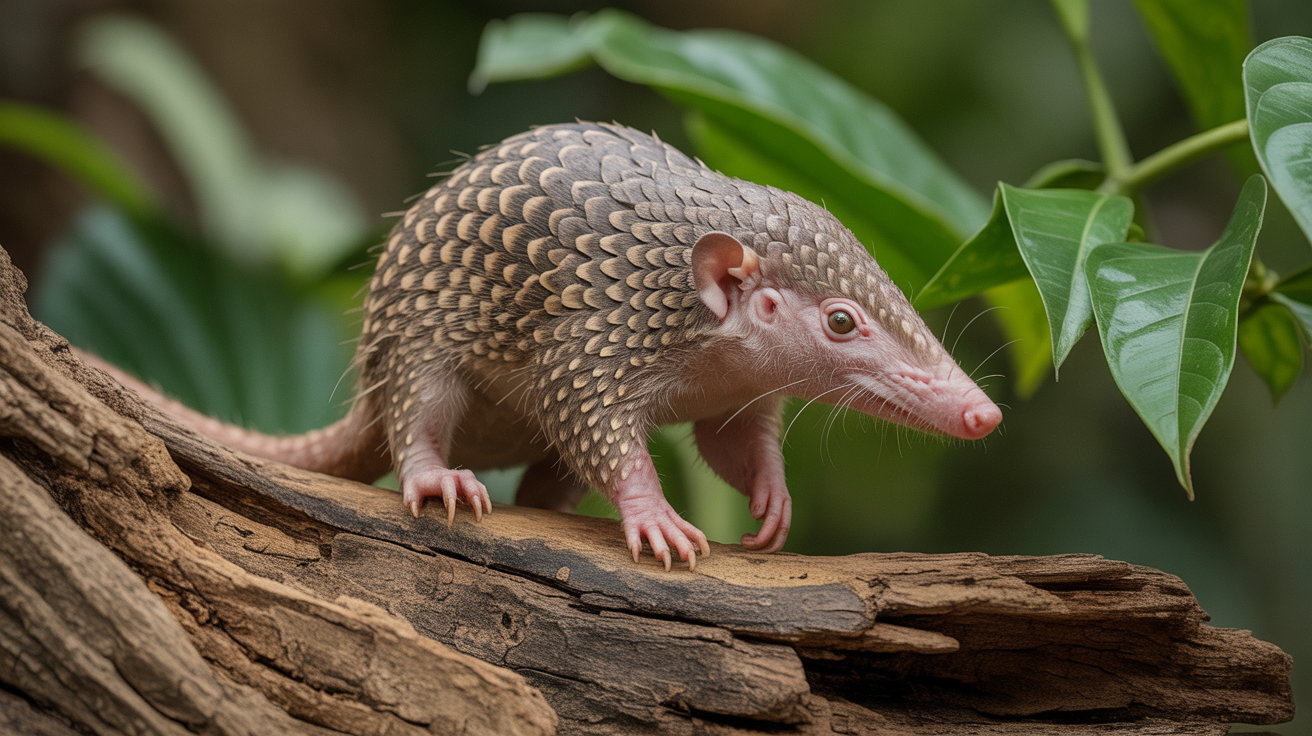
About the Pangolin Tree Shrew
The Pangolin Tree Shrew, also known as the pen-tailed treeshrew, is a small, nocturnal mammal native to the forests of Southeast Asia. Recognized for its unique tail that resembles a pangolin's scales, this species is the only living member of its genus and family. It spends much of its life in trees, where it feeds on nectar, fruit, and insects, displaying remarkable agility among the branches. Its specialized metabolism allows it to consume naturally fermented nectar with high alcohol content without apparent intoxication.
Fascinating facts
Arboreal Lifestyle
Pangolin Tree Shrews are highly arboreal, spending nearly all of their time in the forest canopy, rarely descending to the ground.
Fermented Nectar Diet
They regularly feed on the naturally fermented nectar of the bertam palm, which contains significant amounts of alcohol.
Ancient Lineage
This species is the only surviving member of its family, Ptilocercidae, representing an ancient evolutionary lineage distinct from other treeshrews.
Detailed description
The Pangolin Tree Shrew (Ptilocercus lowii), also known as the pen-tailed treeshrew, is a diminutive, nocturnal mammal distinguished by its bushy tail tipped with stiff, feather-like scales reminiscent of a pangolin's, measuring approximately 11–14 cm in body length with a tail of similar or slightly greater length. Its fur is soft, grayish-brown on the dorsal side and lighter ventrally, providing camouflage among the dense foliage of Southeast Asian lowland rainforests. The species has large, forward-facing eyes adapted for night vision, and a pointed snout suited for probing flowers and crevices. Unlike other treeshrews, P. lowii is the only extant member of the family Ptilocercidae, representing a basal lineage within the order Scandentia. It is highly arboreal, rarely descending to the ground, and exhibits remarkable agility, leaping between branches with the aid of its prehensile tail. Socially, the pangolin tree shrew is primarily solitary but may tolerate overlapping home ranges. Its diet is omnivorous but strongly nectarivorous, with a unique tolerance for ethanol-rich fermented nectar, particularly from the bertam palm (Eugeissona tristis). Reproduction is poorly documented but is thought to involve small litters and altricial young. The species' metabolism and digestive system are specialized to process high-sugar, high-alcohol diets, a rare adaptation among mammals. Its evolutionary distinctiveness and ancient lineage make it a subject of particular interest in mammalian phylogenetics.
Did you know?
Pangolin Tree Shrews can consume the equivalent of 10-12 glasses of wine per night (by human standards) without showing signs of intoxication.
Research & sources
Behaviour & social structure
Pangolin tree shrews are strictly nocturnal, emerging at dusk to forage and returning to tree hollows or dense foliage by dawn. They exhibit a home range-based territoriality, with individuals marking their territories using scent glands located near the anus. Their foraging behavior is characterized by rapid, agile movement through the mid- and upper canopy, using their semi-prehensile tails for balance and support. Feeding is focused on the flowers of the bertam palm, from which they lap nectar with their long, brush-tipped tongues; this nectar is often naturally fermented and contains up to 3.8% ethanol. They also consume insects, small arthropods, and fruit opportunistically. Social interactions are minimal outside of mating, though overlapping foraging areas may lead to brief encounters. Vocalizations are infrequent and consist mainly of high-pitched chirps or trills, likely used for communication during the breeding season or to signal alarm.
Reproduction & life cycle
Reproductive biology in Ptilocercus lowii is not fully understood due to its elusive nature. Available evidence suggests a polygynous or promiscuous mating system, with breeding likely occurring year-round in the stable tropical climate. Females give birth to litters of 1–3 young after a gestation period estimated at 45–50 days, based on related treeshrew species. The young are born altricial, blind and hairless, and are cared for in tree hollows or nests constructed from leaves. Maternal care is pronounced, with the mother visiting the nest infrequently to nurse, a strategy that may reduce predation risk. Weaning occurs at approximately 30–40 days, after which juveniles become increasingly independent. Sexual maturity is reached within 6–9 months.
Adaptations & survival
P. lowii exhibits several unique adaptations: its pen-like tail is covered in stiff, scale-like bristles that may aid in balance or serve as a visual signal. The species' digestive system is adapted to process large quantities of nectar and tolerate high ethanol concentrations, with hepatic enzymes specialized for alcohol metabolism. Its nocturnal lifestyle is supported by large eyes with a high density of rod cells, enhancing low-light vision. The elongated tongue and reduced dentition facilitate nectar feeding. Arboreal locomotion is aided by strong, curved claws and a flexible ankle joint, allowing for rapid movement and secure gripping of branches. Evolutionarily, its basal position among treeshrews suggests retention of several primitive mammalian traits.
Cultural significance
The pangolin tree shrew holds little direct significance in local folklore or traditional medicine, unlike true pangolins or other treeshrews. Its elusive nature and arboreal lifestyle have kept it largely out of the spotlight in indigenous cultures. However, its unique appearance and evolutionary distinctiveness have made it a subject of interest in scientific and conservation circles, symbolizing the hidden diversity of Southeast Asian rainforests.
Recent research
Recent research has focused on the pangolin tree shrew's remarkable ethanol tolerance, with studies showing that individuals regularly consume nectar with alcohol concentrations that would intoxicate most mammals, yet display no signs of inebriation. This has implications for understanding the evolution of alcohol metabolism in mammals. Molecular phylogenetic studies have confirmed P. lowii as the sole surviving member of its family, providing insights into early mammalian evolution in Southeast Asia. Ongoing research includes ecological studies on its role as a pollinator of the bertam palm and the potential impacts of habitat fragmentation on its populations. Camera trapping and radio telemetry are increasingly used to study its nocturnal behavior and habitat use.
Sources
The Pen-tailed Treeshrew (Ptilocercus lowii): A Living Fossil and Its Ecological and Evolutionary Significance
Martin, R.D. & others (2001)
scientificPtilocercus lowii: The IUCN Red List of Threatened Species 2016
IUCN SSC Small Mammal Specialist Group
conservationVideos
Habitat
Tropical rainforest


Conservation
The Pangolin Tree Shrew is currently classified as Least Concern on the IUCN Red List.
Threats & challenges
Currently assessed as Least Concern by the IUCN, the pangolin tree shrew faces localized threats from habitat loss due to deforestation, logging, and conversion of lowland rainforest to agriculture or palm oil plantations. Its dependence on primary forest and the bertam palm for food makes it vulnerable to ecosystem disruption. Although not targeted by hunting, incidental capture and habitat fragmentation pose ongoing risks. Population trends are believed to be stable in protected areas but declining in regions with intense land-use change. Conservation challenges include a lack of detailed population data and the species' cryptic, nocturnal habits, which complicate monitoring efforts.
Taxonomy
Scientific name
Ptilocercus lowii
- Kingdom
- Animalia
- Phylum
- Chordata
- Class
- Mammalia
- Order
- Scandentia
- Family
- Ptilocercidae
- Genus
- Ptilocercus
- Species
- lowii
Community notes
Share your observations about the Pangolin Tree Shrew.
No community notes yet. Be the first!
Discover more wildlife
More fascinating animals from the encyclopedia.