
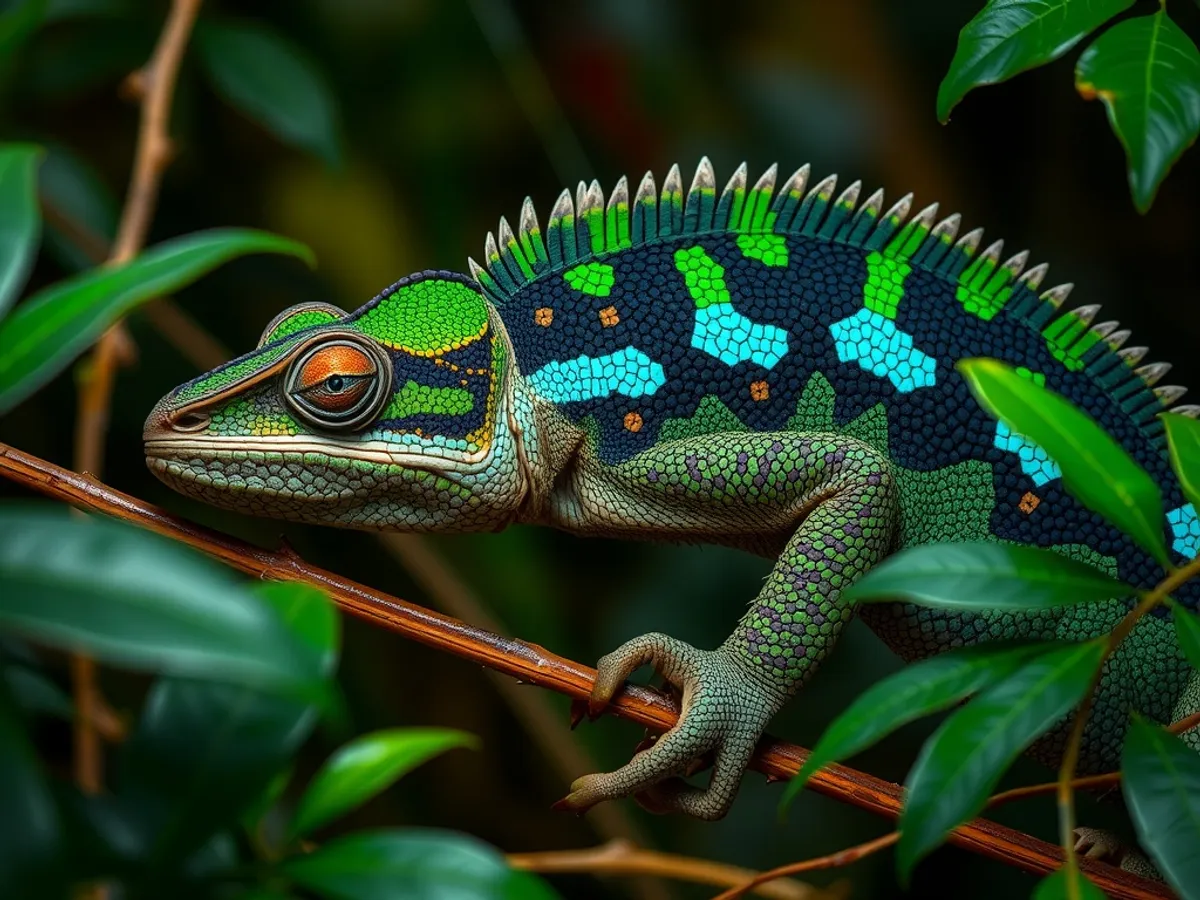
About the Panther Chameleon
Furcifer pardalis does not change colour by moving pigment around, which is what almost every popular account claims. A 2015 study from Geneva showed that the chameleon has a lattice of guanine nanocrystals in a layer of specialised cells called iridophores, and by relaxing or tightening the spacing of that lattice it shifts which wavelengths the skin reflects — a tunable photonic crystal. Loosening the lattice moves reflection from blue toward red. Pigments provide the yellow and red base; the structural layer supplies the blues and the switching. The second misconception is that the colour change is camouflage. It is mostly signalling: an excited or aggressive male turns dazzlingly bright, a submissive one goes dull brown-grey, and a gravid female turns black with orange bars to tell males to keep away. Panther chameleons are endemic to Madagascar, and their colour varies dramatically by locale — Nosy Be animals are blue, Ambilobe males are red-and-blue banded, Ambanja purple-blue, and genetic work in 2015 suggested these locales may be distinct species. The tongue is fired at over 2,500 m/s2 of acceleration, powered by elastic recoil in a collagen sheath rather than muscle contraction, and can exceed the chameleon's own body length.
Fascinating facts
Color Shifters
Panther Chameleons can rapidly change color, displaying a wide range of vibrant patterns, which can reflect their mood, social status, or environmental conditions.
Independent Eyes
Each eye of the Panther Chameleon moves independently, giving them a 360-degree field of vision to spot predators and prey.
Super Tongue
Their tongue can shoot out at high speed to catch insects, extending up to twice the length of their body.
Detailed description
The Panther Chameleon (Furcifer pardalis) is a medium-to-large arboreal lizard, with adult males typically reaching 43–52 cm (17–20 in) in total length, while females are smaller, averaging 23–33 cm (9–13 in). Its body is laterally compressed, with a prehensile tail and zygodactylous feet adapted for grasping branches. The species is renowned for its extraordinary coloration, which varies geographically—populations from different regions of Madagascar, known as 'locales,' display distinct color morphs ranging from vivid blues and greens to reds, oranges, and yellows. The chameleon's skin contains specialized chromatophores and iridophores, allowing rapid color changes for communication, thermoregulation, and camouflage. The head features a prominent casque and well-developed gular crest, especially in males. Panther Chameleons possess independently mobile eyes, granting nearly 360-degree vision, and a projectile tongue that can extend up to twice their body length to capture prey. They are diurnal, spending daylight hours actively hunting and basking, and are primarily insectivorous but may also consume small vertebrates. Territorial and solitary, individuals use color displays and body postures to communicate dominance or submission. Lifespan in the wild is estimated at 2–3 years for females and up to 5–7 years for males, though captive individuals may live longer with proper care.
Did you know?
A Panther Chameleon's tongue can extend up to twice its body length to catch prey with astonishing speed and accuracy.
Research & sources
Wikipedia summary
The panther chameleon is a species of chameleon found in the eastern and northern parts of Madagascar in a tropical forest biome. Additionally, it has been introduced to Réunion and Mauritius, as well as the state of Florida within the United States.
Behaviour & social structure
Panther Chameleons are solitary and highly territorial, with males defending overlapping territories that may encompass the smaller ranges of several females. Aggressive encounters between males involve dramatic color changes, inflation of the body, and head bobbing; actual physical combat is rare but can occur. They are ambush predators, relying on their cryptic coloration and slow, deliberate movements to approach prey undetected. Their diet consists mainly of insects such as crickets, grasshoppers, and beetles, but they may also eat small lizards or nestling birds. The chameleon's projectile tongue is launched with remarkable speed and accuracy, aided by specialized musculature and a sticky tip. Daily routines include basking in the morning to regulate body temperature, followed by periods of foraging and resting. At night, they seek secure perches in the canopy to sleep, often turning pale in color. Social interactions are largely limited to the breeding season or territorial disputes.
Reproduction & life cycle
Panther Chameleons are oviparous, with breeding typically occurring during the rainy season (November to April in Madagascar). Courtship involves males displaying vibrant colors and performing ritualized movements to attract females. If receptive, the female allows copulation; if not, she exhibits dark coloration and aggressive postures to deter the male. After mating, females undergo a gestation period of 20–30 days before laying 10–40 eggs in a shallow, excavated nest in the soil. Incubation lasts 6–12 months, depending on temperature and humidity. Females do not provide parental care post-oviposition and may only breed once or twice in their lifetime, as egg production is energetically costly and reduces lifespan. Hatchlings are independent from birth, exhibiting cryptic coloration and immediate foraging behavior.
Adaptations & survival
Panther Chameleons exhibit several remarkable adaptations for arboreal life and predation. Their prehensile tails and zygodactylous feet provide exceptional grip on branches, while their laterally compressed bodies facilitate movement through dense foliage. The eyes can move independently, allowing simultaneous scanning for predators and prey. Color change is achieved through layers of specialized skin cells—chromatophores, iridophores, and melanophores—enabling rapid shifts for communication, camouflage, and thermoregulation. The ballistic tongue, powered by elastic collagen tissue, can capture prey at distances up to twice the animal's body length. Additionally, their slow, rocking gait mimics the movement of leaves in the wind, reducing detection by predators. Their acute vision, including the ability to perceive ultraviolet light, aids in prey detection and social signaling.
Cultural significance
In Madagascar, chameleons are often associated with local folklore and superstitions, sometimes regarded as omens or mystical creatures due to their color-changing abilities and unusual appearance. They are featured in Malagasy proverbs and stories, symbolizing patience, adaptability, or transformation. Internationally, Panther Chameleons are highly prized in the exotic pet trade for their striking colors and unique behaviors, contributing to their popularity and economic value. However, there is no evidence of traditional medicinal or culinary use.
Recent research
Recent research has focused on the molecular mechanisms of color change, revealing that structural changes in iridophore nanocrystals underlie rapid shifts in skin coloration. Studies on population genetics have identified significant genetic divergence among different geographic locales, supporting the development of locale-specific conservation strategies. Ongoing ecological research is examining the impact of introduced populations on island ecosystems and the potential for hybridization. Advances in captive husbandry have improved understanding of nutritional requirements, disease management, and breeding, contributing to both conservation and the pet trade.
Videos
Habitat
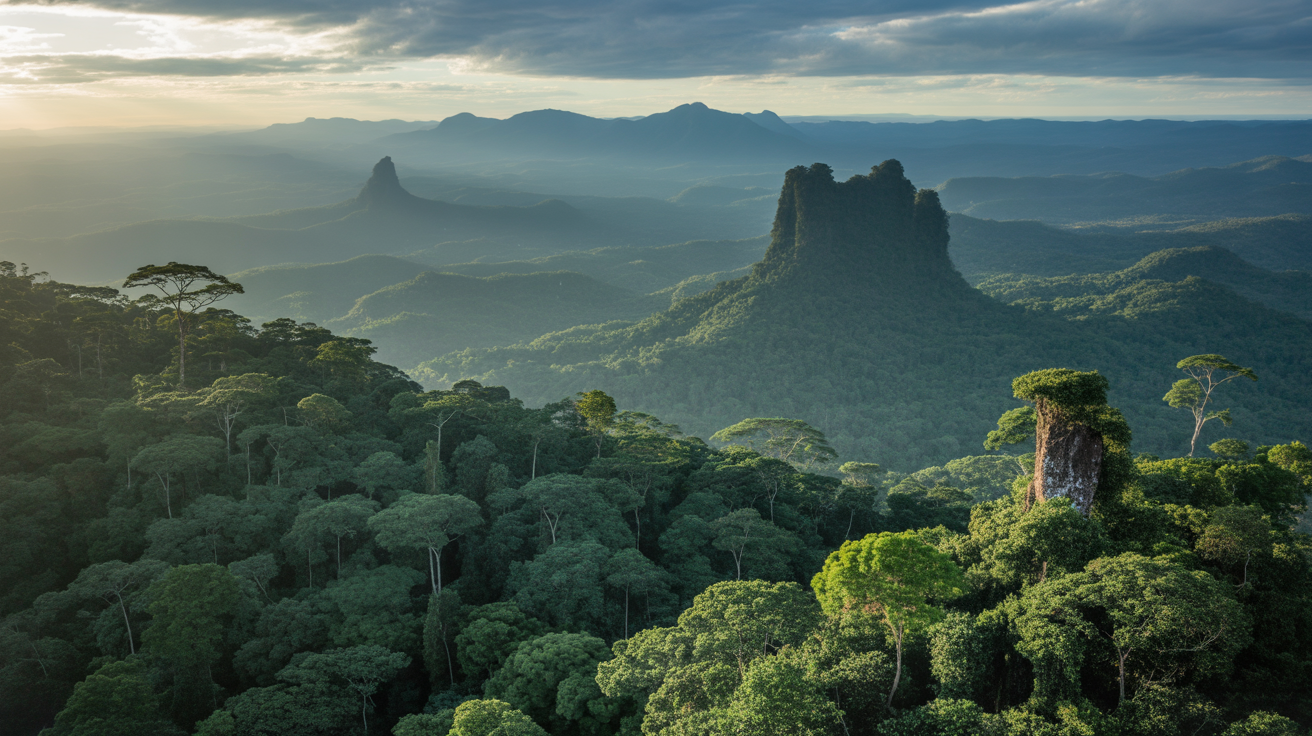
Tropical forest

Conservation
The Panther Chameleon is currently classified as Least Concern on the IUCN Red List.
Threats & challenges
While currently listed as Least Concern by the IUCN, Panther Chameleons face several threats. Habitat loss due to deforestation, agricultural expansion, and urbanization in Madagascar is a significant concern. Collection for the international pet trade, though regulated, can impact local populations if not managed sustainably. Introduced populations in Réunion, Mauritius, and Florida may pose ecological risks to native species. Climate change, altering rainfall patterns and temperature regimes, could affect breeding cycles and habitat suitability. Population trends are stable in many areas, but localized declines have been reported where habitat destruction is severe.
Taxonomy
Scientific name
Furcifer pardalis
- Kingdom
- Animalia
- Phylum
- Chordata
- Class
- Reptilia
- Order
- Squamata
- Family
- Chamaeleonidae
- Genus
- Furcifer
- Species
- pardalis
Where to see a panther chameleon
4 zoos and aquariums in 2 countries are recorded as keeping this species.
 Belfast Zoo🇬🇧 Belfast, United Kingdom
 Dallas World Aquarium🇺🇸 Dallas, United States
 Louisville Zoo🇺🇸 United States
 Audubon Zoo🇺🇸 United States
Community notes
Share your observations about the Panther Chameleon.
No community notes yet. Be the first!
Discover more wildlife
More fascinating animals from the encyclopedia.