
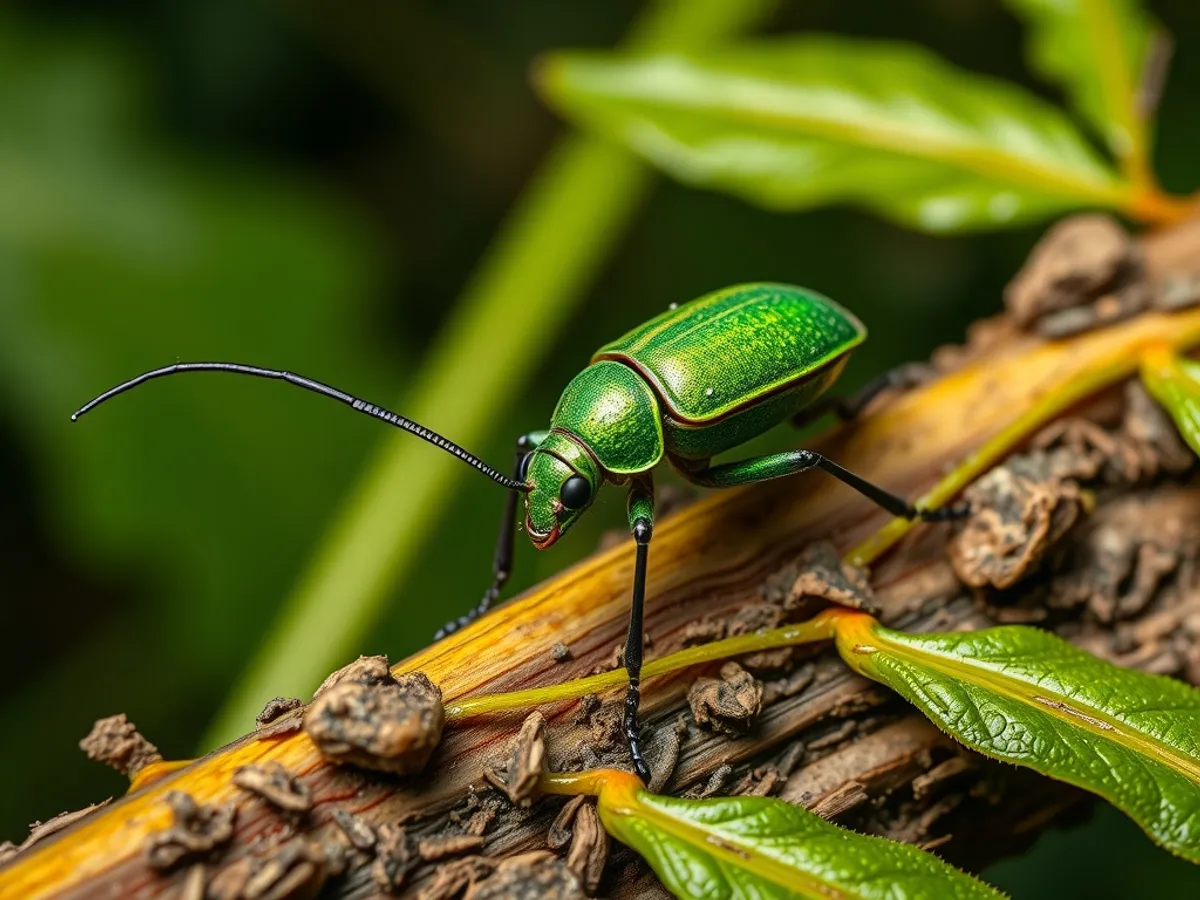
About the Papuan Green Weevil
The Papuan Green Weevil is a strikingly colorful beetle native to the rainforests of Papua New Guinea. Recognized for its metallic green and blue coloration, this invertebrate owes its iridescent appearance to microscopic scales covering its exoskeleton. The species is relatively small and spends much of its life on leaves, where it feeds and camouflages among foliage. Its vivid coloration serves both as a warning to predators and as an attraction during mating displays.
Fascinating facts
Brilliant Colors
The Papuan Green Weevil's metallic hues result from microscopic scales that reflect light, creating vivid blue-green shades.
Rainforest Resident
This species is endemic to the lowland and montane rainforests of Papua New Guinea, thriving in humid, leafy environments.
Leaf Lover
The beetle feeds primarily on the leaves of yam and other tropical plants, playing a role in the local ecosystem as a herbivore.
Detailed description
The Papuan Green Weevil (Eupholus schoenherri) is a medium-sized beetle, typically measuring 20–30 mm in length, with a robust, slightly flattened body adapted for life among the foliage of Papua New Guinea's lowland and montane rainforests. Its exoskeleton is covered in microscopic, chitinous scales that refract light, producing vivid metallic blue and green hues with black banding—an example of structural coloration rather than pigmentation. The head is elongated with a pronounced rostrum (snout), housing strong mandibles for feeding on plant material. Antennae are geniculate (elbowed), aiding in tactile navigation and chemical detection. The legs are well-developed, with tarsal pads that allow for secure grip on smooth leaves and stems. Eupholus schoenherri is primarily diurnal, relying on its coloration for both camouflage among foliage and aposematic (warning) signaling to potential predators. The species is solitary but may be found in loose aggregations where food is abundant. Its life cycle includes complete metamorphosis: egg, larva, pupa, and adult stages. Larvae develop within decaying wood or soil, feeding on roots and organic matter, while adults are folivorous. The weevil's vivid appearance, combined with its slow, deliberate movements, suggests a reliance on chemical defenses, likely derived from host plants, to deter predation.
Did you know?
Despite their bright colors, Papuan Green Weevils are not poisonous; their iridescence is a form of mimicry to deter predators.
Research & sources
Behaviour & social structure
Eupholus schoenherri exhibits primarily solitary behavior, with adults spending most of their time foraging on the upper surfaces of leaves in the rainforest canopy. They are slow-moving and rely on their cryptic coloration and chemical deterrents to avoid predation. Feeding occurs during daylight hours, with individuals using their strong mandibles to chew through tender leaves, stems, and occasionally flowers. When threatened, the weevil may drop to the forest floor and remain motionless—a behavior known as thanatosis (playing dead). Social interactions are minimal outside of the breeding season, though temporary aggregations may form on particularly abundant food sources. Adults are not aggressive and rarely compete directly for resources. Their daily routine involves periods of feeding interspersed with rest, typically in shaded, concealed locations to avoid overheating and desiccation.
Reproduction & life cycle
The reproductive cycle of the Papuan Green Weevil is closely tied to the wet season, when food resources are most plentiful. Males locate females using chemical cues (pheromones) and engage in brief courtship displays, which may involve antennal tapping and circling. Mating is accomplished via copulation, after which females lay clusters of eggs on the underside of leaves or in crevices of decaying wood. The incubation period for eggs is approximately 10–14 days, depending on ambient temperature and humidity. Upon hatching, larvae burrow into the substrate, feeding on decaying plant matter and roots for several weeks to months. Pupation occurs within the soil or rotting wood, lasting 2–4 weeks before the adult emerges. There is no parental care beyond egg-laying, and adults disperse shortly after emergence to seek food and mates.
Adaptations & survival
Eupholus schoenherri possesses several notable adaptations for survival in its rainforest habitat. The iridescent scales on its exoskeleton provide both camouflage among the glossy green leaves and serve as a warning to predators, signaling the presence of chemical defenses. The strong mandibles and elongated rostrum are specialized for feeding on tough plant tissues. Tarsal pads on the feet enhance grip on slippery surfaces, allowing the beetle to navigate the canopy efficiently. Thanatosis (feigning death) is a behavioral adaptation to avoid detection by predators. Additionally, the weevil's ability to sequester toxic compounds from its host plants likely contributes to its unpalatability, a trait reinforced by its conspicuous coloration (aposematism). The complete metamorphosis life cycle allows larvae and adults to exploit different ecological niches, reducing intraspecific competition.
Cultural significance
The Papuan Green Weevil is highly prized by collectors and entomologists worldwide for its vivid coloration and unique appearance, often featured in natural history exhibits and educational materials. In Papua New Guinea, while not central to traditional mythology or folklore, its striking form has inspired local art and handicrafts. Some indigenous communities use beetle elytra (wing covers) as decorative elements in jewelry and ceremonial attire, though this is more common with larger beetle species. The weevil's presence in ecotourism and scientific study contributes to local awareness of rainforest biodiversity.
Recent research
Recent research on Eupholus schoenherri has focused on the nanostructure of its iridescent scales, revealing complex photonic crystals responsible for its metallic coloration—an area of interest for biomimetic materials science. Studies have also examined the beetle's chemical ecology, identifying potential defensive compounds sequestered from host plants, which may have applications in natural pest management. Ongoing fieldwork in Papua New Guinea is documenting the species' distribution, host plant associations (notably with yam and aroid species), and responses to habitat disturbance. Genetic studies are underway to clarify relationships within the Eupholus genus, which is notable for its high diversity and endemism in New Guinea.
Sources
The Eupholus Weevils of New Guinea (Coleoptera: Curculionidae): Taxonomy, Distribution, and Ecology
Riedel, A. (2009)
scientificRevision of the Genus Eupholus (Coleoptera: Curculionidae) from New Guinea
Riedel, A. (2009)
scientificVideos
Habitat
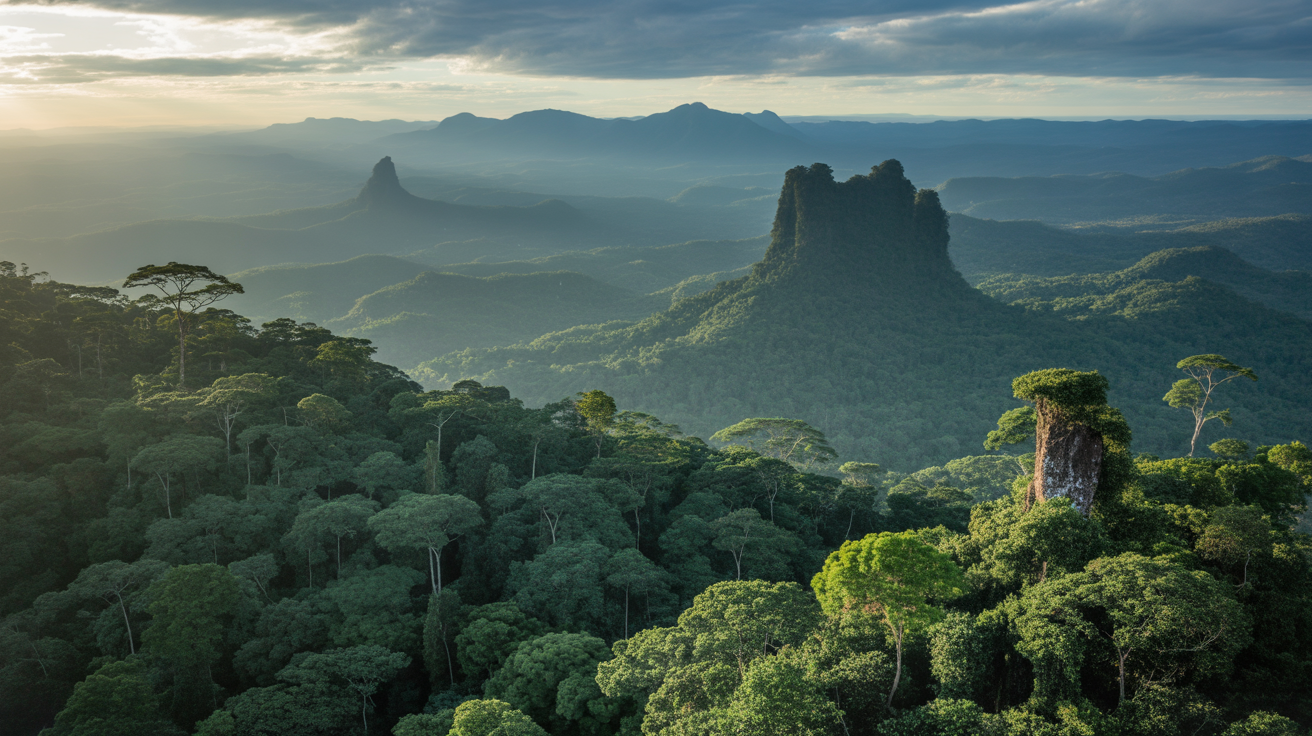
Tropical rainforest

Conservation
The Papuan Green Weevil is currently classified as Least Concern on the IUCN Red List.
Threats & challenges
Currently classified as Least Concern, Eupholus schoenherri faces relatively few immediate threats due to its wide distribution and adaptability within Papua New Guinea's rainforests. However, ongoing deforestation, habitat fragmentation, and land conversion for agriculture pose long-term risks by reducing available habitat and host plant diversity. Collection for the international insect trade, driven by the beetle's striking appearance, is a localized threat but not currently at levels likely to impact wild populations significantly. Climate change, with its potential to alter rainfall patterns and forest structure, may present future challenges. Population trends are stable, though continued habitat monitoring is recommended.
Taxonomy
Scientific name
Eupholus schoenherri
- Kingdom
- Animalia
- Phylum
- Arthropoda
- Class
- Insecta
- Order
- Coleoptera
- Family
- Curculionidae
- Genus
- Eupholus
- Species
- schoenherri
Community notes
Share your observations about the Papuan Green Weevil.
No community notes yet. Be the first!
Discover more wildlife
More fascinating animals from the encyclopedia.